The letter below is written in response to Stephan Salisbury’s Dec. 14, 2017, article in The Inquirer regarding the announced closing of the Painted Bride. The letter’s author hopes that posting this on thINKingDANCE will stimulate a wider conversation about the future of the Painted Bride and other institutions like it in Philadelphia.
As Mr. Snyderman points out in his letter, the future of the Bride affects all of us. Funding in the Philadelphia arts scene is as precarious as it has ever been. How do we foresee that the institutions which provide much-needed infrastructure to Philadelphia’s arts can adapt?
We are eager to hear your thoughts on the announced closing and the suggestions offered in this letter. Please use the comment section below, or direct responses to editor@thinkingdance.net.
Dear Stephan Salisbury, and all those interested in the future of the Painted Bride,
The Dec 14 piece, “Painted Bride’s Risky Move,” was very useful. It pointed to the need for a long-overdue dialogue regarding the Bride’s perceived and actual constituencies that, regrettably, has never been a public discussion. It will also require a serious re-thinking by the Bride’s board and administrative staff as to when an organization’s leadership needs to recognize that, as stewards of an important legacy, their responsibilities may also include turning over that legacy to new leadership that’s more in touch with new strategies for serving their constituents, rather than clinging to past ideologies and concepts.
Many times, solid, well-established organizations such as the Bride have become victims of their inability to see how their mission and outreach need updating. Clinging to a fixed plan rooted in the past can lead to a deadly ossification.
The Painted Bride has an enviable and much deserved heritage. It also has something that no amount of historic creds can match–it (currently) owns its own space!
As an early board member of the Painted Bride, and a supporter during all of its history, I find it sad to learn of the current board’s proposal to sell the building without presenting any clue to what step-by-step plan was proposed as to how that will happen, what research was done to examine and alter existing programs, what work was done comparing their own plans to successful programs at other performance-based organizations in the city, and for what specific activities the proceeds of a sale would be used.
Here are a few serious questions which need answers before—not after—a decision to sell the building is made:
- Was partnering with another arts organization explored? A few prominent partnerships which have sustained smaller organizations in Philadelphia include the Wilma with Ballet X, UArts with The Philadelphia Art Alliance, Drexel with the Academy of Natural Sciences, and the Philadelphia Museum of Art with the Fleisher Art Memorial.
- Was a five-year projected budget prepared, as well as a proposal of what alternative spaces and operational strategies were considered as part of that strategic operational plan?
- Was any long-term financial planning document prepared by professional investment advisors regarding how the proceeds from a projected sale would be invested or used? I.e., was an endowment proposed? How much of the proceeds will be committed for programming? Etc., etc.
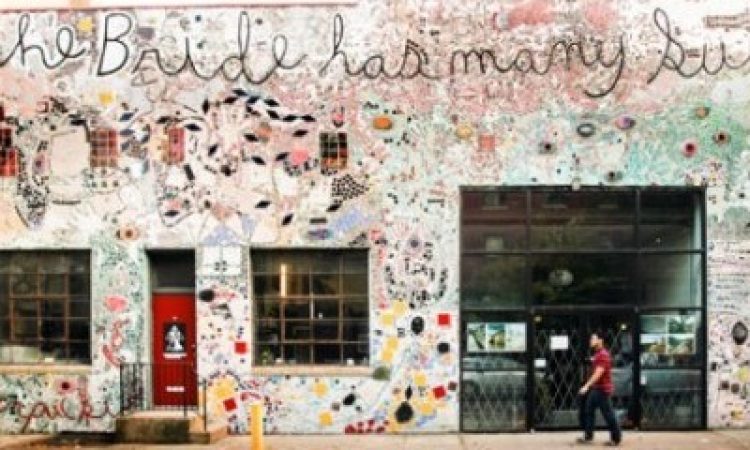
- What provisions have been made to preserve the iconic and unique Isaiah Zagar mosaics that have been the public face of the Bride for decades?
- Before a decision to sell the building was made, what strategies were explored to develop the air rights of the site by creating a public-private partnership that would allow the Bride to permanently remain on its present site, but have it operating out of temporary quarters while NEW construction is underway (examples: Theater Exile; Fringe/Live Arts).
As custodians of a public, non-profit organization, the Board of Directors—and the current administrative leadership—have a legal and fiduciary responsibility to answer these questions. Hundreds of thousands of dollars have been contributed by foundations and private citizens over the last 50 years to support the Bride. The leadership and the board cannot arbitrarily dismiss that commitment.
It is clear that the board and the leadership need to do some serious rethinking of their responsibilities and the future direction of the Bride.
SINCERELY,
Rick Snyderman
Founding member of the South Street Renaissance
Founding member and former president of the Old City Arts Association
Founding board member of the Old City District