Photo: Stephan Takacs

“…not a fucking swan…”

Zornitsa Stoyanova

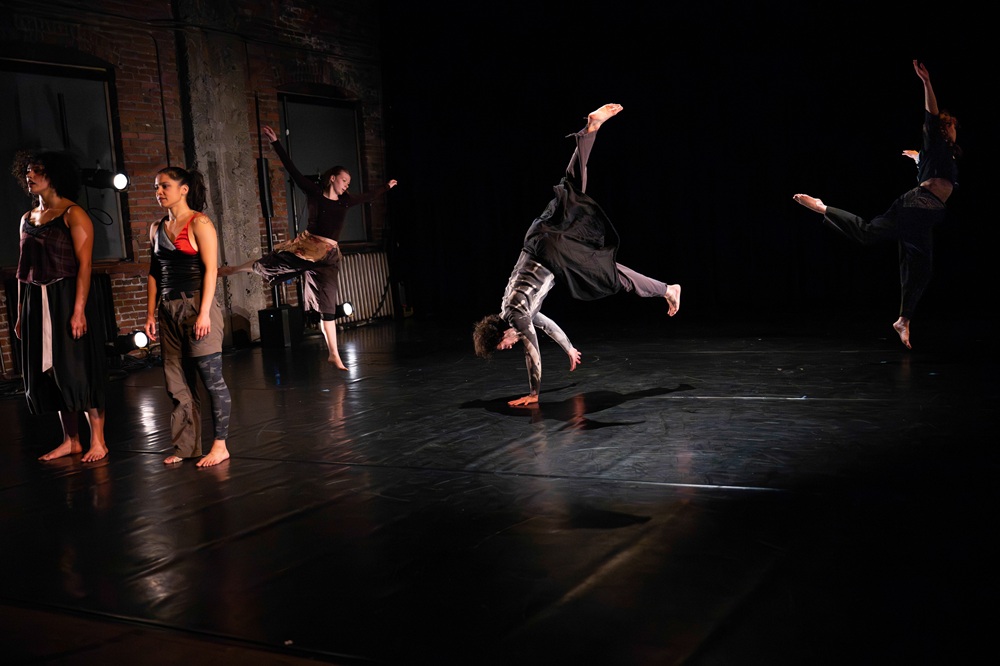
A pair of dancers (Margot Electra Steinberg and Mary-Carmen Webb), anonymous and unmoving with foreheads on the wall and one hip relaxed, are positioned in the far-left corner. Across from them a black clad body (Celine McBride) enters. Her legs bare, she moves forward in an illusion of over stretched “Barbie” strides wearing a silver party wig. The fake hair obstructs her face and she becomes a sexy poodle, moving into forward bends, long lunges and shakes.

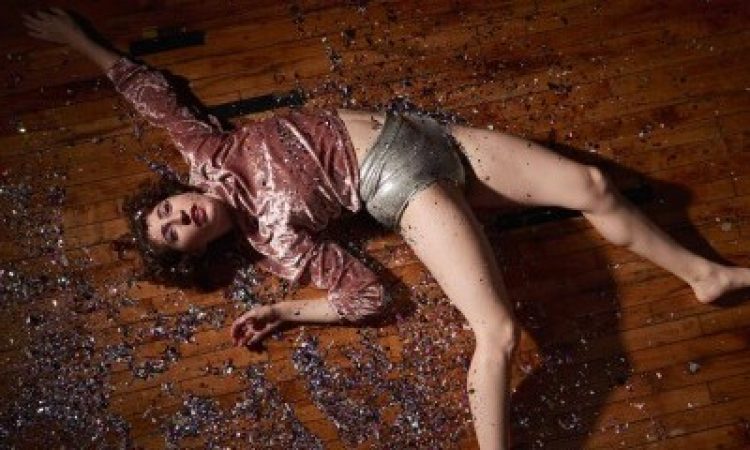
As rhythmic beats (music by Liam O’Connor) start to pump, the unmoving pair animates. All three come together to giggle and hiss in a caricature of girlishness, every facial expression contrived. Their arms reach through the waist of their skirts to pull out glitter and I laugh out loud — a “pussy” party in full swing.

A pillow fight spills white feathers and trash everywhere. “I’m not a fucking swan” one screams, and a trio version of Swan Lake’s four cygnets proceeds. In formation they embrace, fake laugh, hold hands, and pet each other. Screams and screeches, a face of anger, displeasure, giggling and cackling color the constant angular movements and high kicks designed to show legs and buttocks.

All their emotions are too stylized and fast fleeting, I wonder who these young women are. Denied their real affect by the design of choreographer Paige Phillips, I am all too aware of the limited pop culture archetypes we as women are often stuck with.

Après moi, l’obscurité (After me, the darkness) by choreographer Paige Phillips, Mascher Space Cooperative, Jan. 26-27.

Share this article

Zornitsa Stoyanova

Zornitsa Stoyanova is a multidisciplinary performance artist, writer for thinkingdance.net and a mom of two little boys. She is an editor and staff writer with thINKingDANCE.

PARTNER CONTENT

Keep Reading

The Leaders Behind the Headlines: Conversations with the Kennedy Center’s [Terminated] Dance Programming Team

Ashayla Byrd

What happens when political agendas take precedence over a nation’s desire to feel seen and supported in artistic spaces?

A group of five individuals, dressed in business attire, all gather together for a selfie in the velvet-carpeted lobby of the John F. Kennedy Center for the Performing Arts. Jane, at the front left, is a white, brunette woman with a medium pixie cut. Clad in a magenta blazer and black turtleneck, Jane dons a bright, bespectacled smile. Grinning behind Jane, Mallory, a white woman with dirty blonde hair, wears a black and white gingham dress and holds a silver clasp. Malik, a tawny-skinned Black man in a black button-down and trousers, stands beaming at Mallory’s left. Allison and Chloe, dressed in a white button-down and a floral dress respectively, lean into the photo, offering their smiles as well.
Photo courtesy of Ashayla Byrd

Long Live the Queen

Brendan McCall

It’s 1963 and 2025 and Richard Move IS Martha Graham

Lisa Kron, playing dance critic Walter Terry, has short brown hair, is dressed in a tan suit and wears thick-rimmed glasses, sits with their legs crossed and a notebook on top of their lap. Opposite, Richard Move as dance icon Martha Graham sits regally in a long dark dress, their hair up in a bun, and their eyes highlighted with dramatic eyeliner. Between them, is a small table with a vase of white flowers, and behind them are two women in a unison dance shape: bowed forward, with one leg extended high up behind them.
Photo: Andrea Mohin