The writing that follows is not a review but a response, a reflection, a remembrance of the evening.
I allow every detail of the atmosphere to trickle in: the vintage-y sheen of the hallway tile, the sunset’s gorgeous orange pouring in through the windows, the sea of mostly white-haired audience members chatting softly before the performances begin. In the Leah Stein Dance Company studio, on the second floor of the repurposed Our Lady of Mount Carmel School, I await a casual showing of three dances-in-the-making. Stein encourages my heightened noticing, opening the evening with one minute of “deep listening,” a practice coined by experimental musician and former collaborator of Stein’s, Pauline Oliveros. She guides the audience toward a softening of our perception and invites us to mentally track each sound we hear for its entire duration. It is meditative. Tender.
The first showing is Stein’s own work, a duet called Remembrances. The practice of deep listening so close to Stein’s heart is palpable. I see two bodies near the window, one woman’s head (Megan Stern) in silhouette against the sky, the other’s hands (Michele Tantoco) starting to chatter behind her ear. As the movement progresses, little flutters of sound escape from the dancers’ bodies: lip buzzes, brushes, hums, sighs, joint pops. Even the distant conversation coming from elsewhere in the building seems to belong here. Their voices allow me to peer into their internal experience; I see their movement living in places far from here. There she is washing her hands, grasping for a name she cannot recall, searching for a hairbrush in the drawer, a hand draped over her eye, breathing, folding over, re-starting. Their voices become loud and vibrate through the space; shapeshift into gongs, bees, wind instruments. I am reminded of how vocalization offers not only comfort but also fear—its potential for violence, being crudely extraneous. The piece fades away, and in its wake, I reflect on the border between noise and language. I love the kind of voice reflected in this piece—one that sings, twists, and jumps, contorts itself into abstraction—but I also love the voice that speaks. I am sad that once a sound becomes a word, it isn’t just a sound any more.
The sun continues to set.
Three older women (Sheila Zagar, Paula Behrens, and Susan Reisbord) take the studio floor, now set with three chairs, and begin with a smile-laden group hug. They each dance several solos to various songs, with a few occasional breaks into trio movement. It is at times playful, and at others wistful and contained. In Zagar’s first solo, she gleefully points to herself as the accompanying song belts, “That’s me!” before swaying her hips and shoulders to the music. The unfamiliar nature of the spectacle is immediately clear. Three senior women resting in chairs? Societally acceptable. A senior dancer taking up space in a performance, moving her body with shamelessness, coyness, delight? Unheard of! When any one of the women begins to dance, the other two watch respectfully, supportive witnesses to the story her body presents. I see glints of their pasts—details I will never know fully—spiraling from fingers, tucked into glances, and lodged in throats.
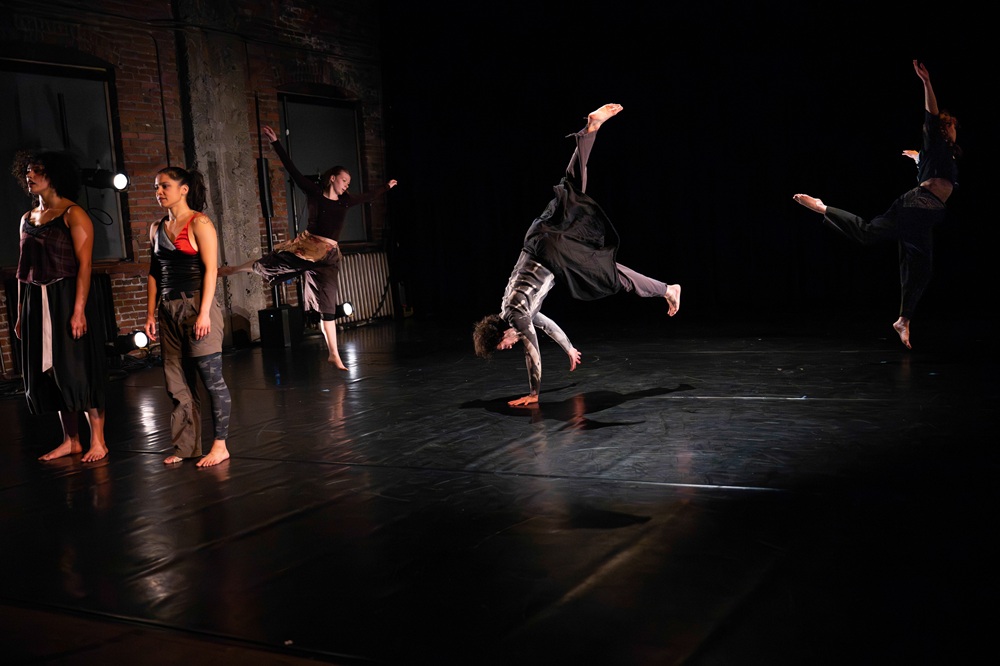
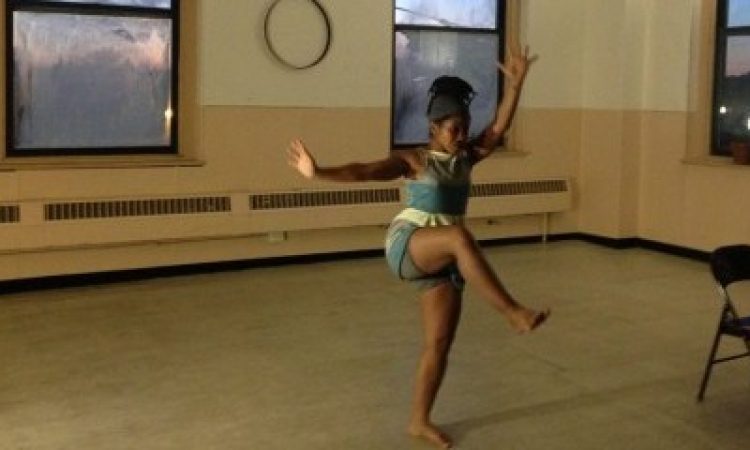
If the previous piece conjured notions of the past, Kimya Imani Jackson’s solo work, the last of the evening, guides us into the future. As a millennial living in Philly, I find that her opening voice recording resonates with me: she ponders about the population as it evolves to be increasingly city-dwelling, freelance, and debt-laden. A familiar field recording permeates the room—I hear a train approach and I sink into a SEPTA station. Her movement is honey-like alongside the metallic clang. The train pulls away until no longer audible. How are we meant to grapple with the feeling of being an individual within a trend? Or, as choreographer Faye Driscoll might put it, “the problem of being ‘somebody’ in a world of other ‘somebodies’”? I feel as if we are submerged together now, perhaps drowning, as Jackson traces her finger in a fluid circle. I continue to rotate mentally around my own questions. By now the LED clip lights have become our only source of light.
I am excited to see how these works will continue to settle into their explorations, and thankful for the warm sharing platform these Studio Works offer.
Leah Stein Dance Company Studio Works, The Art Room Studio, April 30, 2018, 7-9pm http://www.leahsteindanceco.org/