The beginning of Dark Matter Messages by LA-based trans-media storyteller d. Sabela grimes lingers at a threshold. Sabela and performer Brianna Mims stand in front of the small stage proscenium with their backs to the audience. Sabela notes the audience’s sudden hush, as though we “think something’s about to start.” Perhaps what we’re about to witness might have begun long ago—not just before we entered the theater, but long, long ago. Temporal and spatial boundaries extend, spill, and blur in Dark Matter Messages. Departing from science fiction author Octavia E. Butler’s unfinished manuscript “Parable of the Trickster,” Dark Matter Messages takes its world-making cues from Afro-futurist aesthetics and theory, where the boundaries are not created in imitation of the world we know and recognize, but rather are confined only by limits of imagination.
Live video by Meena Murugesan alights on the terrain of the tiny Bridge St. Theater in Catskill, NY (an auxiliary space for the Lumberyard’s “Under Construction” Summer Festival), contoured with white gauzy fabric hanging from one corner, and a large, white balloon resting on the floor of another. Murugesan’s images of leaves and flowers reference our planet, but open into dimensional realmsas the digital images layer over the ordinary materials of the stage. The dancers (Mims and Sabela, joined by AUSTYN RICH and Jeremy Julian Grandberry) enter and exit with rhythmic, stuttering steps, as if traversing an unfamiliar topography for the first time. Short, staccato hits that might be read as hip-hop vernacular morph into elongated flow before they can be categorized, residing in another timescale entirely. Loud beats enter the space only to suddenly drop out—and when they do, the subsequent silence is thick, akin to how I imagine silence is perceived on the moon. During one such moment, Grandberry turns out to face the audience, places a finger to his lips, hushes.
Throughout the hour-long multimedia work, text is layered, augmented, and repeated, like puzzle pieces of a dialect laid out for decoding. Sabela is orator and narrator, both catalyzing action with his words booming through his headset mic and delivering monologues that feel like sacred script. At several moments he announces a beginning. The re-marking of beginnings feels a way to orient and reorient to the present moment, to attend to “nowness.” The dancers chant “time, space, grace, place” over and over, counting each repetition as they go. It could go on forever, the counting has the potential for infinity. This combination of continual reification of the present while gesturing towards a limitless future scrambles conventional notions of time. These black bodies onstage are not confined to liveness—they have a past and a future, embedded in each present moment.
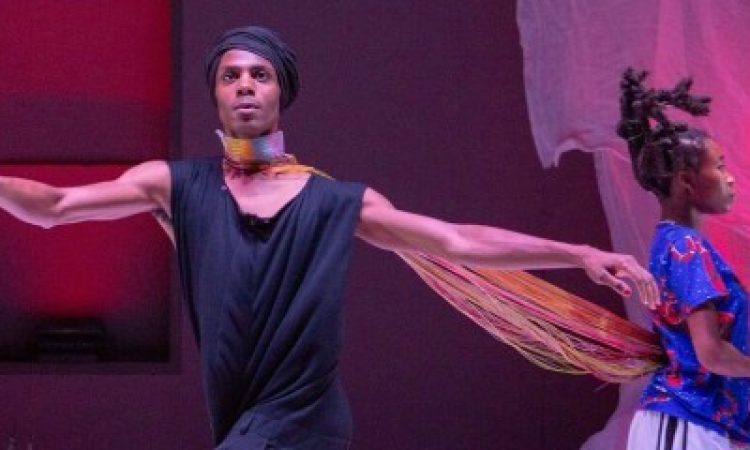
Costume design by Sabela, (with construction by Autumn Randolph, Julian Mendez, and Jacy Barber) straddles the everyday and the extraordinary. T-shirts become layered with adornments that extend, transform, and obscure the body. RICH and Grandberry don head and neck pieces with long fringes draping to the floor, connective threads by which Mims attaches, controls, and mirrors. Later, Mims transforms with a huge, white balloon attached to her head. She wavers, the balloon head wavers in turn. She jerks, bops, and folds. The balloon head bounces frantically, threatening lift off. Sabela dons a full-body shimmer suit, rustling fabric covering his limbs, head and face. As samples of music spanning from the 1960s to the present cut in and out, each making some reference to time, Sabela revolves, freezes, and skips like a record.
In the middle of the work, RICH and Grandberry attend to a piece of glittering fabric on the floor as though it were an oracle. They brush the thread grain from shimmer to matte to reveal sparkling islands, like Pangea separating into continents. Sabela hovers over the middle, drawing a symmetrical pattern of dots and lines into the fabric. It could be a hieroglyph, a symbol from an ancient culture. Or it could be a message from the future, prophecy of what’s to come. These performers are the readers, erasers, and reorganizers of their own map. And while world-making might seem an exercise in crafting boundaries (for how else will we know where we are?), Dark Matter Messages demonstrates the possibilities when we extend horizons and imaginations beyond the limits of an immediate field of view.
Dark Matter Messages, d. Sabela grimes, Lumberyard Summer Festival, Bridge St. Theater, Catskill, NY, July 27-29, dsabelagrimes.com.