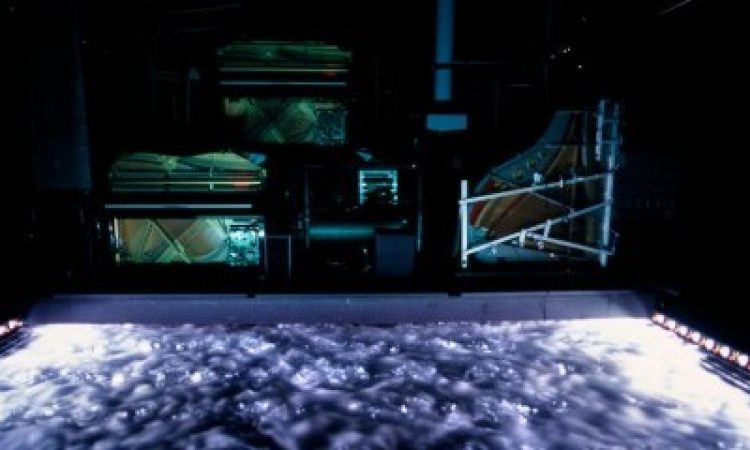
As we are seated in the darkened space of the Navy Yard industrial building, we see light beams coming down from the ceiling, feeding into three luminous rectangles on the floor. Two men show up to pour into them something powdery, perhaps sand, then to fill them with liquid that in turn dissolves the sand. This is the only time we see human beings on stage in this show: after this act of initiation, the humans disappear and the action is fully taken over by the inanimate elements of the stage (and nature).
Conceived, directed, and with music by the internationally acclaimed Heiner Goebbels, Stifters Dinge is not a new show. It premiered in Théâtre Vidy-Lausanne (Switzerland) in 2007, and since then has collected awards and mesmerized audiences and critics internationally. It is now Philadelphia audiences’ turn to understand why.
The stage, with set, light, and video by Klaus Grünberg, is one giant mechanism: large screens move horizontally and vertically, accompanied by projected images and shifting beams of light; five pianos, installed in an intricate visual composition with bare trees, dominate the show. With their “insides” uncovered, the pianos allow us to see as well as hear what they play. The soundscape of this performance is as rich as its visual environment: piano music alternates with spoken word such as audiotaped interview with the famous anthropologist Claude Lévi-Strauss (in which he gloomily comments on the destructive tendency of humans), and folk singing with sounds of dripping water.
This is a very intense audio-visual spectatorial experience, in which the “live” performers are not missed. The evening alternates between longer, more static passages, such as when we are invited to immerse ourselves into a projected drawing of a forest landscape, and more dynamic moments with screens and light moving on stage. It zooms in and out, letting us see things from a distance then bringing them closer to us, directing our focus on details of a painting, or on rain drops creating circles on water’s surface. In effect, it reveals unassuming but complex beauty, power and agency of the natural and “inanimate” world around us.
Disrupting the conventional dichotomy between nature and culture, and questioning the ideas of what makes us “alive” and perhaps even what makes life worth living, this performance offers a rather provocative vision of a world without humans, a very harmonious and filled world, indeed.
Stifters Dinge, Heiner Goebbels, The Navy Yard, Sept 7-9