Joan Myers Brown, founder of PHILADANCO, introduces Choreographers on the Move from the stage of the Perelman Theater: “We’re going to get some oldies and some goodies.” In celebration of the company’s 18th year in residence at the Kimmel Center, they’ve put together a program featuring world premieres alongside the seminal work of choreographers Milton Myers and Christopher L. Huggins.
Myers’ Pacing (1986) opens the night, set to Francis Bebey’s driving drums, flute, and the raindrop-like tinkle of the thumb piano. Three women outfitted regally in red and purple embody the energetic pull of the music toward stage right with a mix of modern-dance extensions and African-influenced wide stepping and chest isolations. The second movement opens with a diagonal line of men in blue, backs towards the audience. A wave ripples through the line of bodies, whipping out the hand of the farthest figure. They form a weaving chain center stage, hands flicking, moving backwards; I feel I could watch this forever.
Next, as in several other pieces in the program, a partnering section. Though the partnering is reminiscent of classical ballet/modern in its use of static shapes and gendered lifting, there are some novel surprises. Rosita Adamo descends by sliding down the back of another dancer. There is also tenderness; one dancer listens to another’s heartbeat. The trust and respect between them are palpable. Within the abstract movement of Pacing, Myers resists reducing the relationships between dancers to pure geometry. In the final movement, the full company fills the stage. Intricate changes in facing and the layering of repeated phrases engulf me in a delight of sound, color, and movement.
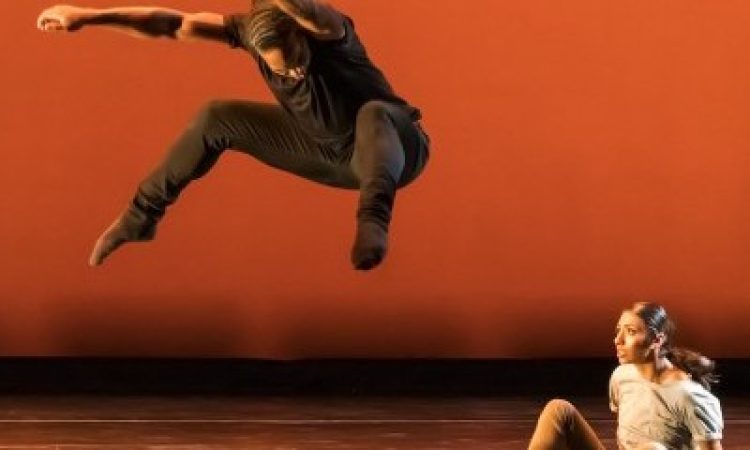
Huggins’ When Dawn Comes skews toward popular contemporary dance, complete with large, almost desperate, emotions. The duet featuring Adamo and Joe Gonzalez stands out the most. Their weight-sharing and lifts are athletically impressive, including one instance of a woman lifting a man—rare for a program like this. There is a clear romantic and sexual pull between the two, a story of neglect and need. My body is tensed for some sort of violence against Adamo, but she has the last word, pushing Gonzalez offstage and fixing her hair as the lights fade. The sassiness is refreshing, but the storyline feels murky.
Myers’ Waves, accurate to the program information, is “an exploration of the Horton technique as influenced by contemporary movement and stage presence.” For me, the technical focus renders the piece less emotionally accessible than Pacing.
The final piece is Huggins’ of-the-moment I come as one, but stand as 10,000, choreographed as a response to the Kavanaugh hearings and the #metoo movement. The first movement of all women in green jeans and socks turns up the emotion again—hands clasped over mouth, jerking torsos, rhythmic gasping breaths. This is followed by “No means No,” a movement which depicts sexual assault. Adamo is tossed from man to man, clearly fighting back, occasionally going limp as if drugged or unconscious. The choreographic, aesthetic attention given to the movement is unsettling for this subject material. It feels so disconnected from my own experience of sexual assault, much more ordinary, less obviously violent, and not nearly as picturesque.
The full company floods the stage for “The Protest,” to the horns and drums of Sons of Kemet, with no time to process what we’ve just seen. The women march on stage with militant attitude. Is this what a protest looks like? The men return and the dancers break off into pairs, dancing a mixture of playful flirting and aggression. Are these men, now posturing their machismo for audience laughs, the same men who assaulted a woman one movement before? We are not even given a costume change to allow us to suspend disbelief. I struggle to understand the message about consent being put forward by the choreographer.
Through the night of differing choreographic tastes, it is PHILADANCO’s dancers that shine. They are sure technicians and passionate artists. After the show, audience members express their desire to come back year after year to see their favorites. There are many notes of gratitude for PHILADANCO’s almost 50 years of providing opportunities for dancers and choreographers of color, preserving and creating new African-American dance. I admire the virtuosity, but wonder whether this ultra-formal system of training, choreography, and proscenium productions can serve those contemporary issues that Huggins and others try to bring to the stage.
Choreographers on the Move, PHILADANCO, Kimmel Center, November 16-18.