Reggie Wilson has the kind of easy brilliance and unpretentious attitude that allows for multiple ideas to exist together, to complicate each other, and to overlap into sharp focus. He began his latest work, “… they stood shaking while others began to shout,” by presenting a PowerPoint about his ongoing research into Spiritual Baptists and ritualistic movement, ideas about appropriation, and a solo performance that was a precursor to the current work. The work premiered last year as part of Praying Grounds: Blackness, Churches, and Downtown Dance (Platforms 2018), curated by Wilson and brought back to Danspace Project/St. Mark’s Church this January as part of American Realness 2019.
During the presentation/introduction, Wilson moved conversationally through arresting footage of a “moaner” being initiated into Spiritual Baptism in Trinidad, a young visual artist giving a TED Talk about portraiture and ownership over one’s own image, and Wilson himself dancing intensely. He also spoke about his own lineage in modern dance, which he traced back to Hanya Holm and Mary Wigman, noting with an ironic chuckle that the work likely looks rather German. He gave a nod to choreographers who have influenced him since he landed in New York City (including Bebe Miller and Bill T. Jones), and casually called out several postmodernists (including Trisha Brown and Twyla Tharp) for what he sees as appropriating the Africanist aesthetic (as Philly’s own Brenda Dixon Gottschild did so brilliantly in her work Digging the Africanist Presence in American Performance).
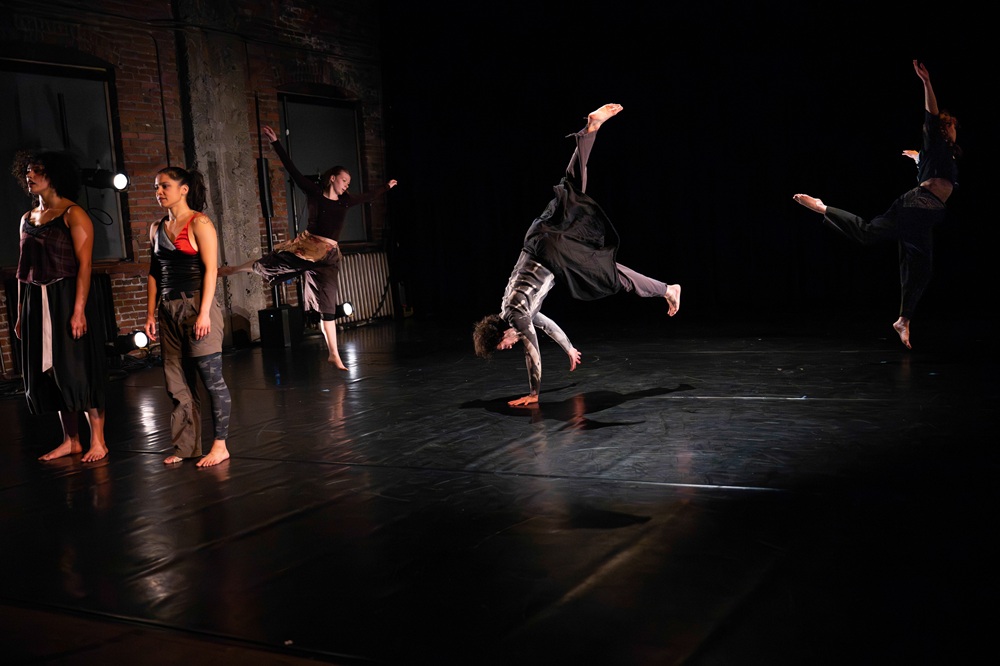
Wilson’s choreography, which he often refers to as “post-African/Neo-HooDoo Modern dance” is firmly rooted in this complicated aesthetic of postmodernism, and he acknowledged this pluralism as he transitioned the audience—offering peppermints, chatting, and giving hugs—into the danced portion of the evening. He then sat on a stool by the church’s entrance for the rest of the performance, amplifying musical selections with a shaker and encouraging his dancers one by one as they entered and exited the dance floor. Once the dance began, it spoke for itself with fluid and grounded passes along the length of the space, seated locomotion with punctuated flinging of arms, and a memorable repeated series of soft gestures to the music of Gladys Knight’s The Way We Were. The cast, most of whom have danced for Wilson for a number of years, ranged in age from late twenties to well into the senior years. The older dancers often stood observing and supporting the younger dancers, who were stomping, leaping, and repeating satisfyingly rhythmic phrases. The piece also drew movement from traditional Shaker dances: this influence came into play as the dancers stepped and shook together, moving around in two circles. This formation began on the floor and was repeated at the end of the piece high up in the balcony of the church. We learned during the talkback that this balcony was used as a slave gallery in the church’s early years. This knowledge made the closing circular image even stronger—creating a sense of communal solidarity and strength for a complicated future.
Fist & Heel’s work will extend into Philadelphia soon with a series of performances in various historic and sacred spaces. Find out more here.
they stood shaking while others began to shout, Reggie Wilson/Fist & Heel Performance Group, St. Mark’s Church (NYC), January 7-12, American Realness (co-presented by Danspace Project and Gibney Dance)