It’s 2009 and Beyonce’s “Single Ladies (Put A Ring On It)” video is blowing up on YouTube. It marks the first time J-Sette the dance-form, which influenced the video’s choreographers Frank Gatson Jr. and JaQuel Knight, is seen outside Historically Black Colleges & Universities. That same year choreographer jumatatu m. poe, director of Let ‘im Move You: This is a Formation, sends J-Sette dancer Jermone “Donte” Beacham a private message through YouTube after watching Beacham’s dance videos. That exchange marks the genesis of their collaboration.
Let ‘im Move You, which premiered at the Painted Bride Art Center after a multiyear development period, lives at the intersection of Blackness and Queerness. The dance-form is traditionally performed by young collegiate women at HBCU sporting events. Men were disallowed from participating at the collegiate level, but despite this, there is a rich history of Queer men adopting J-Sette in nightclubs and pride parades. By embodying J-Sette in defiance of the institutional homophobia, over the course of several decades, they have made the dance their own in Queer social spaces, HBCUs, and on national televison.
Move You is both of and about J-Sette. The content of the performances and the subject matter is J-Sette, which varies with each context poe and Beacham present. Some performance settings are black, some white, including museums, universities, theatres, nightclubs, on the streets of historically black neighborhoods, and very significantly on Instagram. Beacham has stated that his goal is to place J-Sette where it’s never been before. For their premiere at the Painted Bride, they have created a futurist social-dance space with ample room to dance, and few places to sit. The audience members are invited to join as active participants, and some do by grooving alongside the performers. Many, however, stand back and watch like outsiders.
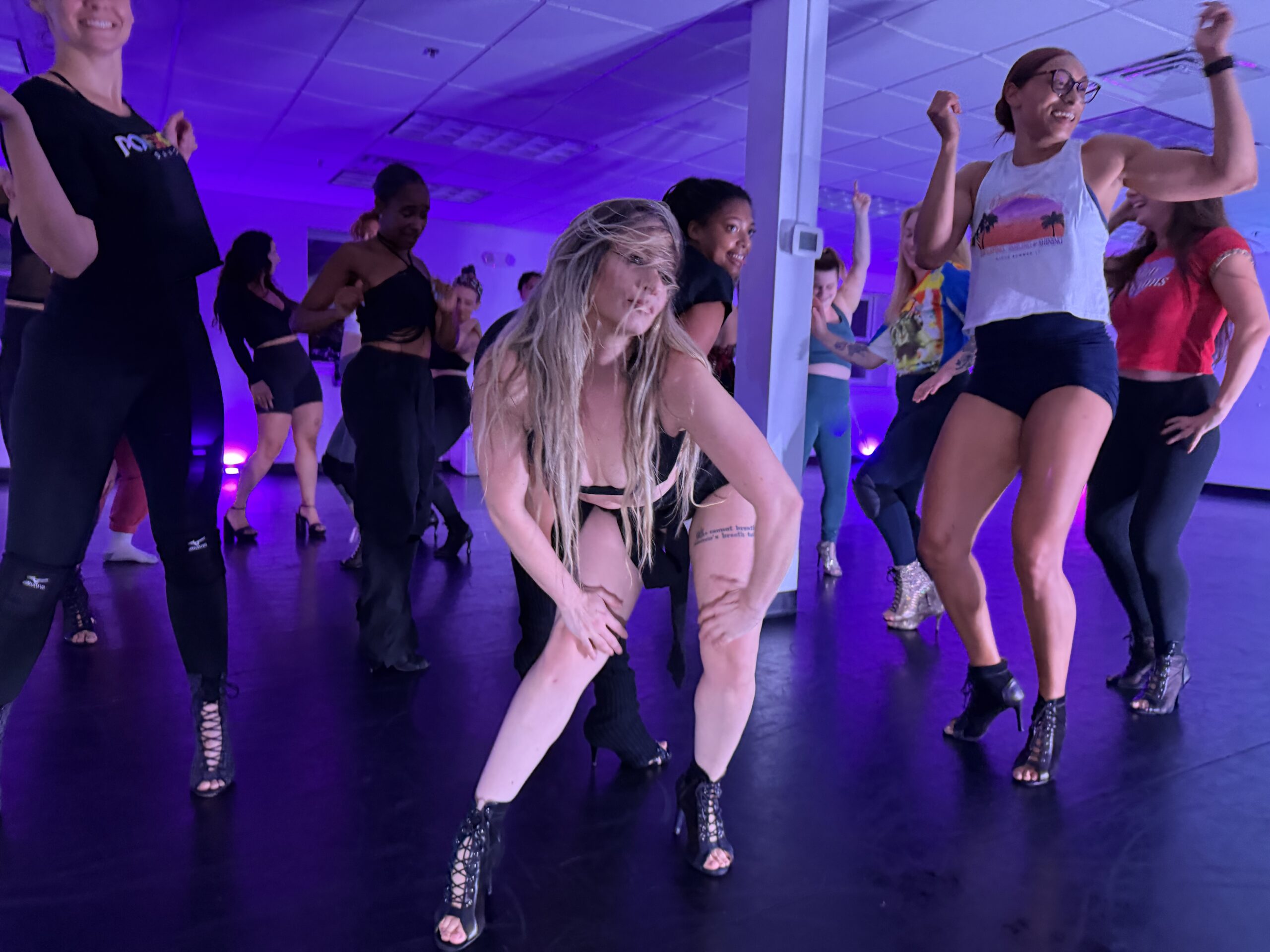
In a pre-performance panel, poe refers to J-Sette as having numerous rules and structures, deeming it essentially “a court dance.” This is very apparent in the formations and dancer hierarchy. Rotating leaders initiate a new formation with a prance step forward and an arm outstretched, the others soon follow and line up. The leader raises fingers to the sky, sometimes in a fist, to signify the start of a new eight-count by standing in a preparation pose—hands on hips, one foot pointed forward, with the other firmly rooting into the ground. The leader performs tight choreography first, and the dancers behind them follow in near-perfect unison in the next eight counts.
Like much of the choreography, the preparation pose, with its unbalanced weight distribution between legs, accentuates the sinewy angles of the dancers’ posteriors. Wearing flat wrestling boots, the dancers mimic a high-heeled strut as they travel through space, another celebration of their booties, calves, and popping hamstrings. Later in the evening, the dancers sing an original song about booties that sounds like a hymn. This ode really drives home a message of joy and love for their bodies.
Running in parallel to the formalism is another of poe’s goals—to reveal “Black joy,” which Thomas DeFrantz extrapolates in a program note. He writes that the dance claims “Queer time and space for participants and witnesses.” The form’s structure allows space for the individuals to make unique choices within their prescribed choreography. With the dances so tightly rehearsed, every unique inflection and interpretation stands out and allows for individuality within the “court.”
The cast performs to their fullest extent. Maria Bauman-Morales is a stage-devouring show stealer. Beacham relishes in revealing costume changes with the zeal of a young child playing dress up. Nikolai McKenzie smirks through the prancing, unleashing ravishing, ceiling-smashing leg kicks. LaKendrick Davis is a steady formation leader with razor-sharp focus. Sanchel Brown radiates fearless, joyful energy. William Robinson’s charisma shines in moments of stillness. poe’s long, expressive fingers stand out each time he slurps his fingers into a fist.
Individual iconic movements jump out in the combinations: A funky chicken undulates into exacting hip hits. Dancers hold their bicep as they flex it. They seductively walk with their hands on their lower back. They krump intensely, but then step-ball-change and shift direction toward a rack of clothes for a costume change. Cocky rooster images abound.
“The show isn’t over yet, but you can leave if you’d like,” the dancers chide us, before launching into another round of formations and new steps. The performance could be winding down but the exuberance demands attention. With the majority of the audience sheepishly vacillating between participating passively and joining the dance, there’s something keeping everyone glued yet guarded. Slowly folks trickle out after the start of the third hour or so, but it’s hard to walk away from fists raised to the sky.
Let ‘im Move You: This is a Formation, jumatatu m. poe, The Painted Bride Art Center, February 8-9.