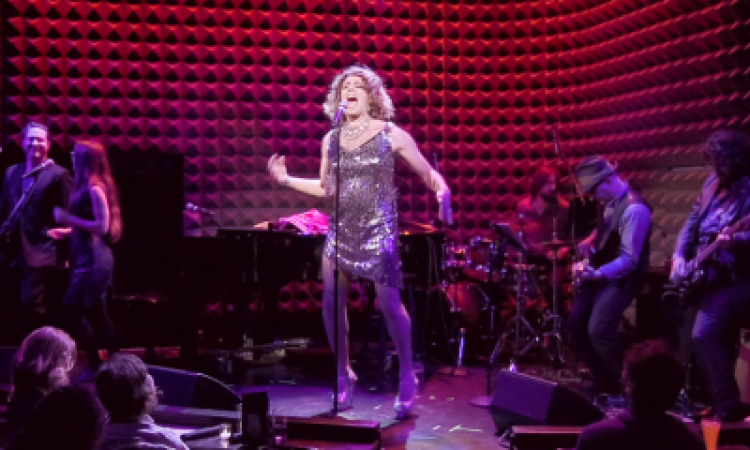
Dito van Reigersberg performing as Martha Graham Cracker possesses the soft, fluttering voice of a Hollywood actress from the 1940s—at least when speaking. Singing, Martha’s strong belt is Tim Curry-esque as she performs original songs, witty, upbeat, and occasionally lyrical, with the help of five other onstage musicians. Meanwhile, the crowd at the Kimmel Center’s Innovation Studio is 60+, mingling, and drunk. I’m ready for a good time.
Lashed But Not Leashed, originally devised in 2015, follows the typical cabaret format of songs interspersed with storytelling and comedy. The through-line of these interludes: Martha Graham Cracker is leaving the stage to pursue grad school, and more specifically a degree in the library sciences. We react as any eager and intoxicated crowd would, screaming, “No!” when she tells us that this will be the “Last Martha Graham Cracker Show,” before presenting a humorous ode to the library where she will spend her retirement from show business. “Me and Franz Kafka inside my comfy easy chair,” she sings.
But is Martha really leaving the performance world? Is Dito? The storyline’s flirtation between the real and the fictitious maintains itself throughout the work. “When I was a little girl,” Martha coos, telling us about how, as a child, she chased a black stallion into a field, only to have it kick her in the face. She points to her face to show us the scar, and continues to do so several times. This elicits a fluttering of laughter. We take pleasure in the moments where Martha (the character) shares personal stories we know can’t be true of Dito, affirming, with a wink, that she has her own life. “When you’re born with a name like Martha Graham Cracker,” she remarks at one point, “you can’t not be on the stage. Can you imagine if I was Martha Graham Cracker the fishmonger?!”
Musical hits of the night include a sexually suggestive ode to chairs wherein Martha mimes sitting on several audience members while singing, “Let me sit on it!” It ends with the audience chanting, “I don’t want no lazy boy!” with gusto. In another witty number, Martha repeats, “I’m a drag queen with a very large…” (a full 8 seconds pass), “vocabulary!” before reciting, in rapid-fire, the proper employment for words commonly misused like there, their, and they’re. Hey, you can’t say she doesn’t know her target audience (yes, the 60+, drunk, mingling, Kimmel-center-going folk).
As our encore ballad comes to a close, with Martha singing, “Goodbye, my friends, goodbye,” I’m torn between what feels like a naive, face-value interpretation—she’s really leaving?!—and a more amorphous understanding. If she’s not really retiring, then why put on this show? Furthermore, what happens when a character retires but the body she lives in does not? And what of the performative legacy she leaves behind in our Philadelphia cultural consciousness—14 years of stories, songs, looks, bar-top aerobics? I can’t say why, but it doesn’t quite feel like it’s over yet.
Martha Graham Cracker in Lashed But Not Leashed, Dito van Reigersberg, SEI Innovation Studio at the Kimmel Center, March 14-16.