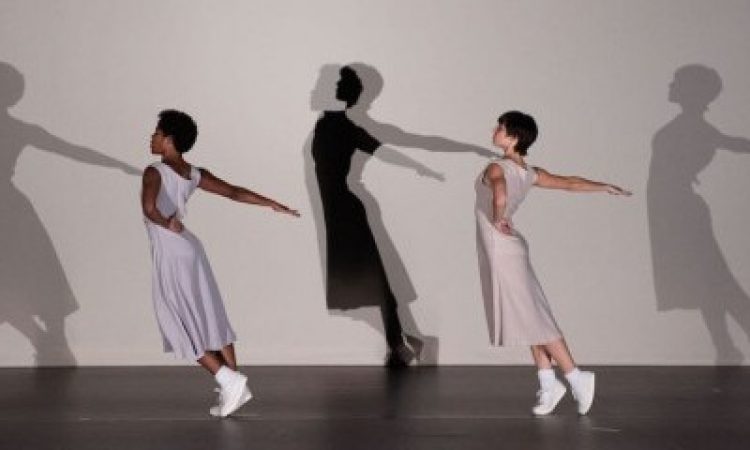
Two dancers in white dresses spin in front of a white backdrop where three shadows play. They start together, performing smooth, precise paddle turns with their arms sweeping stage right. As the pianos in Steve Reich’s music start to phase, the dancers also come out of sync, then meet up as opposites. Smiles linger on their red lips as they come into eye contact. Their arms sweep towards each other and their combined shadow performs its own two-armed sweep. Though I have seen this dance on film before, my mouth still drops open.
Anne Teresa De Keersmaeker’s Fase, Four Movements to the Music of Steve Reich, which premiered in 1982, is perfectly constructed for Reich’s minimalist music. Each dance is built on only a handful of movements, placing the emphasis on rhythmic composition through repetition, variation, and phasing. This 2019 reconstruction comes alive through dancers Laura Bachman and Soa Ratsifandrihana’s playful mastery. They fall from a suspension at the precise moment when the pianos clunk back into phase. HWUH! They breathe out sharply as they whip around like flamenco dancers.
Each of the four movements constructs its own world. In “Come Out,” set to a phasing voice recording of one of the Harlem Six, the dancers perform harrowing movements, beating the blade of a hand against their ribs and stomachs (“I had to, like, open the bruise up, and let some of the bruise blood come out to show them,” the recording speaks). “Violin Phase” returns to the costuming and shadow play of the first movement, with only Ratsifandrihana on stage. Her solo has the most expansive dancing of the night. She throws her head back and arms wide in one triumphant moment.
Bachman returns for “Clapping Music.” The two dancers begin in profile in an angled sliver of light that evokes a train. They hop in time, tapping heels and toes forward and back, upstage arms swinging, popping up to the toes of their bulky white sneakers. They add rhythm to the dense music by punctuating movement in between the claps. Nearing the end, Ratsifandrihana glances at the audience and smirks as she smoothly rises onto her toes for the umpteenth time. “Do you even see what we’re accomplishing?”she seems to say. We answer her with a standing ovation. I leave FringeArts reveling in the virtuosity and artistry of these women; their confidence is justly deserved.
Fase, Four Movements to the Music of Steve Reich,Anne Teresa De Keersmaeker / Rosas, FringeArts, 2019 Fringe Festival, September 12-14.