A small crowd gathers near the street, awaiting the Trisha Brown Dance Company’s performance of Roof Piece in its Philadelphia debut, almost 50 years after its creation. I crane my neck upward, and squint through my sunglasses at the watercolor sky.
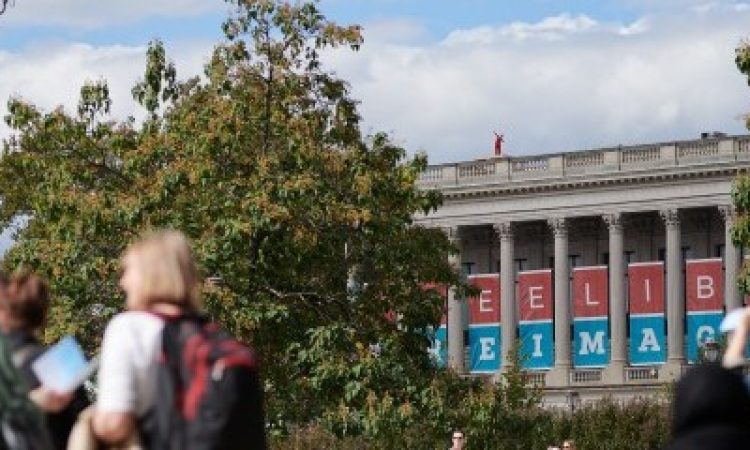
One dancer appears, then another a rooftop away. They wave to each other, presumably signifying the start of the dance. Working its way around the Logan Circle rooftops, my gaze finds each performer, bright red figures in a sea of gray windows, columns, and walls. Saturated monochrome outfits against cityscape. In all there are eight movers visible—spaced out, many stories above on the United Way Building, the Free Library, the Franklin Institute, the Logan Hotel, the Assembly Rooftop Lounge, and the Academy of Natural Sciences.

The program, which contains a map with each dancer’s location, offers a simple description of the work: “Roof Piece is a dance initiated by a single dancer on a rooftop and transmitted to other dancers. After 15 minutes the dance stops and reverses direction for another 15 minutes.”
It’s simple, meditative, poetic. Plie, swing. Wrist flick. Arms resting on the head, forming two mirroring triangles on either side of the face. Shapes are repeated but never held for long. All of the movement is done upright, generating from the standing position with either straight or bent knees. There’s no risk, no exclamation mark, no tricks. The phrase is a long, clear sentence, ending in a period—the easy alignment of the joints, so quintessentially Trisha Brown, dangling unadorned above Center City.
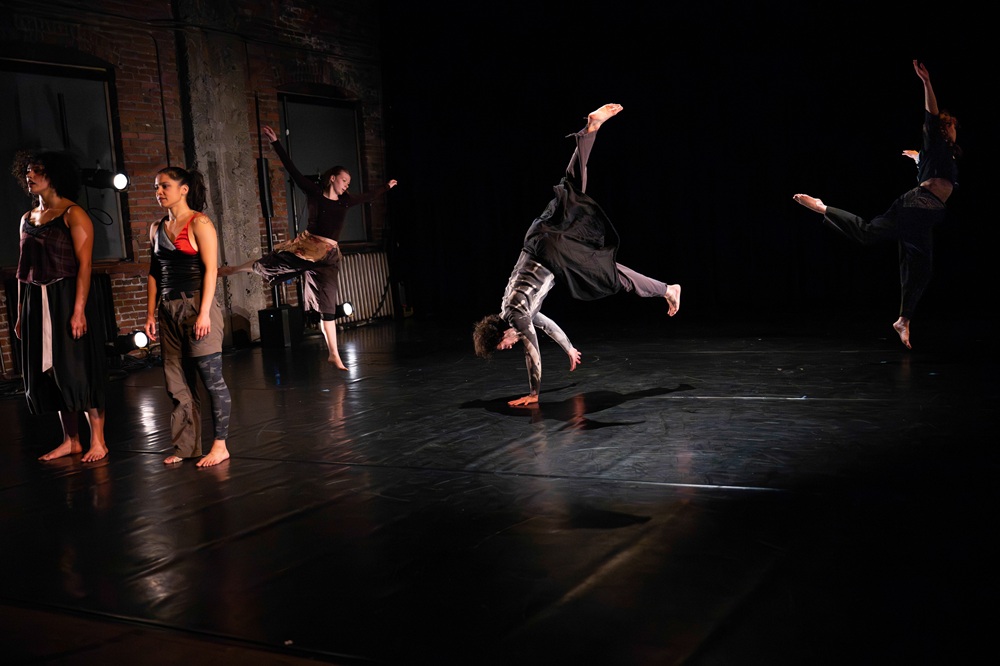
While the dance undeniably engages in public space—many passersby pause, point, wonder out loud—it’s clear that once the dancers are in sight, Brown’s unadorned movement style prevails over audience interaction. Or at least, what we can see of the movement from so far away. I’m slightly thrown by the fact that all of the promotional material shows the dance from up close, with the photographer or videographer also on the roof, while the viewing experience from below offers a much different experience: faraway tiny bodies, silhouettes of arms and legs, the roar of traffic continuous throughout. I appreciate the visual drama of the faraway figure, though some part of me hungers for proximity. I find that the work pulls me in most when I feel that a dancer can see me, or perhaps may be looking right at me. In pursuit of this feeling I spend the latter half of the piece as close as I can get to a dancer on the Logan Hotel. They wear sunglasses, and look in my direction as the dance comes to an end.

In Motion, In Place: Roof Piece at Logan Circle, Trisha Brown Dance Company presented by Fairmount Park Conservatory, Logan Circle, Sept. 24.
Photos: Albert Yee, Vikki Sloveter (close-up)