The School for Temporary Liveness strove to reimagine a school as a poetic “site of possibility for thinking and reflecting in and with the world,” but I still could have benefited from a tutor. Though the week of events was outlined as a school with “classes,” a “study hall,” and so on, I did not see this curatorial frame reflected in the dance that I saw. Perhaps the academic theme simply pointed to the University of the Arts as the central producing entity. Regardless, my first assignment (to register for my class) did not go smoothly; I found the website difficult to navigate and the event information somewhat esoteric and vague. I attended the “Class” at the School: the description of Isabel Lewis’ work was similarly inscrutable, glossing over several huge ideas without much context.
From the program notes:
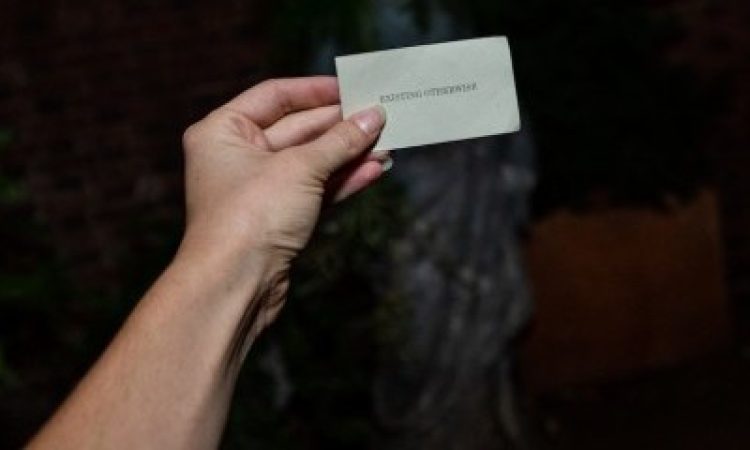
Existing Otherwise proposes alternative modes of engagement with site and architecture as ways of moving towards strategies of healing and evacuating violent modalities of reproduction or representation in the addressal of the past.
Starting in the heart of Rittenhouse Square, a marching band of sorts (“musical entity” LABOUR) alternated bopping with somber melodies while a few dancers, clad in all black and some accentuated by chunky silver necklaces, jumped and clapped or swirled and writhed, depending on the musical tone. Following the performers, we processed to the Art Alliance building and streamed upstairs, filling the sparse gallery-like rooms on the second floor. Here, traditional song structure was abandoned as dissonant tones blared from various speakers. Dancers continued to writhe, magnetized to the floor of the rooms. Some trod from room to room and some appeared from behind your shoulder. Through the work, their primordial contorting evolved into a shared vocabulary; I caught dancers in the halls and rooms, on the ornate staircase, bucking up and down with their hands clasped in front of their knees. All of the movers were entrancing. Even as the pace became more frantic, one dancer in a beautiful black slip cambered their back, arm outstretched, reaching or bridging towards something. When a dancer led us back downstairs, letting their weight spill against the banister and crooning something about statues in the garden into a microphone, I heard people murmuring about the light scent of vanilla wafting through the halls. I knew from the program that the work included ”scent ghosts” as part of the ambiance, though my fall cold precluded me from enjoying this element.
Perhaps, in a true analogy to my time in high school, the dance grasped at so many massive ideas without sinking deeply enough to unpack anything that, ultimately, I left feeling unsure I’d learned anything new.
In addition to Lewis’ “Class”, the week of school-themed happenings was comprised of a “Library,” or three-part live-performance album #PUNK 100%POP *N!GGA by nora chipaumire, as well as a “Study Hall” (a myriad of workshops and conversations) and a “Night School,” including a twilight film screening and sunrise slow walk. I found the programming opaque, but it was admirable that the entire School was free and open to the public.
Existing Otherwise, Isabel Lewis, The School for Temporary Liveness, Philadelphia Art Alliance at University of the Arts, September 25 – October 2.