Big Dyke Energy.
Such are the words painted on the enormous black sign above me as two rock musicians drum and shred guitar onstage. I’m enjoying the pre-show music in a side studio at Icebox Project Space. I’ve been inside the building before, but it’s never looked like this.
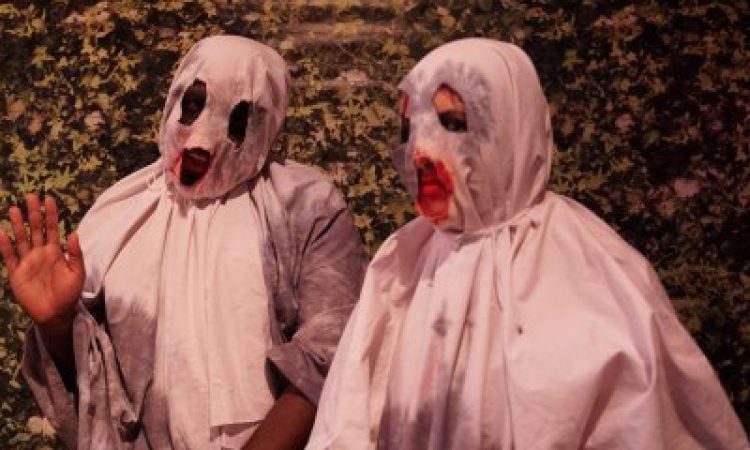
Created by Toronto-based artists Allyson Mitchell and Deirdre Logue and supported by the Pew Center for Arts and Heritage, Killjoy’s Kastle: A Lesbian Feminist Haunted House is a feat in installation. Running from October 16-27, the project features the work of 125 artists from Philadelphia, Toronto, Los Angeles, and other cities, as well as a whopping 82 performers who (as my tour guide explains) haunt the space in the form of stitch witches, poly-vampirous grannies, Lesbian Studies ghouls, and more throughout its run. Filling the large, industrial space to the brim with enormous soft sculptures, graves of lesbian feminist institutions of yore, crocheted cobwebs, and elaborately costumed performers channeling various lesbian tropes, the show delivers a witty aesthetic medley.
My tour guide, a self-proclaimed demented Gender Studies PhD candidate, leads us into the “Hallway of Concerns” before we enter the main space, its walls plastered in signs bearing warnings such as, “expect nudity,” and “you will get wet.” As we enter the Kastle and behold an enormous, pubic hair-covered, intermittently peeing (water magically pours out of the ceiling into a bucket!) gender non-binary godx*, our guide instructs us to watch out for two TERFs (Trans Exclusionary Radical Feminists). The performers encroach on our feet, busily scrubbing away at the floor, effectively shoving us out of their space. I chuckle.
Later we visit “the original witches,” and watch them sew and cut fabric. I drink “witches brew” from a dildo that one of them produces from her pocket. In another room a few local Philadelphia dancers jam out to loud music amongst 4-foot replicas of queer theory books like José Esteban Muñoz’s Cruising Utopia and Angela Davis’ Women, Race, and Class. In yet another area, a proclaimed Social Justice Warrior pounds various punching bags labeled “Racism,” “Colonialism,” “Transphobia,” “Capitalism” and I watch as each knocks into the other.
After watching an array of other unique characters, we are lead out of the main space by our tour guide and into a final processing room. It’s warm and soft beneath a woven canopy of blue fabric; our seats face inward in an intimate circle. A few people behind the project give audience members a chance to talk about what stood out, what we felt could have been different, and learn more about the piece’s other iterations. I reflect on how I wish I could have spent more time in each world, though overall I am excited by the way in which a traveling performance like this mobilizes and conjures the LGBTQIA+ community of each city it’s in—providing an opportunity for the community’s artists, performers, vendors, and viewers to engage with, converse about, and ultimately grow the work. Two week-long free runs, ASL and visually impaired tours, and intimate conversations that break the tired ‘post-show talk back’ formula are further proof of the community-oriented lens of this immense project. In an extension of that thinking, I’ve left the cleverest surprises of the show out of this article—I think it’s best you to catch them at the performance yourself.
*pronounced “god-ex”
Killjoy’s Kastle, Allyson Mitchell and Deirdre Logue, Icebox Project Space, Oct. 16-27.