THE DAY is a piece suffused with death. Fittingly, it takes place in a dark, bare space. On the right side of the stage, a black wooden stool sits in the middle of an asymmetrical pentagon of white tape. The upstage corner of the floor juts upwards to create a small hill, its edges similarly lined in white.
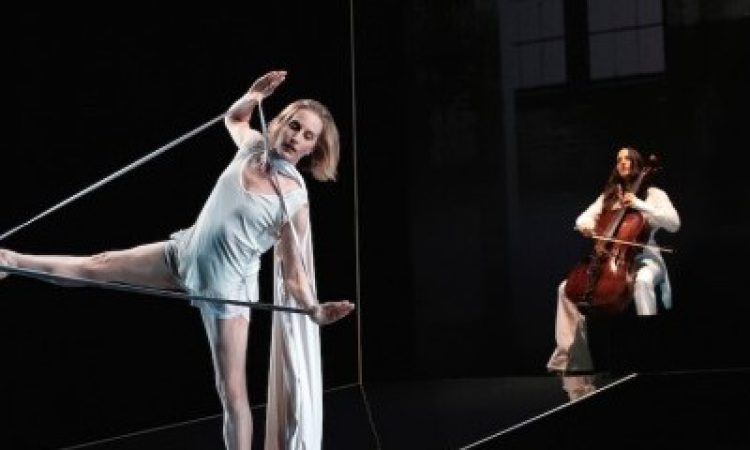
In silence, cellist Maya Beiser settles herself on this platform while dancer Wendy Whelan makes her way to the stool. Their white-clad forms cast ghostly doubles in the reflective black floor. What follows is an evening dense with material. Choreography by Lucinda Childs unfolds against a backdrop of ever-shifting projections. Beiser’s live cello performance overlaps with her recorded voice reading statements about intimate memories. Whelan cycles through a series of props, manipulating a ribbon, thin poles, ropes, and fabric in succession.
Centered around two compositions written by David Lang in the aftermath of 9/11, THE DAY carries the traces of this collective loss. As Beiser writes in the program notes, the piece is concerned both with “the eternal, post-mortal journey of the soul” as well as “the ways we remember our lives, as they are running away from us,” allowing the artists to explore the mortality of loved ones and of former selves.
In its most stirring moments, Childs’s characteristically minimalist choreography grapples with this hefty content through nuanced abstraction. For instance, Whelan stretches a white ribbon between her hands to demarcate a triangle of negative space between her arms. Keeping the ribbon taut as she cycles through a series of unadorned pivots, lunges, and extensions, the triangle remains clear; it is as if she is mapping the planes of her kinesphere. In rigorously maintaining this triangular outline Whelan continuously draws the audience’s eye to empty space, allowing a void to become vibrantly present. She repeats the same movements without the ribbon and its absence, too, is palpable.
Absence continues to resonate as Whelan pulls two ropes from the wings, carefully creating a horizontal line a few feet above the floor. As she leans away from the rope I find myself trying to imagine the person who must have been holding its opposite end in order to counterbalance Whelan’s weight—this absent body moves with Whelan as the memory of a loved one might. In these moments the choreography paces around the edge of loss, attempting to outline emptiness so that the audience might look at it directly.
Elsewhere, the choreography is more directly representational: Whelan slowly rotates two poles in a cross as if marking a grave while Beiser intones, “I learned he was killed in action.” A childlike ghost (white fabric draped over a ball) recurs as a prop. When Whelan, draped in white fabric, dips her pole towards the ground as if rowing through water, I could not help but imagine her as Charon ferrying dead souls across the river Styx. Although I felt that these moments of overt symbolism verged on cliché, Whelan’s understated performance kept them from coming across as saccharine.
It is the projections, rather than the choreography, that at times flatten the production into melodrama. In the second half of the evening, for instance, the audience is faced with a lengthy sequence of a cello shattering in slow-motion, set to what may have been the thunderous sounds of the crumbling World Trade Center. Moments later the cello is shown reassembled, floating amidst a glistening sea and streaming rays of light. The cello, it seems, has gone to heaven. Earlier in the evening, I was baffled when a glamorous video of Beiser’s face, surrounded by gently billowing hair, loomed behind her.
Perhaps because of these overdone projections, or the fact that sound runs through the piece almost without pause, I relished moments of sparseness. As the audience left the theater, I found myself lingering to observe the not-quite empty stage. Although the performers had exited, no curtain had descended to cover the remnants of the performance. White fabric lay crumpled in one corner and the stool stood empty in another, both reverberating with the echoes of their prior animation.
THE DAY will be performed in Pennsylvania at Lafayette College on November 6, 2019.
THE DAY, Maya Beiser/Wendy Whelan/Lucinda Childs/David Lang, The Joyce Theater, Oct. 22-27.
THE DAY is a piece suffused with death. Fittingly, it takes place in a dark, bare space. On the right side of the stage, a black wooden stool sits in the middle of an asymmetrical pentagon of white tape. The upstage corner of the floor juts upwards to create a small hill, its edges similarly lined in white.
In silence, cellist Maya Beiser settles herself on this platform while dancer Wendy Whelan makes her way to the stool. Their white-clad forms cast ghostly doubles in the reflective black floor. What follows is an evening dense with material. Choreography by Lucinda Childs unfolds against a backdrop of ever-shifting projections. Beiser’s live cello performance overlaps with her recorded voice reading statements about intimate memories. Whelan cycles through a series of props, manipulating a ribbon, thin poles, ropes, and fabric in succession.
Centered around two compositions written by David Lang in the aftermath of 9/11, THE DAY carries the traces of this collective loss. As Beiser writes in the program notes, the piece is concerned both with “the eternal, post-mortal journey of the soul” as well as “the ways we remember our lives, as they are running away from us,” allowing the artists to explore the mortality of loved ones and of former selves.
In its most stirring moments, Childs’s characteristically minimalist choreography grapples with this hefty content through nuanced abstraction. For instance, Whelan stretches a white ribbon between her hands to demarcate a triangle of negative space between her arms. Keeping the ribbon taut as she cycles through a series of unadorned pivots, lunges, and extensions, the triangle remains clear; it is as if she is mapping the planes of her kinesphere. In rigorously maintaining this triangular outline Whelan continuously draws the audience’s eye to empty space, allowing a void to become vibrantly present. She repeats the same movements without the ribbon and its absence, too, is palpable.
Absence continues to resonate as Whelan pulls two ropes from the wings, carefully creating a horizontal line a few feet above the floor. As she leans away from the rope I find myself trying to imagine the person who must have been holding its opposite end in order to counterbalance Whelan’s weight—this absent body moves with Whelan as the memory of a loved one might. In these moments the choreography paces around the edge of loss, attempting to outline emptiness so that the audience might look at it directly.
Elsewhere, the choreography is more directly representational: Whelan slowly rotates two poles in a cross as if marking a grave while Beiser intones, “I learned he was killed in action.” A childlike ghost (white fabric draped over a ball) recurs as a prop. When Whelan, draped in white fabric, dips her pole towards the ground as if rowing through water, I could not help but imagine her as Charon ferrying dead souls across the river Styx. Although I felt that these moments of overt symbolism verged on cliché, Whelan’s understated performance kept them from coming across as saccharine.
It is the projections, rather than the choreography, that at times flatten the production into melodrama. In the second half of the evening, for instance, the audience is faced with a lengthy sequence of a cello shattering in slow-motion, set to what may have been the thunderous sounds of the crumbling World Trade Center. Moments later the cello is shown reassembled, floating amidst a glistening sea and streaming rays of light. The cello, it seems, has gone to heaven. Earlier in the evening, I was baffled when a glamorous video of Beiser’s face, surrounded by gently billowing hair, loomed behind her.
Perhaps because of these overdone projections, or the fact that sound runs through the piece almost without pause, I relished moments of sparseness. As the audience left the theater, I found myself lingering to observe the not-quite empty stage. Although the performers had exited, no curtain had descended to cover the remnants of the performance. White fabric lay crumpled in one corner and the stool stood empty in another, both reverberating with the echoes of their prior animation.
THE DAY will be performed in Pennsylvania at Lafayette College on November 6, 2019.
THE DAY, Maya Beiser/Wendy Whelan/Lucinda Childs/David Lang, The Joyce Theater, Oct. 22-27.
THE DAY is a piece suffused with death. Fittingly, it takes place in a dark, bare space. On the right side of the stage, a black wooden stool sits in the middle of an asymmetrical pentagon of white tape. The upstage corner of the floor juts upwards to create a small hill, its edges similarly lined in white.
In silence, cellist Maya Beiser settles herself on this platform while dancer Wendy Whelan makes her way to the stool. Their white-clad forms cast ghostly doubles in the reflective black floor. What follows is an evening dense with material. Choreography by Lucinda Childs unfolds against a backdrop of ever-shifting projections. Beiser’s live cello performance overlaps with her recorded voice reading statements about intimate memories. Whelan cycles through a series of props, manipulating a ribbon, thin poles, ropes, and fabric in succession.
Centered around two compositions written by David Lang in the aftermath of 9/11, THE DAY carries the traces of this collective loss. As Beiser writes in the program notes, the piece is concerned both with “the eternal, post-mortal journey of the soul” as well as “the ways we remember our lives, as they are running away from us,” allowing the artists to explore the mortality of loved ones and of former selves.
In its most stirring moments, Childs’s characteristically minimalist choreography grapples with this hefty content through nuanced abstraction. For instance, Whelan stretches a white ribbon between her hands to demarcate a triangle of negative space between her arms. Keeping the ribbon taut as she cycles through a series of unadorned pivots, lunges, and extensions, the triangle remains clear; it is as if she is mapping the planes of her kinesphere. In rigorously maintaining this triangular outline Whelan continuously draws the audience’s eye to empty space, allowing a void to become vibrantly present. She repeats the same movements without the ribbon and its absence, too, is palpable.
Absence continues to resonate as Whelan pulls two ropes from the wings, carefully creating a horizontal line a few feet above the floor. As she leans away from the rope I find myself trying to imagine the person who must have been holding its opposite end in order to counterbalance Whelan’s weight—this absent body moves with Whelan as the memory of a loved one might. In these moments the choreography paces around the edge of loss, attempting to outline emptiness so that the audience might look at it directly.
Elsewhere, the choreography is more directly representational: Whelan slowly rotates two poles in a cross as if marking a grave while Beiser intones, “I learned he was killed in action.” A childlike ghost (white fabric draped over a ball) recurs as a prop. When Whelan, draped in white fabric, dips her pole towards the ground as if rowing through water, I could not help but imagine her as Charon ferrying dead souls across the river Styx. Although I felt that these moments of overt symbolism verged on cliché, Whelan’s understated performance kept them from coming across as saccharine.
It is the projections, rather than the choreography, that at times flatten the production into melodrama. In the second half of the evening, for instance, the audience is faced with a lengthy sequence of a cello shattering in slow-motion, set to what may have been the thunderous sounds of the crumbling World Trade Center. Moments later the cello is shown reassembled, floating amidst a glistening sea and streaming rays of light. The cello, it seems, has gone to heaven. Earlier in the evening, I was baffled when a glamorous video of Beiser’s face, surrounded by gently billowing hair, loomed behind her.
Perhaps because of these overdone projections, or the fact that sound runs through the piece almost without pause, I relished moments of sparseness. As the audience left the theater, I found myself lingering to observe the not-quite empty stage. Although the performers had exited, no curtain had descended to cover the remnants of the performance. White fabric lay crumpled in one corner and the stool stood empty in another, both reverberating with the echoes of their prior animation.
THE DAY will be performed in Pennsylvania at Lafayette College on November 6, 2019.
THE DAY, Maya Beiser/Wendy Whelan/Lucinda Childs/David Lang, The Joyce Theater, Oct. 22-27.