Raise Your Voice/Maybe Even Higher by ARTIST HOUSE/Asya Zlatina + Dancers was a collection of performances both intensely personal and communal. Lining the reception area at Performance Garage when I arrived for the show were reproductions of drawings and watercolors by children held in Theresienstadt, a Nazi camp in the Czech Republic. This display framed the evening as one of commemoration. The first part of the performance was composed of individual expressions through movement and journal readings; the second featured a longer ensemble dance, both humorous and grave, honoring the creativity and persistence of the Jewish Cultural Organization of Berlin in Nazi Germany. Inciting pain and laughter in alternation, the works were at once disturbing and uplifting.
The first work, Navigation, featured choreography and performance by two of Zlatina’s former students, whose muted, soft cotton t-shirts, socks, and pants cushioned delicate floor work. The following three solos that formed Raise Your Voice explored deeply personal self-reflections through speech and movement, each one focusing on a single journal entry about specific concerns and experiences of the dancer-speaker. These performances shared a rawness, uncensored as they were. Indeed, with the dancers already breathless by the time they began their readings, their choreography seemed layered physically into their writing.
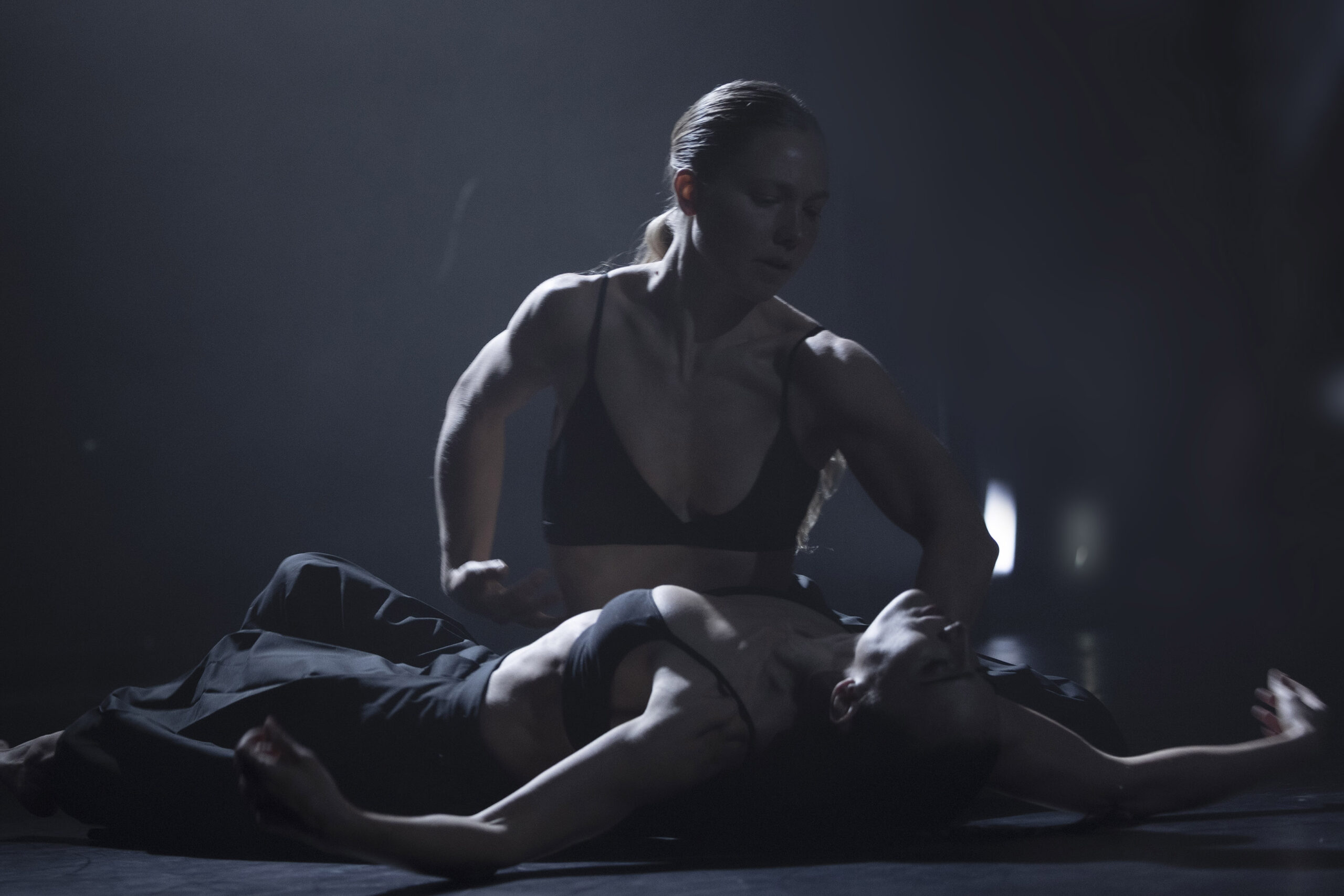
Avinu Malkeinu served as a transition to Maybe Even Higher with its theme of atonement articulated in the Jewish prayer of the same name, sung here by Barbra Streisand. It began with Zlatina crouched over, her back to the audience, arms outstretched but painfully stuttering like broken wings. Eventually, she turned to face us as she stood up, the stark spotlight directly above her highlighting every contour in her body. As the stage lighting widened, Zlatina’s torso undulated and spiraled upward in supplication with powerful turns and graceful leg extensions that read like continual surges of energy amidst suffering. The ending of this moving work was similar to its beginning, except that the broken wings had become stumps, perhaps acknowledging the realities of injury and loss that result from continuous struggle.
Maybe Even Higher mirrored this haunting circularity. At the beginning, we were met with several women in trench coats, one of whom emitted a jarring laugh that devolved into weeping. They joined hands and rotated in line until their backs faced us; one of them—the hysterical one—turned her head back slowly as the scene transitioned. What followed was a set of dances set to Johannes Brahms’ Sixteen Waltzes, Op. 39, alternating between comical group choreographies with balletic structures (and orange tutus) and comparatively earnest solos made of more committed and expansive movements. This is not to say that the parodic element was malicious; in fact, the dancers seemed to enjoy playing with each other in what were presented as ready-made sequences, perhaps emphasizing their ability to find joy within fascist constraint. In one scene, the dancers were literally tied together with rope at the waist but managed to continue dancing ebulliently. Their revelry was periodically shot through with violent intrusions leading to the deaths of one or several members of the group. And yet they repeatedly rose again with different clothing, different movement, and new smiles—even after they had embodied what appeared to be a pile of corpses at an extermination camp. The piece ended when the dancers disrobed to reveal their final costumes: striped prisoner uniforms. This simple but harrowing moment laid bare the dance’s allusion to the Holocaust. Just as it began, the piece ended with the hysterical woman turning back to us with a haunting gaze, its significance deepened by the intervening events.
Maybe Even Higher is haunting, to be sure, but not sinister; it elicits a celebratory awareness—a remembering made possible through movement—of the pain and richness of Jewish creativity.
Raise Your Voice/Maybe Even Higher, ARTIST HOUSE/Asya Zlatina + Dancers, Performance Garage, October 24-27.