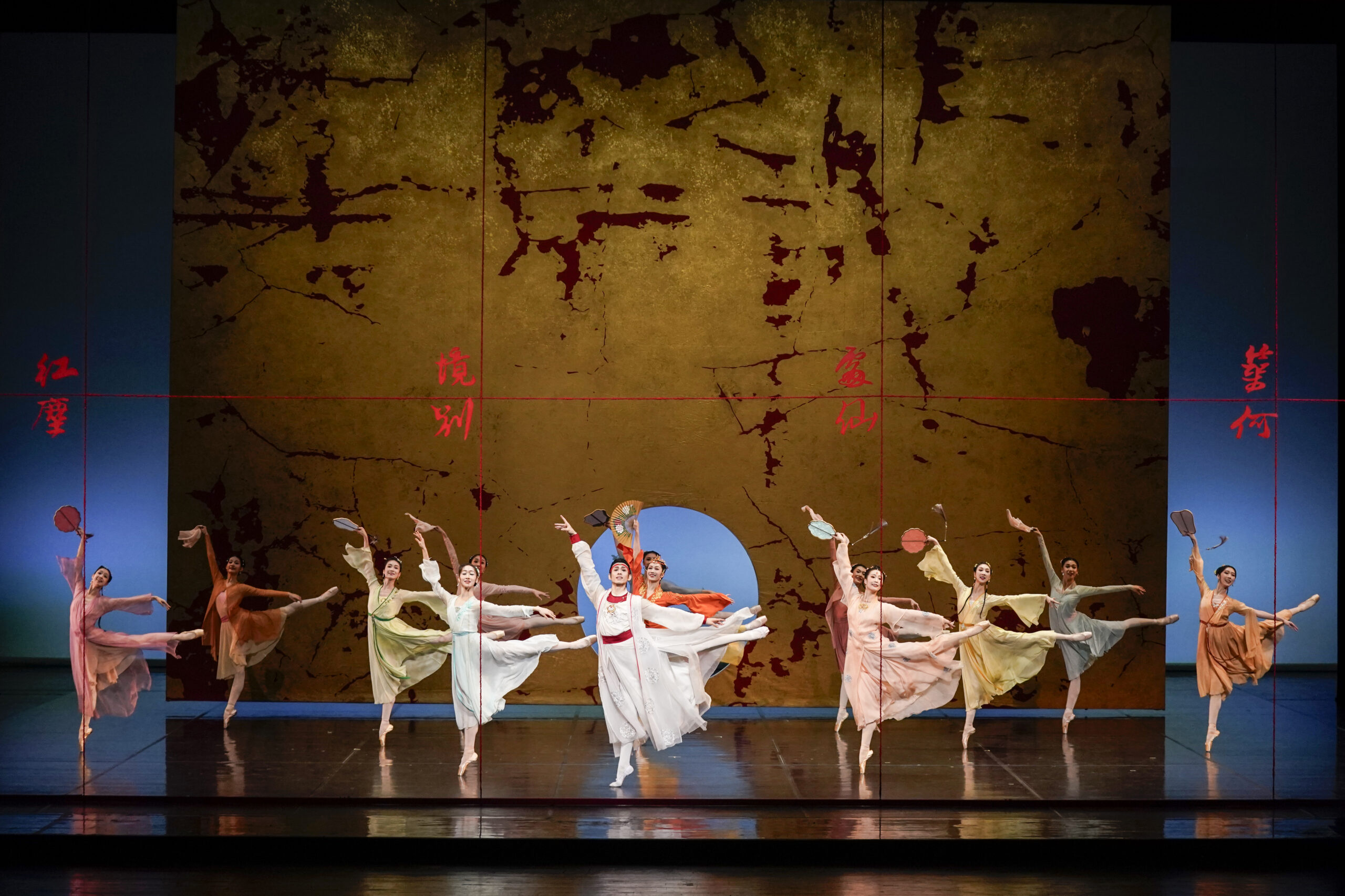
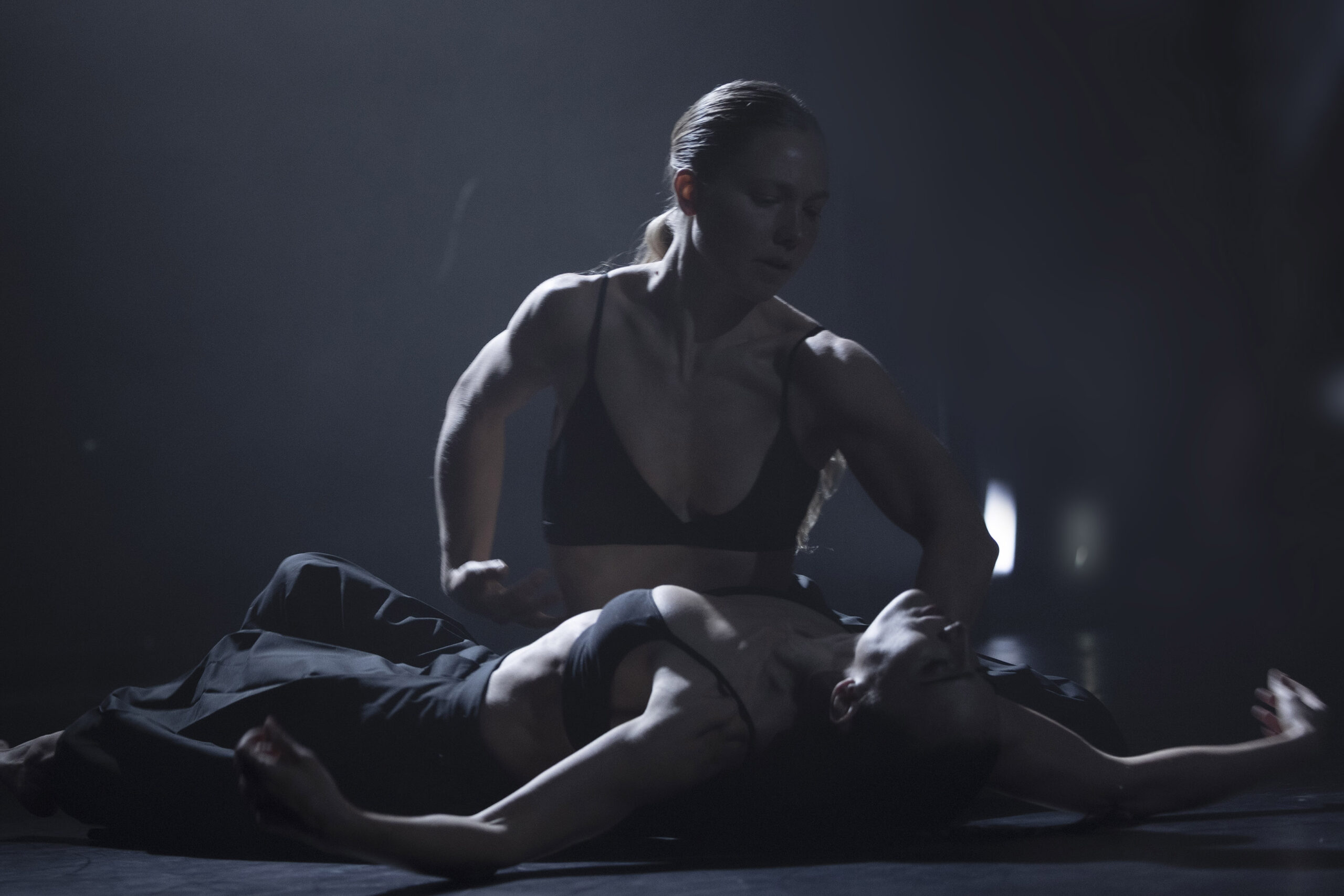
Pennsylvania Ballet’s World Premieres featured lively and sometimes provocative new works by Yin Yue, Juliano Nunes and Garrett Smith. Though varying in their use of costume, music, and mise-en-scène, the three pieces aligned in their emphasis on evocative atmosphere and abstraction, and in their contemporary balletic idiom.
In Yue’s A Trace of Inevitability, the lighting gradually brightened to reveal vibrantly-colored figures clad in socks and cinch-waisted baggy pajamas. This costuming, which lent precision to their shapes without reducing them to geometric lines, reflected an ambiguity in the choreography: Were the dancers people, or perhaps objects? Their costumes were not gendered and yet the pairings and group divisions were almost exclusively male–female. And they danced together intensely, fighting to get off the ground as if undergoing individual struggles, yet without relating personally to one another. They resembled splashes of watercolor on paper, inkblots scurrying across the stage and behind scrims, trying to affirm their humanity. The score by Michel Banabila became increasingly heavy with resounding percussion which, with the glaring lights at the end, magnified the choreography’s growing desperation. Something indeed was about to happen, although I couldn’t tell if it would redeem or obliterate the dancers.
The exquisite silhouettes appearing at the beginning of Nunes’ Connection gave way to syncopated port de bras and a series of duets separated by a male solo (Zecheng Liang), followed by all-male and all-female groupings, together suggesting a collective yearning that coalesced in blooming circular shapes. The mostly uniform, “nude” costumes abstracted the dancers into rapidly turning and expanding lines, the ballerinas’ pliability and balance being gracefully stretched to their limits under the guidance of their partners. Each sequence ended when the active dancers would tag off (perhaps “connecting” to) the next ones before expiring on stage. This ballet—reminiscent of the duets in Jiří Kylián’s Petite Mort—impressed in its unpredictability, especially when Liang alternated seamlessly between classical and contemporary movement qualities in his solo. Similarly, the ending in which the entire group turned to face the audience almost in a bow, as Ezio Bosso’s music still approached its final crescendo, was unexpected and arresting.
Smith’s Reverberance focused on the cello, musically—in a Bach recomposition with a solo performance by Peter Gregson—and visually. Cellos, suspended from the ceiling like lines of kelp under the sea, periodically rose and lowered while the costumes and lighting (designed for all three ballets by Michael Mazzola) evoked different underwater depths with varying shades of blue and green. One cello eventually came under the grasp of a growing number of hands in an all-male group, the dancers’ legs spread and their feet flexed, pugnaciously manipulating the cello with a mixture of awe and desire. It remained unclear to me what the instruments meant, or if they were intended to represent dancers themselves.
It was exciting to see these new works, all of which showcased the company’s technical talents and affective engagement. It is a shame that patron support does not allow for more programs of new choreographies such as these, which have the potential to really make ballet—even classical ballet—contemporary.
World Premieres, Pennsylvania Ballet, Merriam Theater, November 7–10