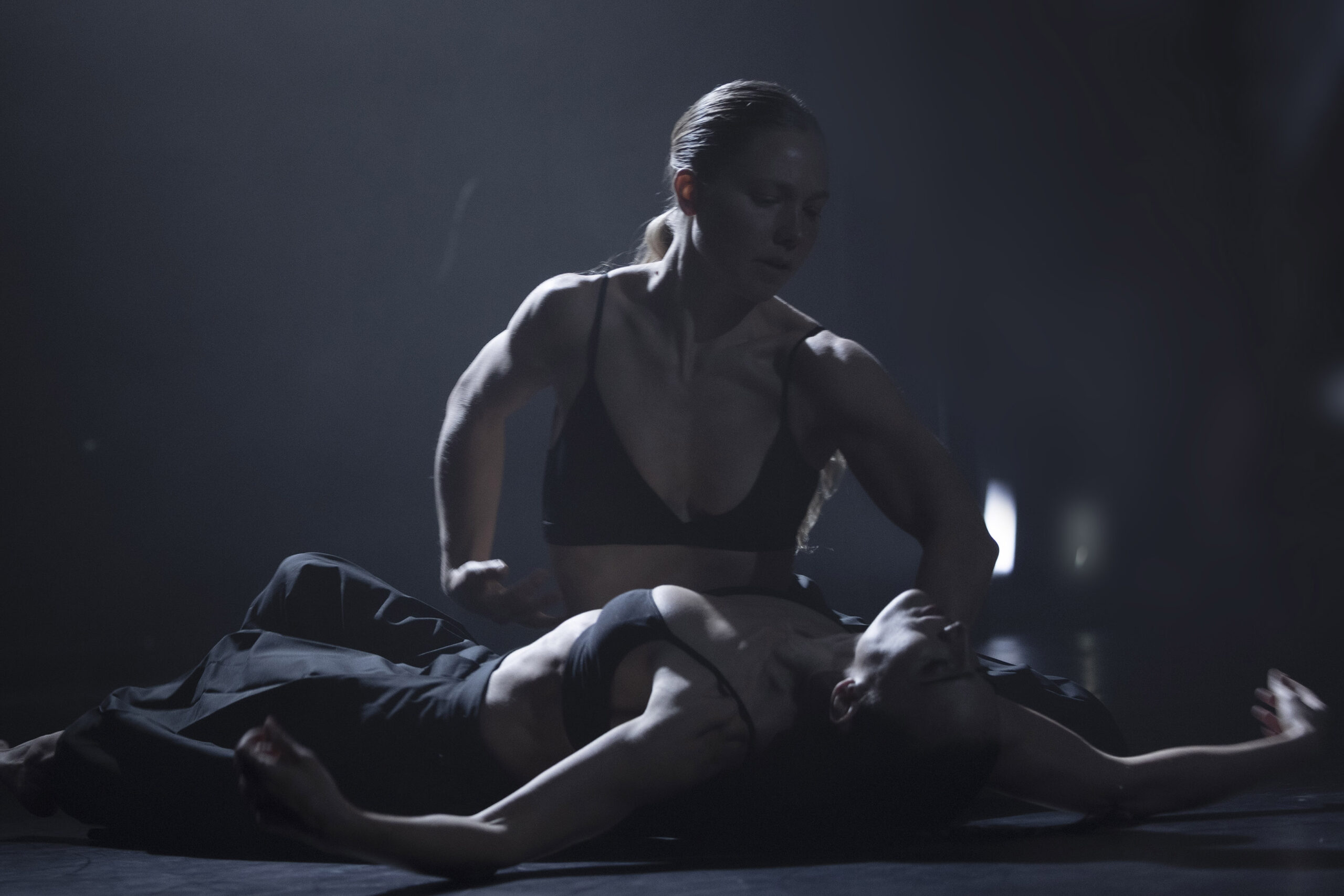
For the past two years, the Philadelphia-based performer and writer Mira Treatman* has been facilitating a simple workshop: get paired with a total stranger, an artist from any medium and any level, and make a short duet to share with the public. On Saturday, a fresh round of former strangers (Raychel Ceciro, Rachel Ford, LeAnne Harvey, Kate Madara, Cory Neale, and Cristian Pérez) debuted their new creations. But where did the project start?—and where is it going? In our recent conversation, Treatman reflects on her work of supporting artists to take risks in Duets By Strangers.
Nearly two years ago, Treatman says, she was eager to seek out “any and all opportunities to lead a rehearsal room or facilitate creative processes or teach,” and eventually landed at Keila Cordova’s studio, 954 Dance Movement Collective, leading various workshops. “The studio really changed my life by giving me the space to try things out, experiment. I had the great privilege of failing here and there. It is important to stay humble as a leader, learn from the students. Cliche? Yeah. But I believe it.”
In a project like Duets By Strangers, one can practically see the notion of failure looming overhead, a dramatic cartoon thought bubble. A stranger? An unknown medium? This piece could be really, really, really bad. It could fail. However, it’s precisely the naming of this space of potential failure, with its set parameters, that can allow artists the freedom to try a new art form, find accountability within a pair, meet new and unexpected people, and for some, try performance when they never thought they could. Furthermore, Treatman selects the pairs with intention. “A few years into offering workshops, I figured out how to be a more effective leader, how to care for everyone in the room. I think often of Barbora’s book review of Curating for Live Arts on thINKingDANCE,” she says, “and feel very validated by the concept that ‘to curate’ literally originates from the Latin root ‘to care.’”
Some highlights from shows over the years? “A participant and her two kids made a piece about gun control with her duet partner. They rehearsed in the family’s home in New Jersey. The piece truly incorporated all four of them. It was super unexpected, but awesome,” Treatman recalls. “I’ve also really appreciated all of the times the participants have taken major risks, notably when they tried a performance medium for the very first time. Watching a really accomplished dancer perform a scene with dialogue, something I believe was a bit new to this performer, was amazing to see. She was paired with an actor. They created a scene and characters, and really, really committed to carrying out their concept to completion. I know for myself that kind of risk taking is what helps me fall asleep at night, helps me find peace—knowing that at least I tried. I hope that the participants who’ve taken those risks carry that with them too.”
She also recognizes some of her own qualms with the format, one of which is how the workshop’s title immediately creates a demarcation between the self and the other. “What in fact makes someone a stranger? What of the strange? The weird? Concerns about the language are present in my mind,” she remarks, “Therefore, I try to be really intentional about how I’m recruiting people for this process, and then too how I pair the performers. It is care.” Some of the artists from the workshop have continued to work together, including two different Fringe Festival productions. Treatman herself met a collaborator, Vitche-Boul Ra, through the process.
As for the project’s future, she simply hopes it continues to grow with added support. For this iteration, with the support of the Bartol Foundation in partnership with Small But Mighty Arts, Treatman was able to expand the project to include communal studio sessions for the first time, which quickly proved useful for the artists. As the project grows, Mira hopes to continue to sustain the project with increased funding put to good use. For information on future iterations, check out Treatman’s website.
*Mira Treatman is a writer, editor, and committee chair at thINKingDANCE.
Duets By Strangers, Mira Treatman with collaborators, 954 Dance Movement Space, Nov. 16, Interview with Mira Treatman conducted Nov. 10.