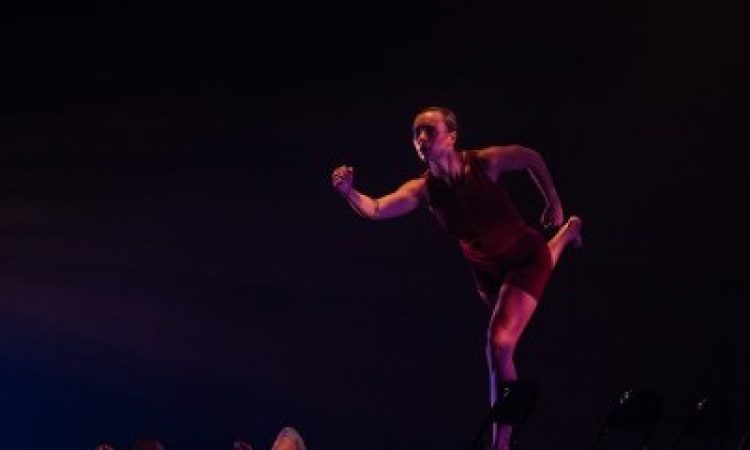
One dancer is in the middle. She wears a tight, rust-colored biketard. She holds the center placement on stage, lifting a leg bent at a sharp right angle in front of her, and slowly swinging it back. She flexes her foot.
This dancer begins the piece, an excerpt of Winifred Haun’s Your nearest exit may be behind you, by herself, but soon other company members flit past her, running, leaping and turning. Though I see biketards in neutral tones (blues, whites, grays) peeking through, the others in the corps are swathed in silken tunics. As they bound about, arms stretched upward and legs in the slightest arabesque, the fabric’s cloudy opacity gives me glimpses of the soft curve of a hip, an arching back , and the dancer in the middle holding a headstand while her legs form a clear-cut capital “L” above her. The dance is linear, geometric, often two-dimensional, and thrown into relief by the simple biketards; the movement of tunics seems like a stream running through an otherwise craggy rock bed.
The Come Together Festival is an annual production from Koresh Dance Company, bringing student groups and professional artists to Philadelphia for a four-day series of performances. The bills vary greatly; this year features local staples such as Kun-Yang Lin/Dancers, Rennie Harris Puremovement, and Pennsylvania Ballet, alongside other groups hailing from different parts of the country. The Friday performance included Harris, The Lady Hoofers, Project Moshen, and, of course, Koresh. During an evening featuring syncopated contemporary dance works, I expected to see anguished women in black two-piece outfits writhing on the floor before barreling through a series of fouetté turns. Haun’s Chicago-based company, with its non-narrative, sculptural lines, offered a welcome respite.
The excerpt from Your nearest exit explored individual bodies as moldable elements, as well as the ways a group of bodies may be shaped in space and time. In 2015, Haun was the recipient of a MacArthur Foundation International Connections award to bring her company to Australia, where they collaborated with another group to create a work combining “modern dance and contemporary circus,” according to Haun’s bio.
Premiering in 2016, Your nearest exit features glimpses of this research in the moments that bring all the performers together. In one, they line up together from up- to downstage, arriving simultaneously out of a roll with their legs folded in front and an arm reaching behind. Their alternate facings, stage right and left, give the spatial dynamic a zipper quality as they begin to break the formation. Towards the end, having introduced yet another line—this time of four fold-out chairs—a line of dancers on the ground flows methodically from shape to shape: swinging back with legs overhead, propping themselves on their right sides, before rolling onto their backs. Next to them, on the parallel row of chairs, a dancer cartwheels along the seats while a small group watches idly by, spotting her as she swings onto the ground again. At this point, some have shed their tunics, revealing more of the bodies at work. As the dancers on the floor flip themselves over the chairs onto the shoulders of the waiting group, the two lines slowly back away from one another while the lights dim.
It’s all simple and nice and good. Admittedly, I harbor a disdain for unnecessarily esoteric dance and, on a program largely composed of pieces that try a bit too hard to emote, Haun’s work stood out to me. Were it on the bill alongside some of Philly’s most cutting-edge, weirdest artists, I might see it differently.
Come Together Festival, Koresh Dance Company and multiple artists, Suzanne Roberts Theatre, November 20-24.