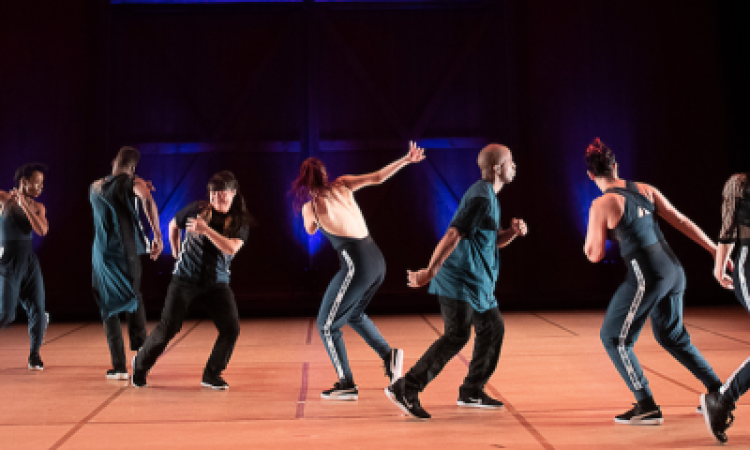
The spotlight rises, center stage, on Matthew “Megawatt” West and Manon Bal. Their initial dance is tiny, made up exclusively of head nods and chins jutting out, like kids sizing each other up on the playground. Such is the beginning of Ephrat Asherie Dance’s Odeon.
Clap,
clap,
clap.
West’s hands begin to produce a steady rhythm. Outstretched and taut, his arms resemble a crocodile’s jaws. Bal soon rushes in to fill the negative space between each clap, chomping her own arms between his. The rhythm accelerates with her sound.
Clap / clap!
Clap / clap!
Clap / clap!
Their sound recedes and house footwork emerges in its wake; the two smoothly pass steps back and forth, their feet pattering lightly on the stage. This time the rhythm is visual, but clear. I can almost hear it in my head.
Live music pours in over their quiet dance: Eduardo Belo, Vitor Gonçalves, Sergio Krakowski, and Angel Lau play a combination of piano, cowbell, tambourine, and stand-up bass, infusing the space with Afro-Brazilian rhythms that at times have an extremely jazzy feel. Fellow dancers Teena Marie Custer, Valerie “Ms. Vee” Ho, Omari Wiles, and Ephrat “Bounce” Asherie join the other two for a series of trios, solos, and duets, blending movements from house and breaking. Custer and Bal twirl and fling their arms in a highly sassy and feminine waacking duet, Valerie “Ms. Vee” Ho steps to the front of the stage and busts out a funky locking solo. In a moment of partnering, Asherie leans onto Wiles before he tosses her off playfully with his hip. Asherie, the choreographer behind the breaking solo is particularly compelling, as she glides along the floor with effortless fluidity.
Sharp looks between the dancers create more moments of exaggerated confrontation, a thread of performative competitiveness running through the work. I think of how much the form of hip hop is imbued with these archetypes, each one trying to prove that they can dance better than anyone else in the cypher: the tough b-boy, the confidently sexy waacker. Yet in Odeon’s world of sometimes overly theatrical facial expressions and a Broadway-like cleanliness (seriously, are these people even sweating?!), what I find myself craving more and more are moments of rawness, wherein the dancers are overcome by their dance and no longer in such tight control. Every moment, every step, seems to fit into its eight-count exactly right—I crave the tension that happens when dancers tug against beat, trick you into thinking they’ve lost it before they get back to the music again.
The show’s offering of such an exploration finally comes in the form of Omari Wiles’ final solo. Although Wiles previously dazzles the stage voguing in bejeweled, elbow-length gloves, in this last pass he arrives sans handwear, performing with only Krakowski on tambourine. The musician’s eyes are fixed on the dancer; he stalks Wiles like a lion, each strike of his tambourine echoing through the space and erupting out of Wiles’ body as movement. Wiles’ dance is West African, voguing, undulating, personal. A loud cheer erupts from the crowd. His movements become more minute and sensual. The song of the tambourine quiets to a dull thump. Krakowski rips the beaten top of his tambourine off and is relegated to only its zills before he ditches the instrument altogether and pounds the floor with his fists. Wiles responds by stomping his feet into the ground, creating his own dripping beat as the percussionist falls silent. Wiles’ body is regal in the silence. Finally, both are still. The room is quiet. Wiles picks up the thin sheet of broken tambourine from the floor and straightens up. He looks at us, tosses his head back, and then fans himself with it, before strutting off the stage. Big applause. Although the piece continues on, I’ve already found my finale.
Odeon, Ephrat Asherie Dance, Annenberg Center for the Performing Arts, February 7-8.