How many performances have we lost to coronavirus? I’m sure the list of shows canceled, postponed, and never started would fill many depressing pages. So let’s instead think about something positive: how many works have we gained? The short dance film has become more popular than ever as a result of social distancing. Adding to the growing collection, BalletX recently premiered four videos as part of the Guggenheim’s Virtual Works & Process series.
In Caili Quan’s “100 days,” Chloe Perkes embodies the silliness that emerges when your home becomes your whole world. She executes balletic kicks and turns that devolve into hip-swaying grooves as her real-life husband attempts to read in the background. Performing in Hope Boykin’s “…it’s okay too. Feel,” Savannah Green and Ashley Simpson shift between stillness and energetic sequences in rooms made more claustrophobic by split screens and shrinking frames. Penny Saunders’ “Brown Eyes,” featuring Andrea Yorita and Zachary Kapeluck, explores an unstable relationship pushed to its breaking point by confinement. It uses reflections, shadows, and video overlays to intensify the visual tension created by the choreography.
The final work to premiere was Rena Butler’s “The Under Way” (working title). Before the pandemic began and George Floyd was tragically killed, BalletX Artistic and Executive Director Christine Cox approached Butler to create a piece about the Underground Railroad. A portion of this work was supposed to premiere live at the Guggenheim museum this spring. However, the unexpected path this year took forced everyone to pivot, and Butler began working on the video version of her longer work in early May. When public outrage over Floyd’s death erupted, the scope of the historically-inspired project expanded to include a more explicit examination of the past’s relationship to current events.
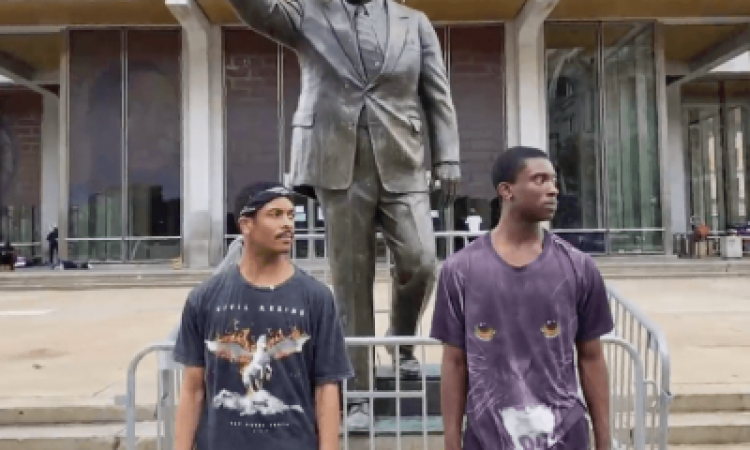
Dancing to pulsating music by Darryl Hoffman, Stanley Glover and Roderick Phifer adeptly transition from smooth extensions to aggressive krumping, from meditative spins on their tailbones to frantic running in place. Stretching their faces and limbs against their shirts as though trying to escape the confines of the fabric, they connect the struggle of the Underground Railroad with today’s Black Lives Matter Movement. One of the film settings prominently features the statue of Frank Rizzo, a former Philadelphia police commissioner and mayor known for police brutality and racism. The statue was taken down in response to protests just five days after filming. These scenes are enhanced by Tara Keating’s videography and Butler’s editing. At times sped up, reversed, and distorted, the clips come together as a series of powerful visuals that stayed with me long after the three-minute-and-thirty-second video ended.
“The Under Way” concluded the show, and at its end, I wanted to stand, clap, and shout. I gathered from the growing number of notifications at the bottom of my screen that my fellow attendees felt similarly. I opened the Zoom chat window and added a few words to a steady stream of text. This in no way felt as satisfying as the uproar of applause that reverberates through a theater after a well-received performance—a response that these choreographers and dancers certainly deserved.
Virtual Works & Process, BalletX with Hope Boykin, Rena Butler, Caili Quan, and Penny Saunders, Zoom, June 14