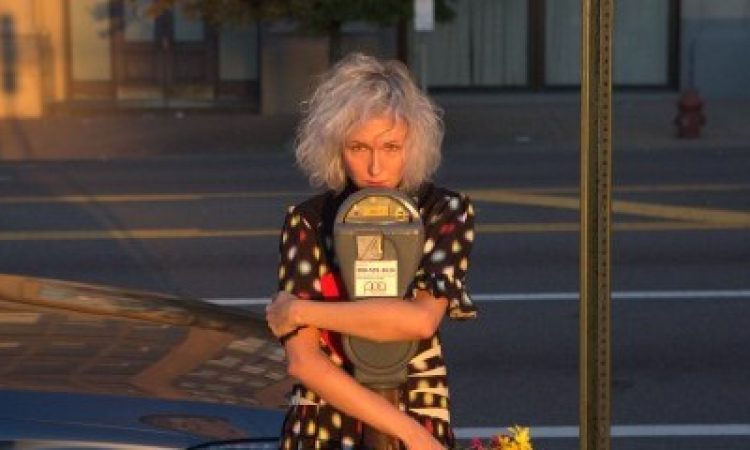
Death, played by Irina Varina, wears a polka dot dress with a heart sewn on the front that cups her breasts like a brassiere in her one-person show, An Encounter. She walks at a funereal pace down Broad Street from Girard Avenue toward City Hall in black heeled boots with a stiff spine and straight mouth. I have been instructed to follow her from across the street and sense the elegance of her timing that has us arrive at the corners just as the street lights change to green, as if she were an omnipotent deity. Her slow gait counterpoints the racing motorcycles and darting pedestrians, some of whom stare at one or both of us.
I am reminded of Christina Gesualdi’s* walking practice, which heightens the senses through slowing down and noticing the details around us. Gesualdi also calls attention to issues of gentrification in her work. As I sense similarities between Gesualdi’s practice and this performance through their common invitation to take in the crevices of the city, I become curious about Varina’s relationship to this part of Philadelphia. Her instructions noted, “Death will be personified as a pretty white girl in a beautiful dress,” and I wonder why she has chosen to perform in a predominantly Black neighborhood.
My question about her relationship to this area of the city is complicated as we travel south into more gentrified, white-occupied spaces. She rests on the front steps of the newly redeveloped Divine Lorraine Hotel. Perhaps this itinerary is intended to shine a light on the racial discrimination in Philadelphia?
Death’s skirt blows upward Marilyn Monroe-style as she walks on subway grates. We pass by the shuttered Philadelphia Met with posters in the windows of concerts that never happened. She walks with her arms wrapped around her stomach, then they spread behind her like an angel’s wings. Her pre-show notes requested audience members repeat her movements. I attempt to embody these shapes while writing notes for this review, and maneuvering around parts of the sidewalk blocked by orange mesh and traffic cones. She skips and screams in the fluorescent light of a gas station lot, rests her body on a utility pole, sticks her head in a trash can. We stomp and jump together on thunderous, metal ground access doors on opposite sides of Broad Street.
As we walk alone together I am struck by the isolation I feel as a solitary audience member viewing a performer from afar. I feel connected to Death through our moments of unison and a sense that she is tracking my presence. But we are far enough away from each other that I can’t make out the words she occasionally hollers, and I feel our current pandemic conditions reflected in the distance between us.
As she says in her marketing materials, Death has been “kinda busy these days,” so after thirty minutes it’s time for her to leave. I am leveled by the speed with which Death was able to evoke in me an attachment to her––and somehow remind me of everyone I’ve ever lost––through her simple gestures and dream-like presence. She slips down a small street. I stand in a pool of street light and grief as I wait for her to disappear.
*Christina Gesualdi is a former thINKingDANCE writer.
An Encounter, Irina Varina, Broad Street, 2020 Fringe Festival, Sept. 10–23.