“Imagine if your body were so permeable that the world just rushed inside of you, filling you up.”
With endless doomscrolling, perpetual Zooming, and the Sisyphean task of keeping up with all the online happenings, my body does feel increasingly soft and porous as the world careens through me unabated via my screen. In a more positive way, I experienced the short film TrashBot (from which the quotation above is taken) as a curious rush of mysterious storytelling, surreal imagery, and subtle references. I didn’t always understand what was going on, but I was along for the ride of this technological lore.
The film follows the story of a researcher seeking out the TrashBot, something of a mythical cyborg who, among other glitchy powers, spontaneously downloads all the memories of any human she encounters. Throughout the search, we experience mashed up technicolor imagery of nature scenes and the digital realm—a figure is seen plugging in a monitor lying face up in a tangle of green growth, and an image of a campfire flickers on. A baby deer eats grass, hunting video games are played, chatrooms visited. A hand pulls at a black-lit neon web of string. These images float questions of what is natural or not, who is hunter or hunted, where a physical body ends and a cyber body begins.
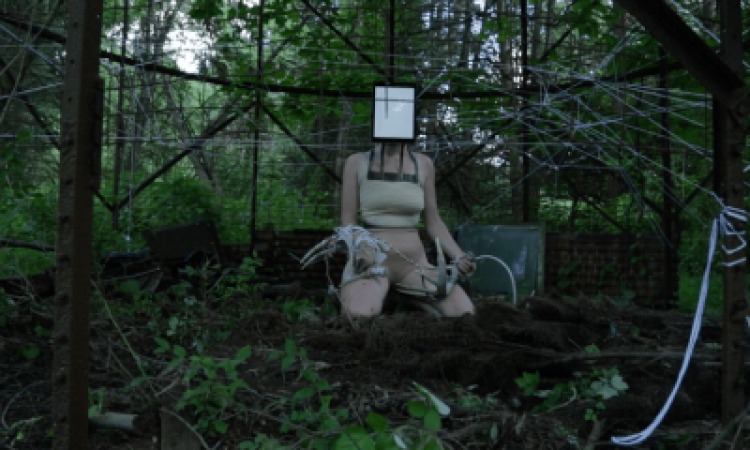
We observe the TrashBot herself only in fleeting moments: a frozen pose in the headlights of a car, a body holding what seem to be deer horns with arms outstretched overhead, feet together and knees to one side, torso and head obscured by bright white light. Other times she holds this pose more centrally on the screen, with wires of all sizes and colors wrapped around her and a screen flashing blocks of color where her head would be.
TrashBot moves at an increasingly frenetic pace as it goes on. Text and images scroll unreadably. Spoken words become heavily digitized and distorted; they overlap into a dense thicket of robotic echoes that I strain to understand, until I let them wash over me. Then, key words emerge (not the body – keen scent – intelligence system – the garbage body – dependent – color – but in fact – laptop gone mad – the garbage body – reaction – copy – exploded) and somehow layer into a disjointed kind of sense, not unlike how we piece together memory and meaning in the digital age.
A film of technonatural angst, TrashBot uses myth to approach an understanding of our scrambled modern bodies.
Trashbot. Aysha Hamouda, Sarah Finn + Garvis-Giovanni Deval. Online. September 10-October 4.