The virtually unpronounceable title of Asya Zlatina’s Fringe Festival offering, #Quarantineksvkhvkhkdvhai, reflects what she states in a talkback for the show is our current shared struggle to articulate and the technological frustration especially of the solitary dance artist creating for the virtual realm. Zlatina, at this talkback, asks us to participate in a title pronunciation contest before revealing its intended sound: a begrudging grumble with a frantic headshake, just like hitting the computer keys when the machine won’t comply.
“Carry On!” is the first of many videos created online by Asya Zlatina + Dancers. All dancers appear in their respective boxes at once (imagine Zoom gallery view). They perform the same phrase, with the lagging video creating interesting timing. It ends with each dancer holding a piece of paper with scribbles closely to the screen; the pages collectively creating a heart.
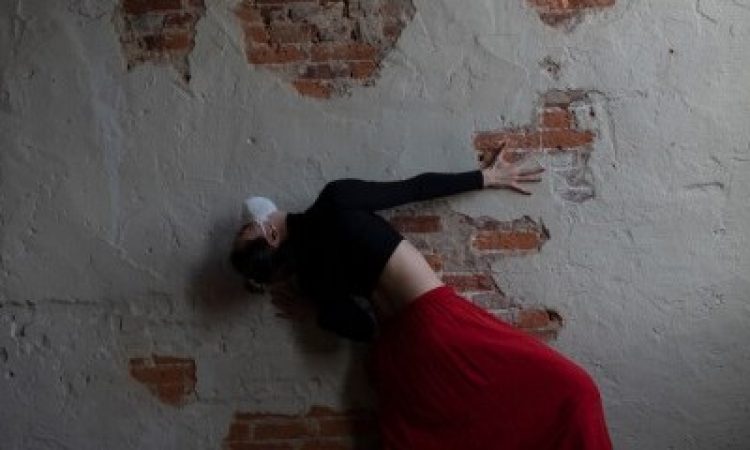
After this, #Quarantineksvkhvkhkdvhai shifts to a primarily solo show, in what has become COVID era fashion: a dancer’s leg extends up, into the video frame and towards the sky. A foot points and flexes. A face moves in and out of shadows.
Zlatina tracks her 2020 year through videos that offer her embodied interpretations of anxiety, isolation, and extinction, among other responses, universal and private. I unintentionally mirror her brimming expressions. I smile, almost laugh. I scowl, tense with anxiety. We connect beyond the screen’s fourth wall.
She reaches for a partner on another screen, yearning for physical touch. A pause. A shift in space. An embrace. I exhale release.
In #Quarantineksvkhvkhkdvhai, Zlatina embraces the future while acknowledging the past, reminding me of her 2016 work Barry: Mamaloshen in Dance! “May Frolics” occurs in a hallway outside the camera’s room, executed behind a blurred screen “like the blur of our future,” Zlatina explains. In a reflection of resilience, Zlatina looks to material from concentration camps, as well as her own years living in the former Soviet Union. Discomfort challenges her boundaries.
The final video, “A Peaceful Acceptance,” embraces a quiet sense of completion, not to be confused with a finite ending. She rolls towards the camera until the image of her body has merged with the screen. I feel calmly present, counterbalancing the tension moments earlier when her feet, clasped at the ankles, distortedly twist around one another.
While the world pauses in uncertainty, Zlatina contemplates how to thrive in her environment and her body. #Quarantineksvkhvkhkdvhai is, as she states, a “point of departure for exploration …using the means we have to” carry on.
#Quarantineksvkhvkhkdvhai, ARTIST HOUSE / Asya Zlatina + Dancers, 2020 Fringe Festival, Sept. 23-26.