With her company performing live at the Annenberg Center in its Philadelphia debut, Pam Tanowitz took advantage of an audience-free theater to explore dialogue between abstract dances and places they weren’t made for.
Gustave Le Gray, No. 2 opened the evening in an approximation of a normal concert dance on the proscenium stage. Multiple cameras afforded different viewpoints, mostly showing the whole stage but at times zooming in on the dancers’ feet or upper torsos. I appreciated these close views of their muscular physicality, but camera transitions were somewhat shaky, and I felt like I was missing out on Tanowitz’s sculpting of space and pattern. To a score of spare piano music, the movement mixed “dancerly” lines, loose limb shaking, pedestrian motions, and geometric shapes. This piece was a warm-up for my attention—intricate but easy to absorb.
More interesting to me was Annenberg Solos: Sites 1-4, a series of amusical, nonnarrative solos that scattered the dancers around the backstage and theater. The lights did not go down on the dancers after Gustave; they simply walked offstage. What followed was a solid minute of watching dancer Jason Collins changing costumes backstage, a deliciously uncomfortable eternity of uncertainty, wondering, Is this a part of the performance? Collins began dense choreographic material among typical backstage detritus—I noted a yellow trash can, two mismatched metal storage cabinets, red dolly, old manikin, tangled cords. I hoped we were getting an untidied view into these spaces so familiar to performers and stagehands but unseen by audiences.
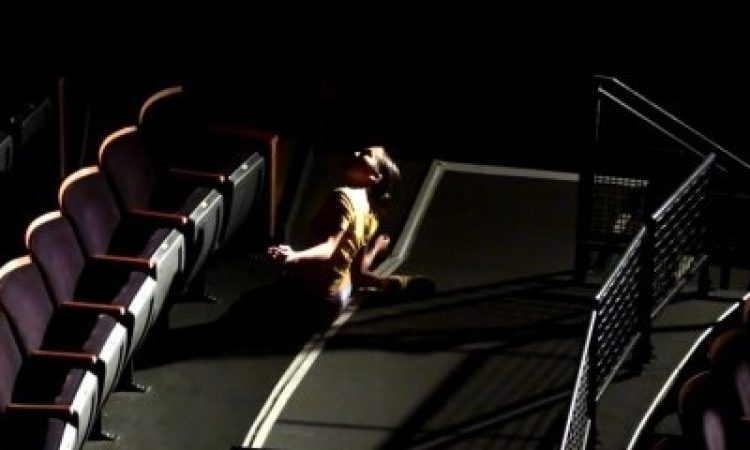
A soundscape of city-like noises swelled, with the addition of Tanowitz’s voice live cueing the dancers to start or finish their sequences. The camera panned to show Christine Flores in the distant ADA seating area, her solo amid the empty black velvet seats, with Collins remaining in the foreground. Later, Victor Lozano appeared in the stage right wing (“Victor, go”), shown in tandem with Flores. The view switched to Zachary Gonder on the audience balcony near a red exit sign, and as the camera zoomed in, Lozano fell away out of the bottom of the frame. As Gonder’s solo evolved, the camera backed up to show the nearly empty theater, with only the other three dancers and two camera operators seated. As the lights went to black on Gonder moving and Tanowitz cueing, “Zach, Zach end,” the empty house felt less spare, filled in a new way.
In the post-show Q&A, after confessing a long-held desire to work in a theater without an audience, Tanowitz revealed that she choreographed the solos on Zoom during spring lockdowns separately from the Annenberg Center commission, and later repurposed them in the new space (with the support of advance photos and videos from Annenberg staff, and one day onsite before the livestream). I found myself disappointed to learn that the movement wasn’t made with the place in mind, perhaps making the work more site-responsive than site-specific. Still, the intentionality of the camera angles and the activation of unexpected areas of the theater made for interesting viewing.
During the live screening, I was caught up in the novelty of seeing a familiar place enlivened in a new way, while a second watch illuminated new connections and conversations between the dancing and the place (such as Lozano’s highly linear sequence among lighting rigs, some of which cast shadows the full length of his torso). These repeated engagements with the choreography were a luxury not typically afforded by live performance (the recording was available in Annenberg’s online portal for 48 hours after the initial screening), and I relished uncovering more flavors that evolved with additional viewings.
A chat box allowed the virtual audience (around 300 passes were sold) to comment in real time on what was happening on the Annenberg stage and traveling through our screens. The wave of appreciative comments was not quite as visceral as a ripple of ooooh sweeping across a theater, but it was something. It felt good to be watching dance that was happening live somewhere, even if I wasn’t physically there. People recognized and greeted folks they knew in the chat, perhaps the closest thing we have now to running into each other in the lobby. I chuckled to myself when the Annenberg Center’s official chat presence popped in to assure viewers that all was well at key moments to head off panicked questions, like when a dance started in silence. And I had to agree when others expressed their surprise at the short length of the program, which was barely 50 minutes including Q&A (especially given the $25 tickets, steep compared to many digital dance offerings).
Now that moving online is the default and necessary mode for many performances, I was heartened to see a different response to the creative constraints of the time, even if the video quality was at times suboptimal. Tanowitz’s Annenberg Solos was certainly not a piece that would have been made under non-pandemic circumstances.
Pam Tanowitz Dance, Pam Tanowitz Dance, Annenberg Center online, October 15-17.