The title of this children’s book, I Will Dance, says it all. Eva, a child who lives with cerebral palsy and uses a wheelchair, is not satisfied with using her imagination to dance on two legs. She’s tired of pretending to dance. She will dance like the able-bodied children.
On her tenth birthday, she wishes for a pink tutu. She wants to dance, to be a participant instead of a spectator. What she really wants is to redefine dance, to show by example that one can dance upright on two feet or seated in a wheelchair. “Maybe I could roll my chair between, around … until we are all mixed together.” However, while Eva wants to be unbound from the constraints of her wheelchair, she still is bound to a stereotypical view that equates dance with ballet.
Author Nancy Bo Flood shows us—as Eva eventually convinces herself—that dancing in a wheelchair is an everyday occurrence. The book also normalizes having two moms as parents. Eva’s mothers are presented matter-of-factly, holding Eva as an infant, helping her blow out the birthday candles, reading the newspaper at the kitchen table, simply being present for Eva.
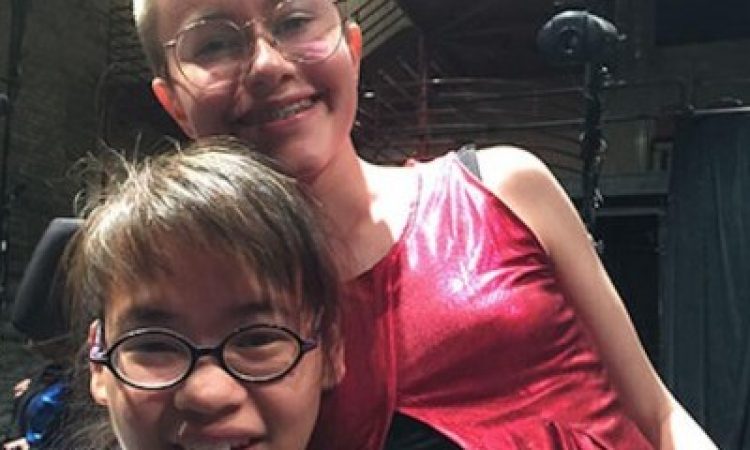
The little girl in the book is inspired by a real-life Eva, an orphan who was born prematurely and not expected to live. Eva joined the Minnesota-based Young Dance company’s All Abilities program, which opened up a world of possibility for her. As the company’s website explains, the program morphed from adaptive dance classes to “translating the movement language created on one body to the unique language of another person’s body.” What makes the All Abilities dance program so successful is that it integrates able-bodied and disabled dancers, who learn more than just dance fundamentals. They gain life lessons that will serve them well beyond the dance studio. Today, Eva is a performer/choreographer with the dance company.
The book jacket states that I Will Dance is appropriate for ages 4 to 8. The author, an accomplished poet and trained psychologist, writes from the perspective of 10-year-old Eva. She manages to capture the frustration, fears and sense of freedom that Eva experiences in her quest to express herself with dance.
Because my son, Dan Silvers, is a third-grade teacher, I asked him to share his insights on the book from an academic perspective: “Fear is something that holds many students back from doing what they love, especially for students who have been told ‘NO’ over and over again,” Dan told me. “This story allows us to break through that fear. It allows us to see what is possible beyond our imagination and pretend dreams. Feeling accepted can change the attitude of anyone, especially those who have not been accepted their whole lives.”
Eva is paralyzed not only physically but mentally as well. Like any child, she wants to fit in. “What if they stare, whisper” she asks herself. Many children, particularly young girls, lack self-esteem. This book gives us a glimpse of how a physical disability can turn self-doubt into something truly crippling and how, with a supportive environment, that self-doubt can be transformed into self-confidence.
Beyond the uplifting story, what makes this book so enchanting are the watercolor illustrations by Julianna Swaney. Graceful swirls, silhouettes of dancers in all shapes and sizes, and a warm color palette form an illusion of motion on each page.
For me, the only disappointment is the absence of male dancers until midway through the book. I would have liked to have seen boys pictured dancing early on in the story. A book tackling stereotypes in dancing should more accurately reflect all types of dancers. While the book’s illustrations show dancers in all skin tones, it’s not until the second half of the book that dancers of all genders are shown.
I Will Dance is not just about overcoming odds or a little girl wanting to fit in with other kids. It’s about facing your internal demons head on in order to overcome them. It’s about not giving up on your dreams. The book also is about the power of community and, specifically, of a dance community. As the book’s illustrations so perfectly depict, this sense of community fosters something truly magical not just for Eva but for all those touched by the experience.
Nancy Bo Flood, I Will Dance. Atheneum Books for Young Readers: 2020.