It takes me a second to notice the green-robed woman in a peacock headdress standing in the back corner of the Mount Airy yard. After a few minutes of slow-motion gestures, while the small audience takes their seats, she lets out a great “Ahhhhhh!” the beginning of a poem that welcomes six dancers to the stage. Oh, and by stage, I mean a cleverly converted two-door garage.
Dream Chapters, co-conceived and produced by Evalina “Wally” Carbonell and Weiwei Ma, is a series of six solos created and danced by six performers. It feels all the more dream-like for being the first in-person performance many of its audience will have experienced this year. While the performance is a collection of six parts, it’s bound together by the original poetry of Tatyana Yassukovitch and the careful coordination of the six performers who often assist, lift, and echo each other in the moments between solos.
Joshua Culbreath’s lines and scribbles kicks off the evening with introspective intensity. He stumbles, falls, repeats the stumble, sometimes evolving it into a moment of sharp footwork or acrobatic virtuosity. These movement sketches are echoed by his interaction with a notebook. He slams it down, crumples pages, then eventually returns to those pages to smooth them out. In a stunning final moment he lowers himself from a handstand toward the pages, suspending for a moment on just his head, like a pencil poised to write, before releasing back to the floor.
Weiwei Ma’s In Dream and Paul Matteson’s up-lift both fill the small stage with images of child-like wonder and play, though very different in tone. The pajama-clad Ma partners with a fluffy white pillow which she transforms into everything from a violin to a boat, her excited gaze turning to the audience. Matteson’s piece, while also full of spiraling, prancing movement, is set to audio that I slowly realize is a child spinning daydreams and fantasies from a hospital bed.
Clad in sharp high-heeled boots and an arresting yellow fabric half mask that leaves only his mouth revealed, Ariel Isakowitz departs from childhood play in Satyr. His dramatic appearance summons into my mind images of what Narnia’s ballroom scene might look like, as he alternates between staccato seduction and animalistic shakes and scrambles.
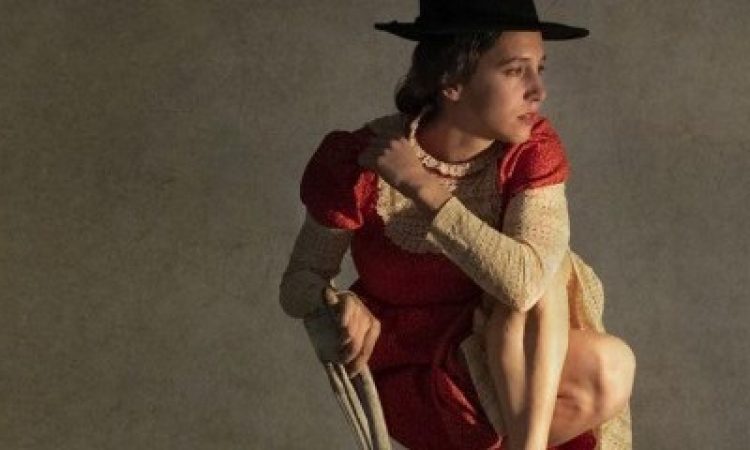
Evalina “Wally” Carbonell’s Apple begins as a mesmerizing duet with a chair. She grapples and clambers around it, eventually ascending it to pluck an apple. This act frees her from the chair and she whirls, unrestricted, occasionally spewing out bites of fruit.
Shayla Vie-Jenkins closes the evening withr e s t, set to a striking excerpt from Alexis Pauline Gumbs’ audio meditation Undrowned: Black Feminist Lessons from Marine Mammals. This solo, partially performed behind sheer black floor-to-ceiling fabric, spirals and unwinds, rises and drops, often feeling as much prayer as dance. It concludes with Shayla’s body, freed from the sheer fabric, slowly rolling away from the audience as she wraps herself in thicker black cloth before coming to rest. I wonder whether this is death or sleep, release or renewal.
This final solo offers an opportunity for the outdoor setting to support the choreography. Seeing Dream Chapters on a day with borderline dangerous winds, I am often distracted by how cold I am and how difficult it is to hear Tatyana Yassukovich’s poetry over the rushing air. But as Shayla moves, the wind works wonders on her hanging fabric. At one moment, it drifts suddenly backwards, allowing her to dive under and emerge for just a moment, face and body fully visible from its shroud. I gasp at the unexpected synchronization.
In a spring and summer that will likely see more outdoor performances, Dream Chapters reminds me of both the frustration and glory of this time. The producers hold to clear safety standards, keeping audiences distant and masked while performers are unmasked but at least the requisite twenty feet distant. While responsible, this made it hard to connect with dances that at another time might have been thirty feet closer to me. However, it also allows for moments like the wind working magic or a house manager running indoors to fetch a blanket for a family with a young child, saying, “I was asked to present this to you by Wally.”
We might all spend a summer sitting through the elements, sometimes unable to hear and craning our necks at distant performers, but I hope that we will also find moments to feel more like a community, to see each other’s ingenuity and care at work.
Dream Chapters, co-conceived and produced by Evalina “Wally” Carbonell and Weiwei Ma, Mt. Airy Waves, April 30-May 2.