The COVID pandemic and the police killings spurring the Black Lives Matter awakening have generated deep loss and grieving that sharpened our focus on the continuing inequities that result in suffering and its ultimate, death. This confluence is addressed in Remember Them , a site-specific work by Shayla-Vie Jenkins and curated by Katy Dammers in the performance series, On Buried Ground, and set within the Christ Church Burial Ground. It is a revelatory investigation of the racial history of the Burial Ground with goals of understanding and healing. It deserved many more than its two performances in the Fringe Festival.
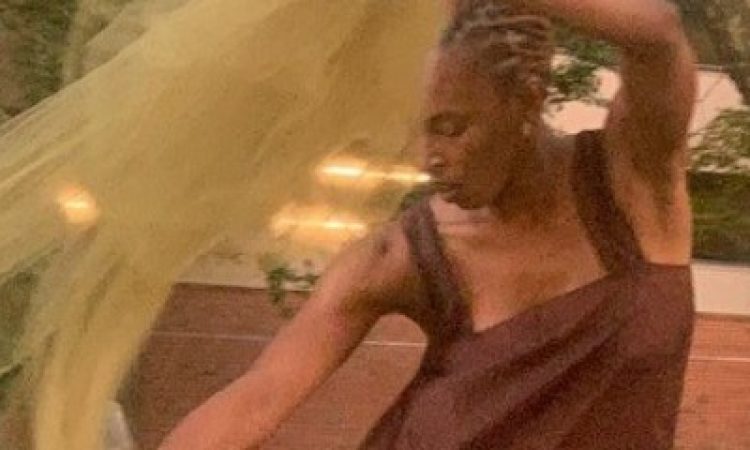
The Burial Ground, first Lenape then Quaker farmland, was on the outskirts of Philadelphia when built in 1719, and is now at 5th and Arch Streets. Upon entering, we see Jenkins seated in a majestic, stoic posture, contemplating the graves before her. Her slow unfolding arm gestures and soft circling of hands bespeak her meditation on the three centuries of history before her. Her gestures subtly transform into pointed emphases as we hear a recorded excerpt from Frederick Douglass’ historic abolitionist speech, What to the Slave is the Fourth of July? (1852). When he refers to our forefathers, Jenkins points down to the gravestone of Benjamin Franklin before her.
Jenkins, who performed with Bill. T. Jones/Arnie Zane Company from 2005-2016, learned that four African-Americans had been interred there in unmarked graves in the colonial period. After the audience moves to a second area among the gravestones, Jenkins, a fury of swirling circles, extends her leg as her foot carves a rounded space in the gravel for one of the four; she then lowers herself to the ground to draw the name of Violet Plumsteed in the gravel. (The program lists the others, William Richards, Charles Merchant and Sharpers, all recognized in Jenkins’ candle light ritual with the audience, and who will now be formally honored by Christ Church.) Jenkins gently asks, “Who to remember? Who to forget?”, noting that Black people in 19th C. Philadelphia could not be buried in public burial grounds and there were no lists of Black dead in the potter’s fields.
As the setting sun returns darkness to the cemetery, Jenkins rolls onto a dark, extended cloth enshrouding her body, marking its presence on the bare ground, and connecting us to the forgotten histories of these grounds.
On Buried Ground, Remember Them, Shayla-Vie Jenkins, Martha Chamberlain, Katy Dammers, Christ Church Burial Ground, Fringe Festival, Sept. 11. Emily Bate presented Welcome Home in the On Buried Ground performance series on Sept. 9.