“It’s just important everyone has the paperwork before we start.”
Mariana Valencia swings her arms and stretches, watching her audience closely as we pass around large sheets of paper. The papers have drawings of various figures in Mexican-American culture: El Astrólogo, La Reina, El Comediante. The paper only just gets to my hands when Valencia walks towards us.
“Everybody in this room has papers.”
An initiation, one of many. Valencia takes her time changing into a performance outfit. A stagehand paints her nails while she chats idly.
A rasquache beginning. Rasquache, Valencia tells us, is a “subversive, not completely legit attitude of adaptability and resourcefulness that is mindful of style.” She repeats the definition, as if expecting us to be taking notes.
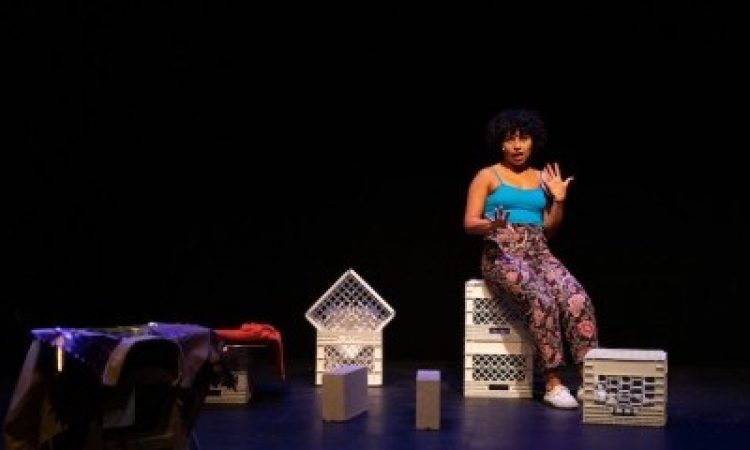
AIR, Valencia’s solo performance, balances neatly between rasquache energy and meticulously intentional performance. Fanning her nails, fingers spread, to dry them. Posing with one hip cocked, the dramatically tented fingers of one hand resting on the other arm. Every action and word is baked with layers of meaning.
Valencia is our confidante and, for those unfamiliar with Mexican-American culture, our fastidious guide. But we are never allowed to be voyeurs. Every time we hear Buenas Noches, spoken aloud or in an audio clip, we are instructed to respond, Buenas Noches.
Valencia becomes newscaster Edna Schmidt, a glass panel balanced on crates serving as a rasquache news desk. She tells us that Puerto Rican Schmidt would relax her hair for broadcast. But, Valencia says, “there’s nothing relaxed about me.” She puts a clip through her curls instead, transforming them into an 80s pouf. I laugh, relaxing at Valencia’s self-awareness. There’s a tension in her—jaw snapping shut after speaking, the poses of her choreography held perfectly still before she moves—that unnerves me.
“Buenas Noches,” says Edna Schmidt/Valencia.
“Buenas Noches,” we respond.
My words sound awkward, coming from a mouth unfamiliar with Spanish.
Valencia bookends the piece telling us about her first dances. We watch three-year-old Valencia dancing on El Club Del Niño on Chicago cable access television.
“What if, instead of putting kids in cages, we put kids on stages?”
After the applause, the audience goes silent. No one moves to get up or starts chatting. We all pick up our paperwork and begin reading.
AIR, Mariana Valencia, The Drake Theatre, Fringe Festival 2021, Sept. 17-18.