I arrive into the familiar Christ Church neighborhood space. It is dimly lit, and the static sound of a heavy bass pounds repeatedly in my ear, reverberating throughout. In his latest work, softly, as I leave you, Tommie-Waheed Evans is clearly setting the viewer up for a cathartic and interactive experience from the moment they enter. Being a Waheed Works alum myself, I know all too well how the performers must feel, preparing to perform the mastery of Evans’ choreography. Although I now am on the other side of the curtain, nerves imitate butterflies in my gut while energy is escalating and I have no idea what to expect, but I am so thrilled for the journey!
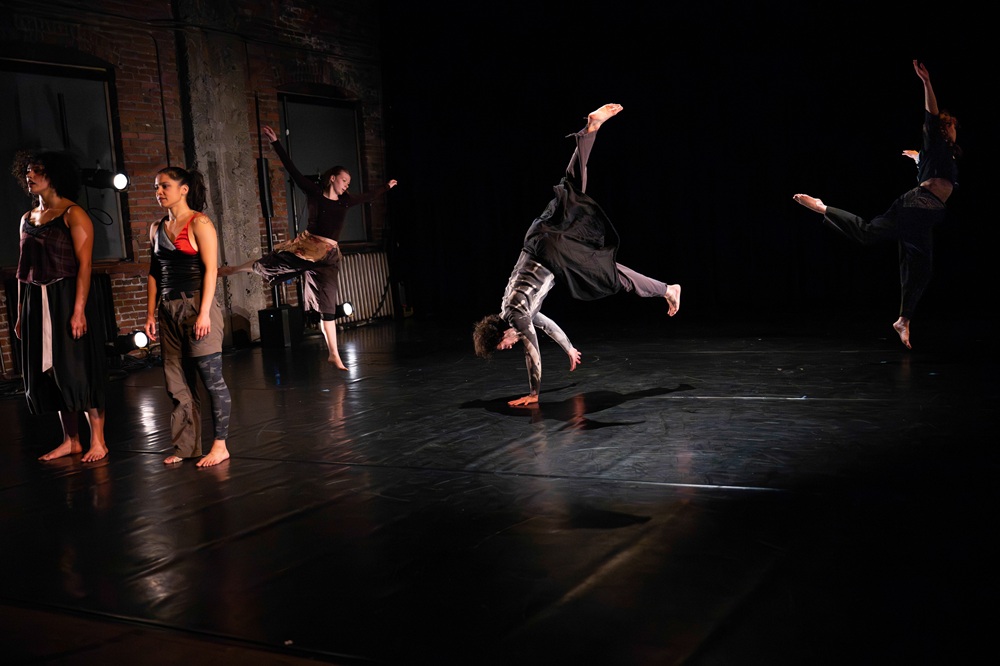
An acapella version of Anita Baker’s song Rapture begins to play with a soft echo. There is stillness in the audience as we listen and wait for the dancers to paint the blank canvas that is the stage. Blackout. Suddenly, a stunning group of seven are before us in a clump, moving slowly and minimally in unison. All at once I see togetherness as they move in sync, separateness in the broken gestures and collective breath in their stillness. The slow, sustained movement starts to battle razor-sharp precision. Baker’s voice returns, sounding warped like falling dominoes. Powerhouse Song Aziza Tucker breaks out in a sensual solo, toying back and forth with embracing herself and embracing nothingness. Da’ Von W. Doane then pierces the space with such delicious carving of the limbs, the movement is musculature and cerebral at the same time. The rest of the bodies weave in and out, on and off stage, rapid feet pulsating simultaneously. Going everywhere, going nowhere. I am beginning to detect the thematic pattern here, seeing relationships appear and dissolve because of the ongoing transition that is life.
The chaos is interrupted by a moment of reminiscing and calm covering the space. Shortly following is the first duet, which is aesthetically satisfying as I watch long arms and legs melding harmoniously. Abruptly, diagonal crossings interject with bodies traveling back and forth, similar to that of a mechanical machine. Repetitive, gestural arm movements are speaking frantically and helplessly. I am enthralled by a stunning duet between Leah Friedman and Doane, portraying utter trust, surrender, risk, as well as the sharing of physical and emotional weight. Whatever this narrative is, I am well invested.
The stage then welcomes back veteran Joe González along with Aliyah Clay, giving a solid performance. They share a moment of embrace so genuine, I felt as though I were between them. Baker’s voice returns yet again, so unrecognizable she sounds like a deep-spoken giant, singing in slow motion.The dancers begin physically translating Baker’s contorted voice, their bodies’ contortions matching her vocalizations . An unexpected breakthrough occurs with upbeat electronic music. I see celebration and triumph, with torsos contracting and reverberating, and feet stomping. I believe this is a moment of praise, of overcoming a love and a deep loss. However, all truly comes full circle in the closing chapter of the piece featuring González in a riveting solo. He is hugging air yet gasping for breath with his entire body. Arms are open, inviting us into his soul. The biggest highlight of the evening was watching González’s spine repeatedly contract so profusely that his tight bun violently unraveled into his long, flowy mane.The release of the hair itself was a visual exhale. We see the final emotional duet immediately follow, pairing González and the glorious Roderick Phifer. Intertwined yet emotionally disconnected, González softly leaves Phifer and I am left with a hard punch to the gut.
Softly, as I leave you embodies power in the silent storytelling. The story leaves room for interpretation and opens space inside the viewer for vulnerability to show up.
softly, as I leave you, Christ Church Neighborhood House, June 10-11, 2022.