It was a beautiful fall day to watch — and participate in — dance demonstrations and performances representing a variety of styles, cultures, and ages. What made it even more special was the setting, Grounds For Sculpture in Princeton.
The afternoon-long program, Day of Dance – Mud Baths was presented by The Outlet Dance Project. Choreographers were invited to immerse themselves in all things earth, soil, land, and clay. The first presentation was a family affair, with Ty “Dancing Wolf” Ellis, his wife, and children. In traditional Nanticoke Lenni-Lenape clothing, they not only danced but explained the traditions and meanings associated with each type of dance, such as healing and mating dances.
The dancers, including 80-year-old Chief Mark “Quiet Hawk” Gould, were accompanied by two drummers and rhythmic chanting. “The drum is the heartbeat of our people,” said Ellis. “There is no dancing without the drum.” I found it interesting that, during some powwows, the dancers not only compete with one another but also with the drummers, who try to trick them by stopping their drumming mid-dance, forcing the dancers to freeze in motion until the drumming resumes.
Following the demonstrations, the audience was encouraged to form a large circle and move around to the beat of the drums. I joined in and found a sense of community as part of the circle.
Those of us who faithfully went from one performance to the next were led through the sculpture garden by drummer Sukadeva Augustine, a veritable pied piper. He next led us to a performance of Carmelita, named for the serpentine Autin Wright sculpture that served as both backdrop and prop. Choreographer Maxine Steinman took the mud theme to heart, as the dancers — Oksana Horban, Columbine Macher, and Sierra Sanders — smeared themselves with mud, becoming one with the earth. Even their leotards and flowing pants were earth-tone shades of brown, rust, and burgundy. “Terra cotta” pots made of plastic became props, the dancers holding them, sitting, and standing on them.
While others may have been surprised by the dancers’ slathering of mud, I inadvertently got a sneak preview as I made my way to the first performance of the day. I happened upon the trio doing a not-quite-dress rehearsal, their street clothes splattered with mud. When I asked Steinman about the ages of the dancers, all equally lithe and limber, she said they represented three generations.
The dancers were accompanied by violinist Sana Nagano who was dwarfed by a larger-than-life sculpture of, what else, a couple dancing in the open area behind her. As the dancers emerged gracefully from the vegetation to the grass to mounds of dirt, a proud peacock strutted by in the background. Does art imitate life, or vice versa?
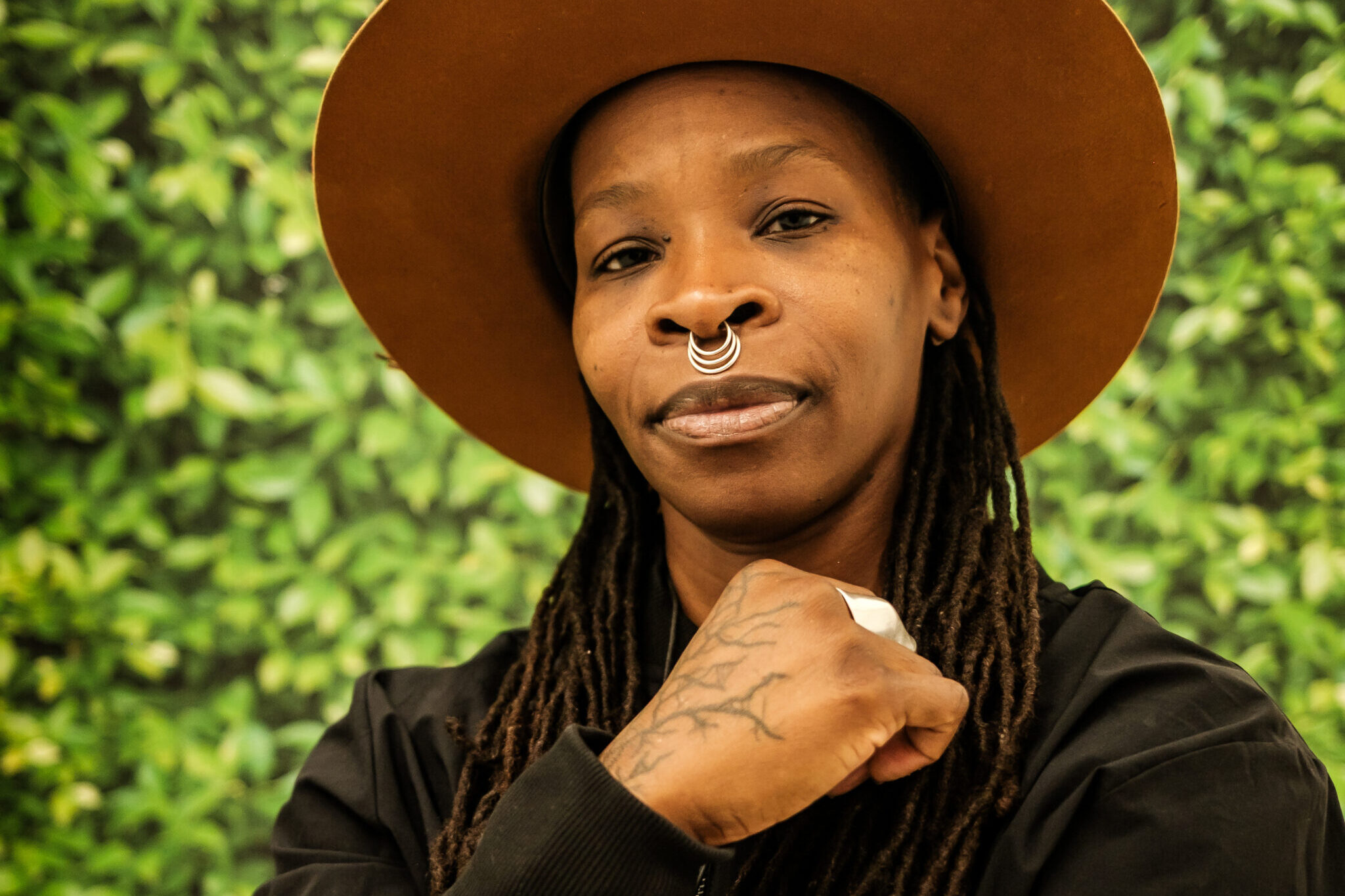
Next, we “traveled” to Cuba, by way of Nigeria, to see Elegua, performed and choreography by Cachet Ivey, a dancer with Kulu Mele African Dance & Drum Ensemble. It’s fitting that she danced next to the Matters of the Moment sculpture by Mike Gyampo, born in West Africa. The tradition of Elegua — an orisha, a spirit or force of nature — originated in Africa. Ivey’s interpretation, rooted in Cuban music and dance, was just as powerful. Clutching a scythe-shaped stick, she encouraged the audience to clap along and ended her performance with an audience-engaging call and response.
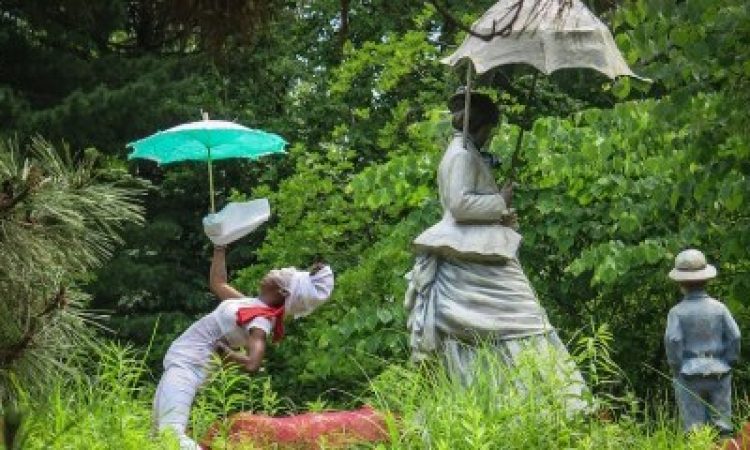
I was captivated by Yamini Kalluri’s performance, Bhoomi. She danced inside an umbrella-like Big Perception Plane sculpture by E. Calder Powell. Kalluri, a professional Kuchipudi dancer, is the founding director of the Kritya School of Dance in New York City. Kuchipudi is one of the nine classical Indian dance styles, known for its vigorous movements. Kalluri’s choreography was the epitome of grace, her bare feet moving delicately over the dirt. Her performance was part dance, part pantomime, and her expressive eyes hinted to the storyline. Like the dancers in Carmelita, she incorporated mud into her performance. Unlike those dancers, however, she cleansed her hands in a bowl of water afterward in view of the audience. I appreciated the gesture; after Carmelita, I felt as if I needed a good shower.
The last performance of the day was Hattie Mae Williams performing Minus 9 alongside Clifford Ward’s Tangent Warriors sculptures. Williams and Ward collaborated on the choreography, weaving in elements such as earth as well as their ancestors. Ward has said that the poses of dancers/choreographers including Roni Koresh and Rennie Harris have inspired him to create sculptures and paintings that “dance.”
Following the performances, my husband and I strolled around Grounds For Sculpture. As I looked at each installation, the curves and lines of the day’s dance movements swirled in my head, and I found similar shapes in the unmoving sculptures.
Mud Baths, The Outlet Dance Project, Grounds For Sculpture, Oct. 22.