There’s an ivy plant outside my bedroom window. From the outside, it snakes up the stucco exterior, crawling against gravity toward the sun. From my bed, it highlights the structural integrity of my apartment, and I find gratitude in the walls. They hold a structure that wraps me in warmth, softening me into a home.
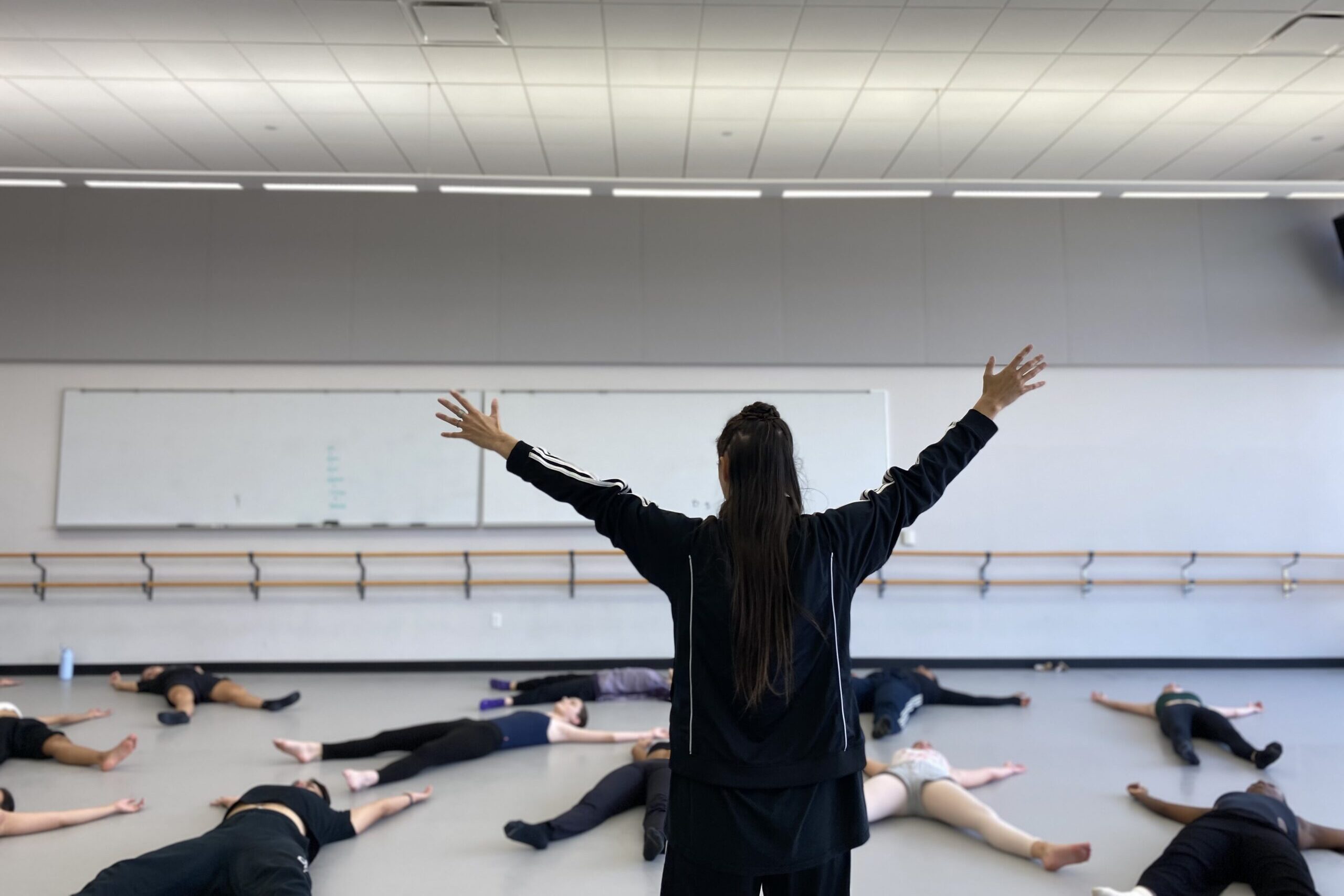
Nine dancers sit in a circle as the audience trickles in. Jungwoong Kim, director of Improvising Home, slowly begins to melt into the floor. He succumbs to the ground, as if it’s plush, and gently rolls toward the center of the circle. Kim reaches the knees of a dancer across the circle, who extends their arms, palms up, to gather him into their lap. He keeps rolling, vertically up the person’s torso, who holds steady as Kim maneuvers the best pathway upward. They wrap around each other. It’s an active embrace, magnetic even, as their individual efforts match and meet each other’s to become as entwined as possible.
The guitarist begins playing his strings with a violin bow as a second dancer rolls into the floor toward another’s lap. They are received much like Kim was, with strong, open hands that gather and curl up into an embrace. More dancers join the score, rolling and entwining, and I notice Kim start to disentangle himself from his partner. It all moves slowly, creating a world where each touch, breath, and glance have its own weight. As Kim rolls away, I’m captivated by the care present, from both people, in the departure. Couples continue to gather and send each other away, each entrance into and exit from embrace occurring with clarity, stability, and softness.
Kim walks out of the score and returns with a tape recorder. In a shaky voice, he hesitantly asks the audience to pass it around and say our name and “what you consider home.” As the audience nervously speaks into the device, Kim improvises a solo in which he paints the air with his limbs. At times it seems he’s interacting with objects, items that aren’t really there, that impact the way he jumps, jolts, and folds into himself. He moves with weightless security, softening into every place he touches on his body, on the floor, and on the wall. I wonder if there’s an imagined home he’s moving through, and I want to know, as he asked us, what he considers home.
Improvised duets and trios take the stage as dancers lift, hold, throw, and roll into each other. It’s clear these dancers have a familiarity with one another’s bodies, they’ve shared a contact improvisation practice that allows each vignette to tumble into the next with ease. There’s a bellowing song, a collage sculpture, and a scroll of paper. Red and long like a carpet, this paper is taped up so that it hangs from the wall, unraveling onto the floor. It’s as if the scroll climbed from the ground, growing up the wall.
The recorder returns to Kim, and he presses play, sharing our responses to his opening question. I hear “home is where there’s good people and good food” and “home, to me, is where my loved ones are.” A number of people simply state their neighborhood; “Center City,” “Powelton Village,” “around the corner,” and I laugh at these drier responses. As we listen, the ensemble returns to the rolling score, making their way from right to left, folding into the ground, pausing to receive, gather, and embrace one another. They make their way to the far left wall, one by one adding to a structure of bodies that climbs, like the ivy, like the paper, like the embrace, up the wall. The nine-person being reaches into vertical space and spills onto the floor, each dancer finding spaces to fit into one another.
In the days following, I found I wasn’t satisfied with my initial response to Kim’s query. I tried to make sense of the connections between the embraces, the scroll of red paper, the memory of my ivy, and the final body mass. The piece made me realize the qualities of home that work together to create a whole. There’s stability—whether felt in the stucco, a wall, or another person’s body—necessary to provide safety. When stability is present, a softening and unraveling is possible. The duet between stability and release, a partnership core to Improvising Home, is what I consider home.
This piece is one of a three-part 4th Friday Dance Series at Studio 34 in West Philadelphia. Catch the last showing, Shannon Brooks’ Psychic Highway, on March 24th, 2023 at 7:30pm.