I am sitting in the front row when I spot a lonely disco mirror ball perched on a wooden chair in a dimly lit corner of the stage. I wonder how the ball will illuminate the stage without the accompaniments of flashing lights and thumping bass music. However, I needn’t worry because in the experimental dance piece, Spiegel Spiegel, artist Madeline Shuron* breathes new life into the disco ball. Using the ball along with mirrors, movement, and vocal expressions, Shuron interrogates the constant gaze and reflection on the body and juxtaposes the self against a refraction of diverse identities.
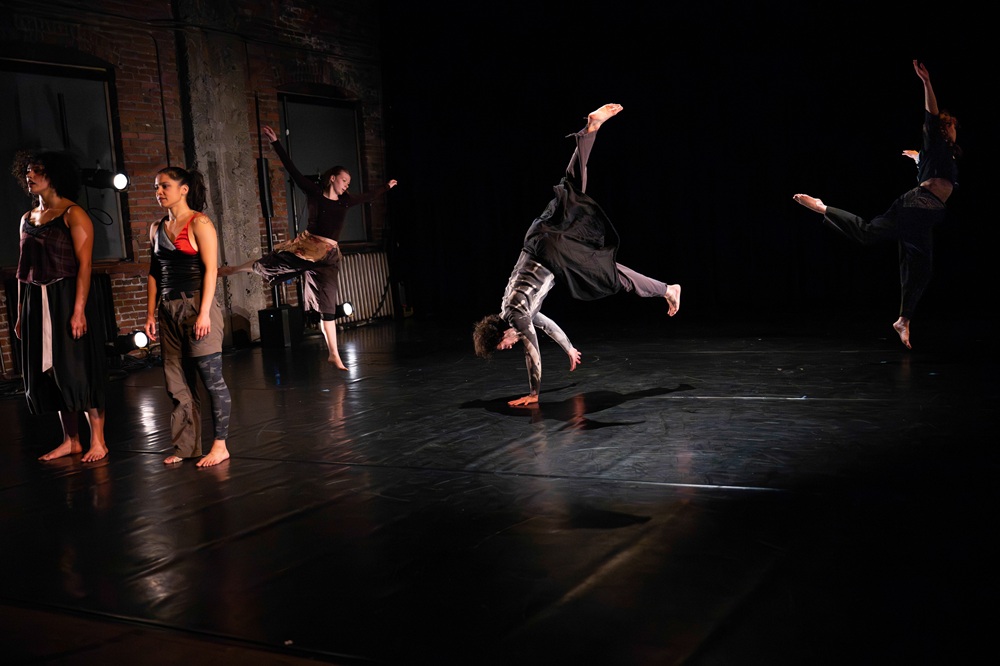
The 40-minute performance begins in silence, with six dancers clad in white T-shirts and blue jeans entering the stage one after another. As each dancer enters, they aggressively collide and knock their predecessors to the ground, then continue with a mechanical arm swirl and tilt of the body. When the live environmental music, performed by Susanna Payne-Passmore begins, the dancers explore a circling arm movement that transitions to individualized improvisations where a fluid turn, a powerful lunge, and a playful floor roll are dynamic reactions to the circling hand momentum. In response to a simulated crowding of bodies onstage, the dancers repeat utterances of “sorry” and “excuse me.” These moments, coupled with the dancer Nadia Ureña’s emotional monologue and Payne-Passmore’s environmental music and soaring vocals, facilitate a hypnotic resonance, which allows the audience to collectively join in an ecstasy of self-reflection.
As Payne-Passmore’s haunting humming crescendos, the dancers intensify their exploration of the multiple selves by mimicking and echoing each other. They point their fingers toward the corners and place their trembling hands on their faces, conveying anxiety and fear to the many selves they see. Yet they are also apathetic when, during synchronized face-to-face moments, their facial expressions are unresponsive and blank. Near the end of the performance, a dancer picks up the disco ball from the chair and slowly spins it in her hands, and a beam of light momentarily blinds me through the reflection of a facet of the mirror ball. In that fleeting moment, I find myself transported to the other side of the mirror, becoming both an observer and a performer who reflexively connects with the dancers on stage. Thanks to the dancers’ brilliant performances and the musician’s harmonious live music, Shuron’s choreography transforms the German word “Spiegel” into a corporeal and aural experience.
*Madeline Shuron is a writer with thINKingDANCE.
Spiegel Spiegel, Madeline Shuron, The Fidget Space, Cannonball Festival, Philly Fringe Festival, Sept. 3 & 7, 2023.