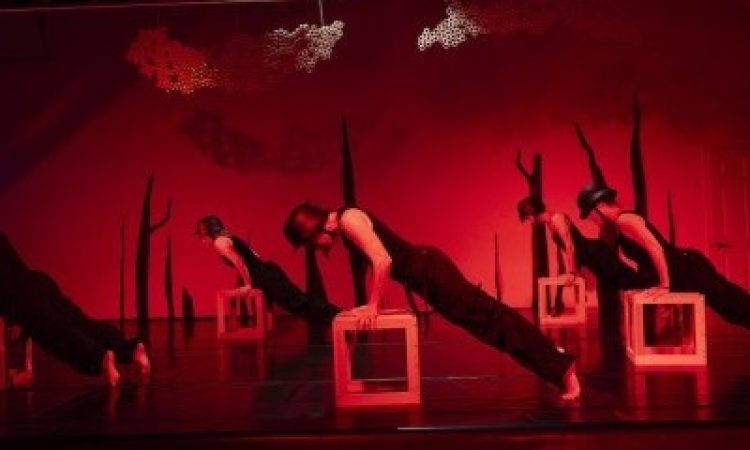
all quiet on the western front, produced by Humble Materials, began with five dancers, clad in black at the edge of the padded platform stage at Philly PACK. the stage was minimally dressed, the only set pieces being a few wooden cage-like blocks to the side, a clothesline fully stocked, and five battle bowlers (hats) at the foot of the stage. we are on the frontlines in France, each soldier we meet a German boy between the ages of about 13-17.
through the piece, we come in and out of the perspective of the central five boys and that of their mothers. the same five dancers represent both the child/mother throughout the piece. from the boys’ perspective, there is an innocence as they talk about war, questioning why common folk like them must fight other common folk in a war started by the emperor. the dialogue is slightly awkward, feeling as though it fell short of its intention. the sincerity of the actors strengthens the piece, but i still found myself confused at the syntax, and often wondering about how/if the piece is in conversation with the landscape of war and violence today. it almost doesn’t withstand the test of time, as it centers whiteness and heterosexuality, lacking a nuance that could connect it to the resurgence and consistency of violence that we have been witnessing in Gaza, and within American politics and community organization since the 2016 Black Lives Matter protests surged.
the camaraderie formed by what can be surmised as trauma bonds between the boys, strengthens and evolves as the they experience murder, bloodshed, and the deaths of their brothers on the battlefield. a standout moment of the performance features the boys revering a poster of a nearly naked woman, as one of them physicalizes sexual gyration, likening it to diving into the ground as they do in the trenches. the authenticity of this exploration of sex, violence, and inexperience, was a highlight. the chemistry of the actors sustains the piece, but a slight lack of destination for the story harms the pacing of the show. this coupled with dredging transitions, often took me out of their world. the lighting design was another highlight of the performance, with a sequence of the night sky in blues, greens, reds, and pinks, being my favorite picture.
throughout the performance, i was hoping for more connection between the generations as opposed to only their contracting natures. i did feel the foundation was very clear, and understood the relationship between the generations was a large piece of the conversation. though, through a mistake of my own, i excitedly deduced that once the boys died, they became their mother. this happened with the first two deaths, and then the pattern ceased, which caused me to realize my interpretation was not quite what the performers intended. the theatre was anything but quiet however, as upon the final blackout, the audience erupted in cheers.
all quiet on the western front, Humble Materials, Philly PACK, Sept. 19-21.
Homepage Image Description: A group of dancers wearing all black with old-fashioned wartime helmets pile over one another, leaning onto each other with eyes tensely closed. A red light encapsulates the space, as large black spikes climb upwards along the back wall.
Article Image Description: A group of dancers wearing all black, with old-fashioned wartime helmets assume a slanted plank position with arms leaning into wooden cubes. A red light encapsulates the space, as large black spikes climb upwards along the back wall and two permeable sculptures are hung from the ceiling.