Pure Lucia: Quidditas Suchness, curated by Dustin Hurt’s Bowerbird, is one of eight events in a series highlighting the legacy of composer Lucia Dlugoszewski (1925 – 2000). Dlugoszewski’s experimental and inventive approach to musicianship, and her affinity for turning the mundane material world into her sonic playground, was honored at the FringeArts stage over a two night series.
In addition to performances of Dlugoszewski’s scores, the Erick Hawkins Dance Company stages two original choreographies by Hawkins (1909-1994), Dlugoszewski’s husband and long-time music collaborator who became the company’s artistic director after his death. Combining the significance of body language with the dance technique in his choreography, Hawkins’ take on modern dance is a pleasure to watch.
Here and Now with Watchers (1957) is a tender and somber duet personifying two birds, “love birds” perhaps. Entering the stage from opposite curtains, dancers (Jason Hortin and Hayley Meier) appear with presence, stomping a foot on the marley as if to call attention to their arrival. Their dance offers a grounded, indulgent movement repertoire and embraces a slow, leisurely quality.
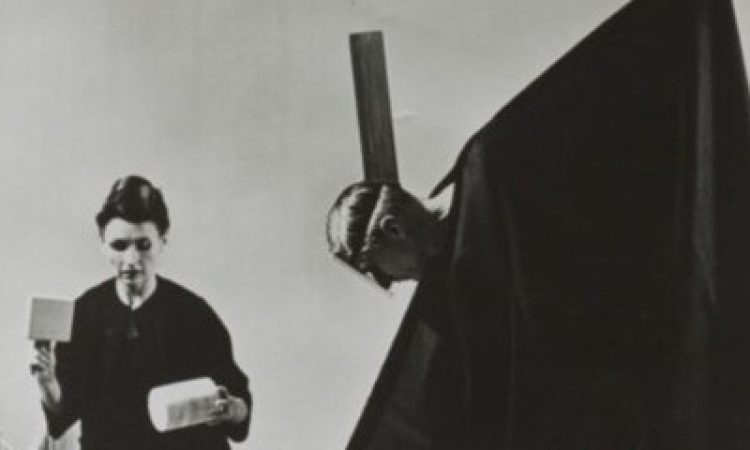
Initially, I wonder if the leisurely pace of the choreography is crafted this way in order to exhibit the dancers’ attire. Their eye-catching costumes suggest the skeletal wingspan of a bird with its fence-like structure that also has the likeness of a xylophone. The performers carry the wings in front of their chests which require their upper body-half to move as one unit. Black fabric streamers hang to the floor from the winged framework, catching wind in correspondence with the dancers’ movement. Their feet mostly remain in close contact with the floor, using bent knees, forced arch, and sweeping rond de jambes or tendus in their travel across the stage. The occasional developé and attitude are attention-grabbing, as they oppose the dancers’ primarily grounded stature, and replace it with balance and flexibility that appears effortless.
After disappearing off-stage momentarily, dancers return wingless, in white leotards. They never stray from their leisurely pace. The work remains compelling and engaging in its simplicity and intentionality, without a change of pace or sense of urgency. The dancers each maintain a firm stature that gradually dissolves throughout the work as they explore their connection. Their posture reads vigilant with upper bodies held tall and erect, with head and neck swiveling toward the direction they’re heading. Their arms stretch wide to either side in place of the wings they left backstage.
Rather than flaunting technique and dynamics in the movement phrasework, the form lives in the feeling – the dancer’s presence, attention, and timing tell a story. The duet’s relational and tender aspect captures a sense of curiosity, communicated through subtle shifts in posture, gaze, and eventually touch. Through the stage’s spectacle, the audience witnesses the evolution of feeling and vulnerability in performers’ rapport-building. The deep rumbling of the timbre piano, performed here by Agnese Toniutti, dramatizes the mood.
Variations in the dancers’ proximity also impact the storytelling. Their focus alternates between one another then back to self, exhibiting intrigue, a guarded hesitation, and eventually surrender. Initially they share space only at a distance, joining in synchronous movement motifs, then differentiating again to engage in their own dances. The next time they synchronize, the space between them shrinks. This continues. Soon, they’re touching. When Hinton’s fingertips lightly trace Meier’s extended forearm, carefully, timidly – Hinton’s soft, indulgent touch ends suddenly, with a quick push of rejection. Instantly, both dancers escape in opposite directions.
The dancers reconnect as they walk downstage side by side, shoulders touching, and feet tracing semi-circles on the floor that land toe to toe. They make picturesque poses that fit together like a puzzle, and begin to share weight, relying on one another for balance and stability, or rest. Hawkins’ dance creates a language of subtleties, inviting viewers to sense the dancers’ emotions through the movement narrative brought to form so eloquently by Meier and Hortin.
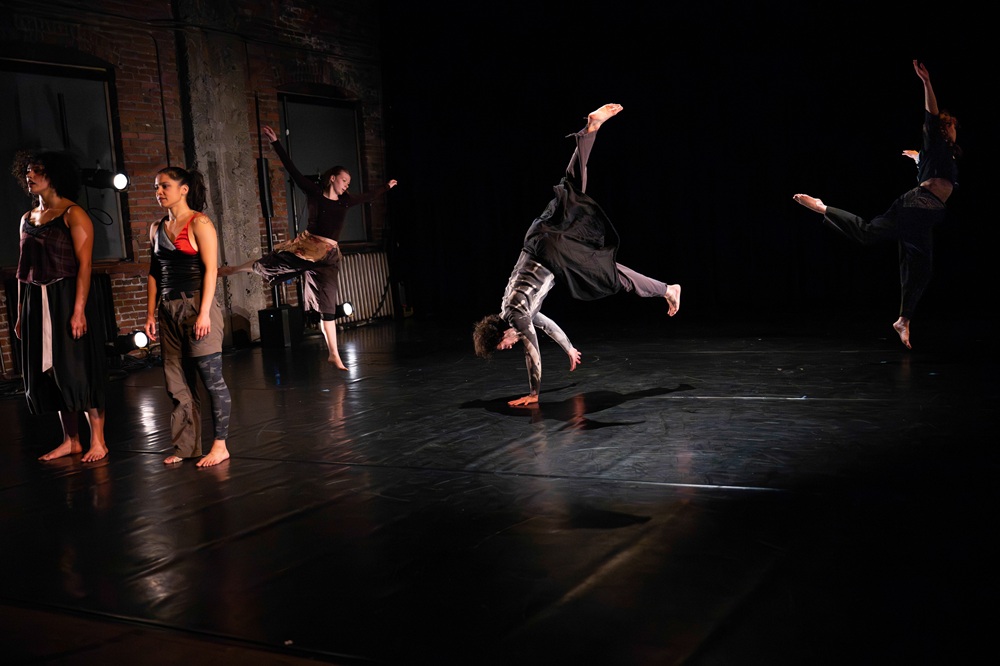
Cantilever (1963) is a shift into an energetic activation, contrasting the former dance in tempo and temperament. Featuring four dancers (Hortin, Meier, JR Gooseberry, and Halie Landers) the work is an adventurous show of technical skill and strength. Starring powerful leaps and impressive demonstrations of flexibility and balance, the ensemble cycles through solos, duets and trios. This lively number is performed in brightly colored leotards to Toniutti’s solo piano. Abstract in design, Cantilever takes on a lighthearted decorum that seals the evening length program with an upbeat assertion.
Pure Lucia: Quidditas Suchness, Bowerbird, FringeArts, May 9-10.