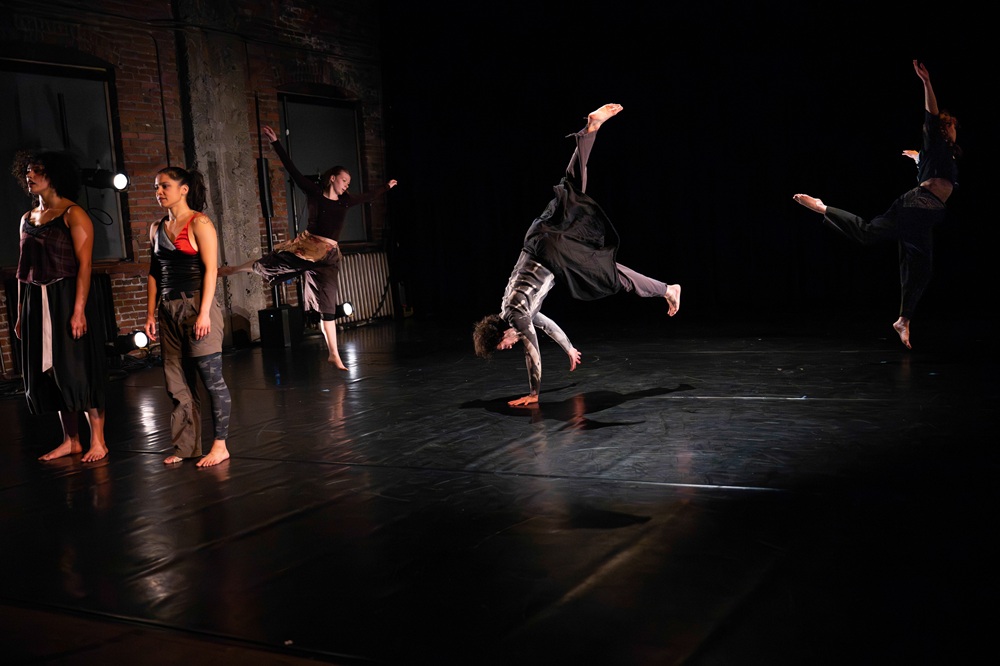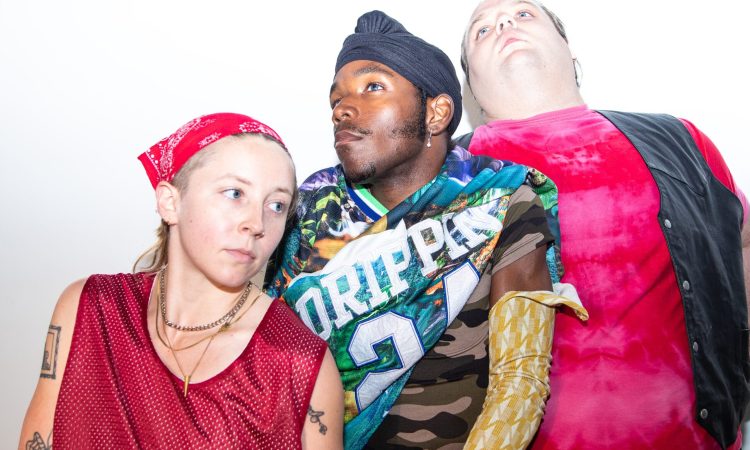
There is a table in the center of the open installation when I walk in and on it are beads, ribbons, and string. These are materials intended to construct friendship bracelets that signal to the performers—Annie Peterson, Loren Groenendaal, Vitche-Boul Ra, and Zeze Schorsch—which audience members would be open to being included to any participation. I am lousy at knots so my bracelet shatters as the dancers invite us to pull our own trigger and it feels ironically metaphoric. Still my consented role is understood as Loren Groenendaal, one of the four performers, immediately pulls me onstage for a show opening contact improv duet. It is a quiet duet for us at first, our arms pushing and pulling each other away and towards and we wrestle with our comfort, opening and moving in silence. Slowly we find a flow and suddenly we are running. Soon the three other performers invite more viewers into the space; immediately making the room, the city, and the playground warm and inviting.
The piece felt accessible; though I had no idea what would happen when the rehearsed would invite me to play yet I also always knew what options I had and where I could go. The rehearsed danced together and apart throughout the space and the invited were able to sit, stand, and lay wherever preferred. The rehearsed handed us flashlights while the invited chose what to shine a light on. There was a moment towards the end of our play where all of the consenting invited stood in a single line parallel across the entire space. We, with hands clasped, played with pushing and pulling and eventually managed play of our own without direct guidance of the rehearsed.
We Pull The Trigger does not promise identical looking shows; instead its use of improvisation and play invites us to create, observe, and interact despite not always knowing. Process rather than production. Wouldn’t you like to play?
We Pull The Trigger, Adam Kerbel + Performa, Asian Arts Initiative Third Floor, September 6-18.
Correction: This article, originally published September 6, 2025 was updated on November 7, 2025 to include the names of all company artists and collaborator Gene Farbe. Both the thumbnail and feature images were replaced with an updated, high quality image provided by Adam Kerbel.