Early on in Free to Be, Katherine Kiefer Stark asks the audience if she’s nice. Why would she not be nice if she has everything she needs and everyone is nice to her? A classic white woman dilemma. She then muses that no one who has written about her work has ever called it white, though she’s always been white. Funny, because when I see Stark in a matching beige outfit, unpacking a blue suitcase with some generic, (un)identifiably white music playing in the background, asking these sorts of questions, I can’t help but think–this show is going to be some white people shit. And it is. Intentionally so. To her credit, I don’t mind at all.
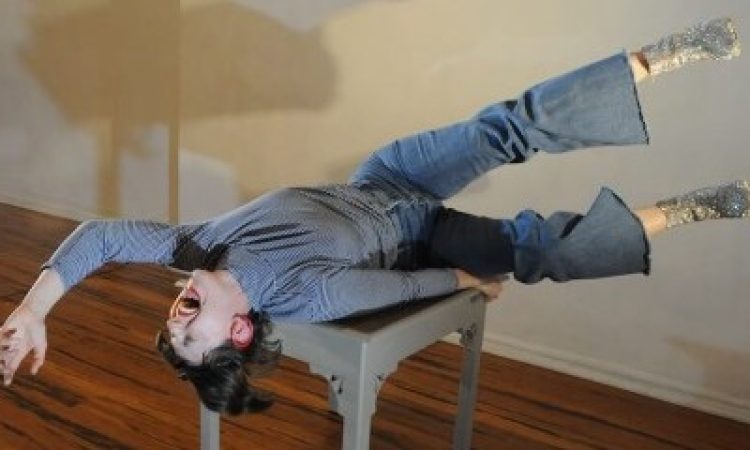
Free to Be is divided into three sections, titled something like White and Jewish, Mental Gymnastics, and Nationalism. Each section is built with profundity and parody, storytelling and lipsync, tension and release. The work shines when Stark details her mundane, but complicated, internal conflicts as a white, Jewish woman using legible, yet poetic verbal and physical language. A moving example: Stark sits cross-legged, weight centered on a small wooden coffee table painted silver. The tabletop has room for one, maybe two, to sit comfortably. Fist pumping, she performs protest with loud cries of “Hey (hey), Ho (ho), the gentrifiers have got to go.” As she chants, with great effort, she tries to lift and shift the table’s legs. She says she wants to shift the system. Yet, the table doesn’t budge. No matter her intentions, unless she gives up her seat at the table, it won’t.
Linking topics like privilege, specialness, oppression, white supremacy, and ethnonationalism to her own Jewishness, Stark’s work brings up opportunities for meaningful reflections and (dis)identifications for white and/or Jewish audiences. My only qualm is that she could have said more, directly. Specifically, there is a note to parents with kids younger than 13 on the Fringe website regarding some emotionally-heavy content, including the topic of genocide. While echoes of the Israeli/American genocide in Palestine are present throughout the piece–a drawing of the US flag is made into an Iron dome, Christian and Jewish nationalisms are mentioned–genocide is never overtly spoken about. The elephant in the room stays in the shadows, nicely.
Stark says her stories are not special, but in the present US, with her set of identities, any public performance about these themes is special. So, when Free to Be chooses to stay nice, I want it to instead rightfully deserve its specialness by vocally, overtly challenging oppressive ideologies. Using her logic, why just do a “nice” performance…when you have everything you need and everyone is nice to you?
Free to Be, Katherine Kiefer Stark, Louis Bluver Theatre at The Drake, September 24.