After a decades long friendship, award-winning Japanese interdisciplinary movement artist Eiko Otake and Chinese Dance-Theater pioneer Wen Hui began their first collaboration, What is War (2025). The performance, which unravels collective memories of war and its aftermath, draws from Otake and Wen Hui’s own embodied histories of the Second World War. I sat down with both women as they unspooled their complex relationships to the physical and emotional residues of wartime memories.
This is an excerpt of our full conversation.
ankita sharma: How did What is War start?
Wen Hui: Personally, the project started when Eiko was in Beijing giving a lecture. For me, Eiko was the first Japanese person around me to talk about the Second World War. Her first words were an apology – for when Japan occupied China. Then, she talked about her father’s story.
Eiko Otake: My father’s story is one of many things we shared with each other. Wen Hui said “if we are to fully collaborate, let’s make a piece that I could only want to do with you.” So, the history between China and Japan became an important part of it.
I was born in 1952. That year, the American occupation in Japan ended. I grew up learning about the Second World War from those who experienced it. I absorbed anti-war sentiment from every teacher, book, and film I felt was important. My father also basically lied to get discharged from the military. I come from that kind of family. That doesn’t mean my family members were heroes, but it means that society was not totally for the war. Unlike what films and media may show, civilians had a different feeling in their bodies.
Around 3 million Japanese people died in WWII. Since the Second World War, however, Japan has not gone through another comparable catastrophe. China, on the other hand, has gone through so many things – the Communist Revolution, the Great Chinese Famine, and the Cultural Revolution. In many ways, I am closer to WWII than Wen Hui is. Yet, I was shocked to hear that until my visit, Wen Hui did not know that her grandma had died in a Japanese air attack on her hometown.
WH: Yes, I only learned that while staying with my mom for five months during the COVID shutdown. I’m rarely at home. While there, I asked my mom questions about family history. My mom was only 5 years old when my grandmother died. Both me and Eiko have strong family stories about World War II. Learning that shook my heart.
as: Do you feel responsible for keeping these histories of war alive?
EO: Kyoko Hayashi, the writer and Nagasaki Atomic bomb survivor, my friend, is dead. When anti-nuclear people like her were alive, many of them worked hard to share their experience. But now, she, Kenzaburo Oe, and my parents, uncles, and aunts are all dead. I have become keenly aware of how I remember their voices. Listening to them was my personal experience. With this performance, I hope the audience will hear us and listening will become their own experience.
as: What lessons are you hoping the audience will hear?
WH: We started What is War in 2020. Since then, more wars have started. Though our physical distance from war may vary, war is in front of all of us. Everyday, on Instagram, you see war. You can close your eyes, but you cannot stop thinking about it. We want to explore these feelings.
EO: Yes, in Gaza, Trump is trying to make himself a hero by having this ceasefire, but the animosity doesn’t end when the bombings stop. People who live there can’t forget what has happened. Children saw their friends killed. Adults saw their children killed. There’s famine. There’s so much to work out in memory, justice, human rights, lives lost.
WH: It’s in our body’s memory. We’re not in a new body – you are from your parents, your grandparents. You remember connections to their bodies in yours.
as: How do these ideas show up in your teaching practice?
EO: Old people often say young people don’t know things, but young people know about digital things more than us. As an artist-teacher, I feel it’s older people’s responsibility to pass on episodic knowledge and analogue thinking. You need both to navigate the world, think philosophically, evaluate how people live, make decisions, and act.
In a college class Wen Hui and I were co-teaching, we had students create a book for young children, asking “what do you want to tell people younger than you?” It changed “oh you are 20 years old, you have to study” to “oh you are 20 years old, what do you want to share with a 5 year old?” We cultivated our desire to share with younger people what one thinks is important.
as: A strong piece of history in the work is the story of Comfort Women – women forced into sexual slavery by the Japanese military. How did you capture their stories?
WH: We chose to visit the memorial site of the Nanjing Comfort Women’s House. We wanted to dig into those women’s stories in this piece. Not too many people tell us stories about women in World War II. Most stories about war heroes were about men.
EO: One of my friends devoted her entire life to this issue. She went to China and many other countries Japan had occupied and assaulted. Comfort houses were a huge system that the Japanese government and military had made.
WH: In rehearsal, we put out a sculpture of Comfort Women with videos of Nanjing. We improvised. Eiko walked in and took off her clothes. That moment for me was just…wow. I was quiet. I really felt what’s in Eiko’s body. It was not a performance. It was a real feeling.
EO: I hope Japan will change so that we can bring this piece to Japan. In America, we cannot be naked on the streets. In Japan, you cannot be naked in the theater. Becoming naked is important for this piece.
as: What makes working feel important right now, after such long careers?
WH: It’s important to try and speak deeply to people and society. It doesn’t matter how – film, theater, dance, installation – it’s necessary to say what’s important for me.
EO: I love working. There is always at least one person in the audience that will respond to what Wen Hui or I do. I work for that one person. Since each person responds differently, I can’t work for 100 people. I don’t often adjust things to my audience. I just work, and I hope people won’t regret coming. Given how the world is right now, I could get depressed if I didn’t work hard. Working makes me think deeply. I hope I do not look away.
This conversation reminds me of the quiet necessity of this work – preserving lessons from artists before they fade, passing wisdom forward. Years ago, when Eiko was my professor, I learned that we all share a collective responsibility to offer possibilities to future generations. In Eiko and Wen-Hui’s voices, possibilities bloom as generations fold into themself, time holding still. I hope time holds their words for as long as possible.
Eiko Otake & Wen Hui perform What is War at BAM from October 21-25.
Homepage Image Description: Tender and frail. Eiko Otake, a slender, elderly Japanese woman dressed in a crumpled white gown, brow furrowed, worriedly looks at the ground in front of her. With bent limbs, elbows prominent, she clutches a woman familiar to her close to her body. Dressed in a lightly pinstriped red blouse with steel-colored trousers, this woman, Wen Hui, leans to the ground, gazing down at the edge of her fingertips.
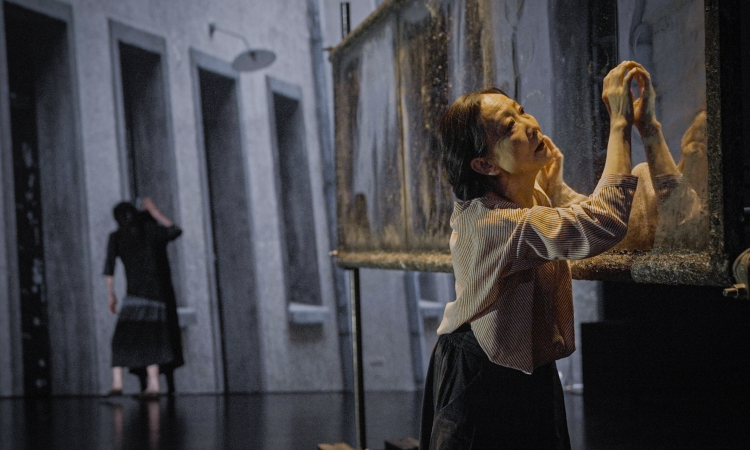
Article Page Image Description: A Chinese woman, Wen Hui, stands in a grey, concrete room with three long vertical doorways. A figure dressed in black, whose back is turned to the camera, in the background. She gently touches an old, heavy, rust-encrusted horizontal mirror, dusty from time, hanging in the air. Warm light shines on her face, a worn down curiosity in her expression.