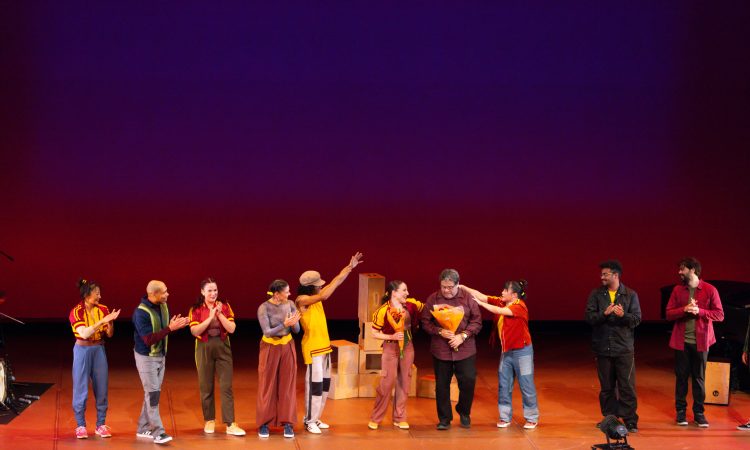
A dim pool of light slowly awakens center stage, revealing dancers Manon Bal and Dorren “Mogli” Smith seated atop a stack of several small wooden boxes. Stoic yet brimming with potential energy, they charge the room with anticipation. A piano rests downstage left, a drum kit mirrored on the right, as if the instruments had been in quiet dialogue long before audiences arrived. Still seated on the boxes, Bal and Smith begin to move in silence—carefully, deliberately—intertwining their bodies in shapes that emerge, weave, collide, dissolve, and resurface. Moments later, Grammy-winning jazz musician and composer Arturo O’Farrill enters from downstage left, breaking the fourth wall with a gracious bow and a warm smile. With the first notes of his original composition, the collaborative vision of O’Farrill’s ensemble, Kathy Kaufmann’s lighting, and Ephrat Asherie’s direction ignites, allowing Shadow Cities to unfold.
The unfold is delicate, intricate, and brings a cascade of unexpected pleasures. Shadow Cities showcases artistic director and choreographer Ephrat Asherie’s gift for interdisciplinary storytelling, grounded in African Diasporic traditions such as call-and-response, polyrhythm, and polycentricity. The work refuses a central protagonist. Instead, its hero is the intentionally unintentional—the spontaneous joy sparked when a dancer riffs off a musician, a musician responds to a dancer’s impulse, or a performer redirects a beam of light to animate a shadow and expand the narrative world with moveable spotlights that could be transported manually across the stage floor.
In this way, the lighting itself becomes a performer. Kaufmann’s design sharpens the audience’s attention to the work’s intricate textures and seamless transitions: clean diagonals guiding performers’ entrances and exits, shifting pools of light that appear and vanish directing audiences’ view, and rectangular washes of colored light projected onto the cyclorama that frame how we are invited to read the performance space.
Shadow Cities becomes a container for many interpretations of what it means to occupy an “in-between.” The recurring motif of dancers moving dynamically and rhythmically in silence introduces a fragmentation, a pause infused with the sound of pitter-pattering shoes on the stage floor that complicates the otherwise continuous interplay of live music, motion, and theatrical structure. Upstage center, dancer Valerie “Ms. Vee” Ho gestures fervently with outstretched arms between piano and drums before launching into a spirited duet with flutist Alfredo Colon. The performers trade playful provocations in a lively call-and-response, their movements marked by fleeting gestures and a nimble lightness—like slipping down a windy city sidewalk. The result reads as an embodied meditation on liminality, as though both performers are enacting the betweenness of leaving one location and arriving at another. Betweenness also emerges as Hip Hop and Club dance vernaculars collide throughout the work: dynamic Breakin’ floorwork rubs up against the upright, partnered motion of the Hustle, the social dance of New York City; House footwork-rhythms slip in alongside West Coast forms like locking, waacking, Toyman, and the Fresno. The swift melting pot of several vernacular dance traditions renders the stage a dynamic melting pot of movement histories. These fleeting appearances resist easy tracing and never fully settle before moving onto something else, mirroring both the improvisational unpredictability of a jazz ensemble and the layered complexity of diasporic social dance lineages.
Roles are fluid. Dancers become musicians, drumming on the boxes or introducing new instruments; musicians become dancers, moving through improvised and choreographed exchanges. The boundaries between mover and music-maker blur in the complex narrative, prompting the audience to reconsider the identities themselves and the histories behind them.
The collaboration between Asherie and O’Farrill evokes a living Jackson Pollock canvas: sound, light, social dance, costume, and architecture drip, weave, and collide across the stage, layered, textured, and cohesive. A memorable moment occurs as dancers gather upstage left around the piano, evocative of an underground jazz club. The lighting dims, making the music the star, shaping the atmosphere as the dancers exchange glances in a shared, suspended groove. Their expressions carry an easy warmth, an appreciation for one another that feels like a prologue. The moment infuses the performance with a palpable and reflective sense of history. For the final image, a single moving light arrives in front of the mobile boxes—objects that have served countless practical roles throughout the piece—suddenly transforming their shadows into a proud city skyline, eliciting a soft murmur beside me: “It’s the Philadelphia skyline!” I am left wondering which skyline other audiences might see, and what stories they will bring to that moment of recognition.