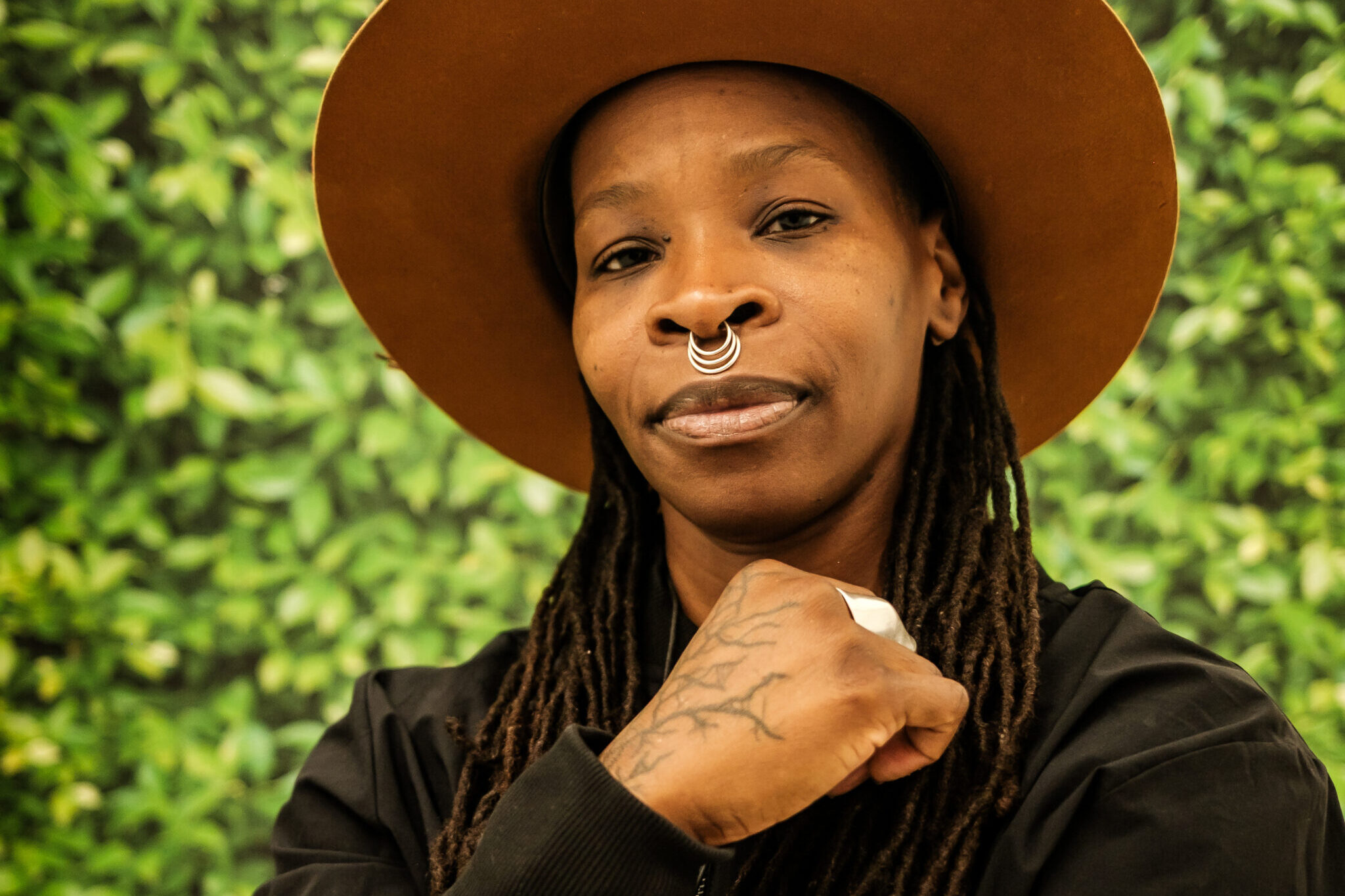
While volunteering for the Center for Jewish Nonviolence between 2016 and 2019, Philly-based dancer, choreographer, and educator Ella-Gabriel Mason visited the West Bank with the purpose of “supporting Palestinian non-violent direct action and community support projects.” Now, a decade later, Mason’s project“Dancing Collective Power” draws from those experiences in Palestine to explore how dance improvisation can train the body for collective protest.
A dance maker and budding social organizer myself, I was thrilled to sit down with Mason to talk about “Dancing Collective Power” and the crossover between dance, direct protest actions, and activism. An excerpt of our conversation, edited for brevity and clarity, appears below.
Zoe Farnsworth: What was your inspiration for the “Dancing Collective Power” project?
Ella-Gabriel Mason: I was helping to run nonviolent direct action training for volunteers, a majority of us white Jews, who had been recruited by the Center for Jewish Nonviolence to travel to Palestine to support actions led by our Palestinian comrades.
During the training series, we set volunteers, including ourselves, up for the expectation that, once in Palestine and involved in direct actions, we would at the very least get pushed around, and some of us might be arrested or deported. We wanted to prepare to deal with harassment from settlers and possible harassment or brutality from the Israeli military in their civil administration capacity.
In those training sessions, we taught people how to work with their bodies and collaborate together in high stress situations. I noticed that the skills we developed in training and the simulated heightened stress felt parallel to dance improvisation skills and performance settings. Performances generate stress, and group dance improvisation requires navigating collective decision making with your body. However, it’s a really different context, different stakes, right?
And still, direct actions felt connected to improvisation and performance: the nervous system activation, the skills required to ground the body, to make smart physical choices, and to coordinate with other people. This line of thought inspired questions about how to use my body to both feel powerful and communicate the message as well as be as safe as possible from my end during an action. After coming back from Palestine, it became clear that applying these skills and stress activations in a safer setting, like a dance improvisation class or performance, could be a potentially useful training method for non violent direct actions.
ZF: How have you experienced grounding in the body, making smart physical choices, coordinating with people, and using the body to communicate a message in a direct action?
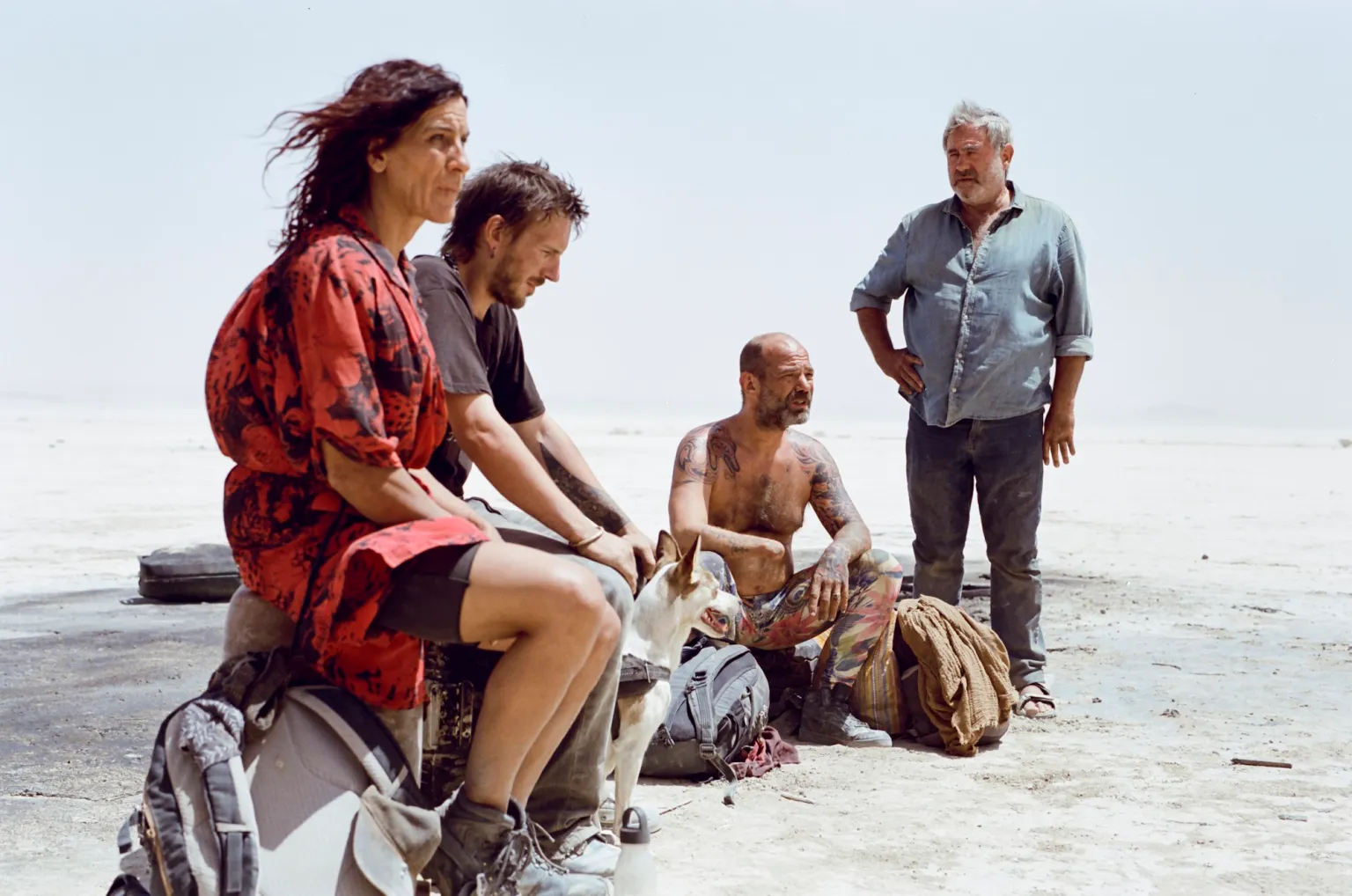
EGM: Our cohort of volunteers was with a West Bank community repairing a dirt road by filling potholes with gravel. As still happens frequently with a Palestinian-led community project in the West Bank, the Israeli military came to shut it down.
The military said, “This is illegal building. You all need to leave.” Since arrest posed a significant danger to the Palestinian activists, we had already planned for them to head out once the Israeli military came. Then the international activists, many of us white and Jewish, would exercise our privilege and hold down the space and risk arrest.
ZF: What happened next?
EGM: A couple of Palestinian activists didn’t want to leave. They said, “It feels really bad to flee right now.” Staying was a huge risk for them, which they knew going in. One said that during this moment, he thought “Maybe I’ll get out in six weeks. Maybe I’ll get out in four months.” Normally with a mix of international support activists and Palestinians, the military will focus on grabbing the Palestinians. As the military closed in, they started to single out one Palestinian activist. Some international activists saw this and grabbed hands to form a circular chain around the Palestinian activist, separating him from the military. Sitting down together in a dense tangle of limbs, the group made a solo arrest unviable, which was great. So everyone got arrested together, making it much easier for our legal team to track us. The Palestinian was released that night.
And so I saw there a smart improvisational choice happening collectively by a subgroup within the action and a smart use of a physical, contact structure. So a question for me was: How do more people feel ready to do that? People don’t always see the opening for jumping in with their bodies or feel prepared to take advantage of the opening.
ZF: What followed from your experience in the West Bank?
EGM: I made a short staged piece in 2018 inspired by that experience, but I soon became more interested in researching how dance could aid direct action training and planning. Receiving the Leeway Art & Change Grant in 2024 allowed me to begin interviewing Philadelphia organizers. Once I identified gaps in their current training models, I then worked with five dancers to find ways to translate our improvisational dance skills into useful exercises for direct action training. These became activities to develop strategic awareness, spontaneous and nonverbal decision-making, and explore how to physically support one another when dealing with pushing, shoving, and kettling (the police protest containment tactic). The result of this interview process and embodied research was a five hour curriculum.
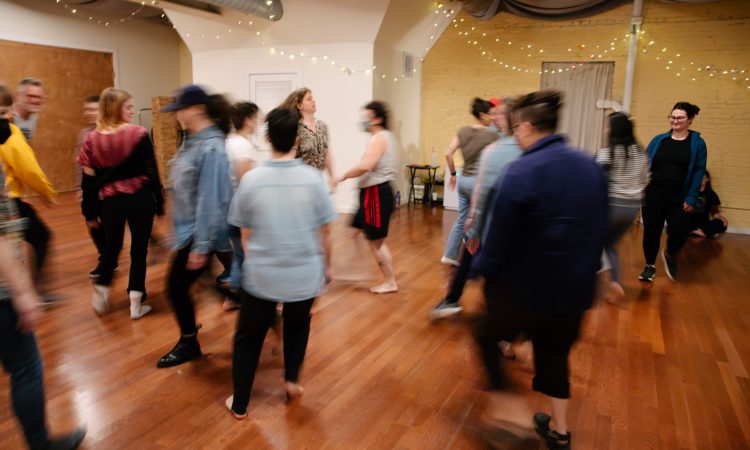
ZF: And did this lead to “Dancing Collective Power,” performed at Studio 34 in West Philadelphia this past spring of 2025?
EGM: Yes. The purpose was to share some of the research, demonstrate some of the techniques, and invite the audience into the space to try out a few of the exercises. I followed up the lecture/performance with a round of open community workshops in the fall of 2025.
ZF: Which was great by the way.
EGM: Thank you! I intend to keep offering these workshops and iterate on the curriculum as I continue to gather feedback from folks who try it out. My hope is that as groups get comfortable with the material, they’ll tailor their own versions. These practices are for utility. Take what is working and let the rest go; adapt them to your context and your body and your community.
ZF: What would be most useful for you at this stage in “Dancing Collective Power?”
EGM: I haven’t spoken to enough folks who organize in different social justice contexts from my own. I imagine different versions of these exercises or different kinds of dance skills would be helpful in different communities facing different issues, like communities of immigrants in the U.S. or people with disabilities. I’d love to receive a warm introduction to other social justice groups. Funding for more research with dancers would also be helpful, but a lot can be done without it.
ZF: What would you say to someone who has a similar interest in using art as a tool for political action, or has a project they’re looking to start?
EG: If you don’t already belong to a group you’re actively organizing with, this is the time to join. Invest some time in going to meetings and doing what will not feel related to art-making in addition to finding the places to bring art in. There isn’t a replacement for taking time to build trust and participating in the work of collective decision-making and envisioning. I know it can be challenging to make time, because it’s already challenging to balance making art with doing whatever you need to do for work to survive. This work has been worth it to me, and I accept I will produce fewer stage performances to be organizing for change and our communities.
*The writer has danced and made projects with Ella-Gabriel Mason.
Zoe Farnsworth in conversation with Ella-Gabriel Mason, Zoom, October 24, 2005.