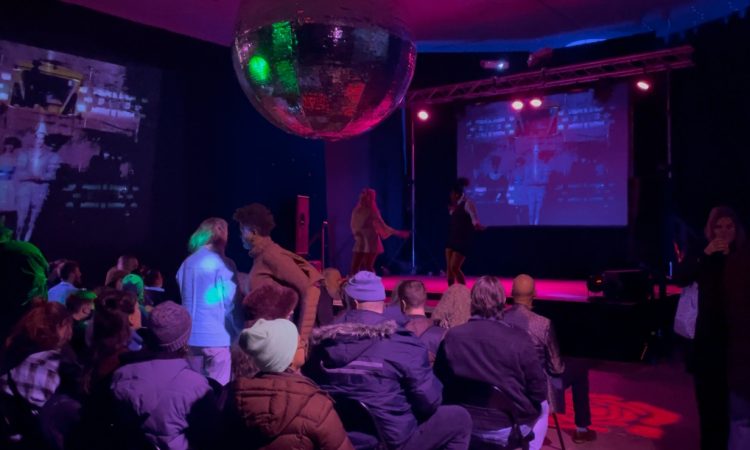
Kayliani Sood and Marisa Illingworth begin the rehearsal with a mark through. They walk onto the stage in silence, and stand in a pair. They both gesture pointing up like an idea popped into their heads. Good Old Fashioned Loverboy by Queen springs on. What follows is a queer love dance–flirting with each other and the audience. They follow the lyrics, matching gestures, abstracted or literal, of driving, hearts beating and booties bumping. Moments of tender touch mix with deft surprising shifts of level, shape, and sharp fast-paced choreo. It is clear how much the dancers care about working hard and getting it right. But they’re not getting paid; they’re doing it for the fun of it. To be clear, they should all be getting paid.
Don’t Stop Me Now is a cabaret-style one-hour concert of 12 different pieces all set to different Queen songs. Last year, producer Paige Philips heard Icebox Project Space had an opportunity for artists to host an event, no cost upfront, with a 50-50 ticket split for December, January, and February. It went so well last year that here we are again. Philly’s dance scene’s work ethic, eclectic gathering of styles and practices, and hunger to experience joy in art making, explode out of this concert.
Below are interviews with various choreographers and dancers involved in the show. The conversations are paraphrased and edited for clarity and brevity. Some occurred during a rehearsal I was invited to, others over the phone.
Zoe: How did it all start?
Paige Philips: I wanted to bring together some of my friends and artists I admire to make work for Philly Loves Bowie Week. I was worried no one would say yes, but people only declined if they were out of town or had a scheduling conflict. It was incredible.
I realized that people are hungry for more opportunities to show their work. There’s almost no funding for dance right now, and many choreographers have been making work for years without a consistent outlet. When I reached out, I was very transparent that this wasn’t about making money. Everybody’s participating for the love of the dance.
And so, ta da.
Here we are with this beautiful community event.
It wasn’t competitive at all last year, but it was like, let me show you what I can do.
Zoe: Why is this show special?
Paule Turner: This show is enlivened across so many demographics and forms and camps and theater, dance, performance art, gender. It’s so Philadelphia, it’s so cool, and it’s scrappy, it’s messy and inspiring.
Zoe: Tell me a little bit about your piece in the show.
Paule: My piece this is sort of a little short funeral for the death of DEI with a few memories towards emancipation. Doing this show last year, I liken it to drag, which I love. Like, okay, you’ve got one song to be as pointy as you can be or would like to be. And you know, as I said earlier, I have no shame, so…
I feel like what I learned in Philly all these years of what art we try to make is that there’s a value of process over product, and the game of the evening, let’s see what we can do; every opportunity is magic. Everyone being so open minded to see, and watch, and listen, to people’s interpretation and perceptions…that’s what I like about the Philly dance scene, and that’s what I think this show is like.
Zoe: What are you excited about with this show?
Megan Bridge: The caliber of choreographers participating in this show is through the roof. And I imagine that what’s going to come out is some really surprising, delightful, powerhouse choreography.
mik philips: I think it’ll be a little serious, a little silly, a little sultry. It’s nice to come together and have many different “mini performances” in one show. It’s the middle of winter, everyone’s cold; I think things can get kind of quiet around the city this time of year, so it’s a nice opportunity to get together.
Zoe: Why did you choose to do this concert?
Vitche Boule-Ra: I am never really in this sort of context of making work directly in relation to a pop song.
I sort of see Freddie Mercury’s embodiment on stage as very similar to that of how Highlander manifests himself. I think Queen lends itself to being larger than life but also exploring the intimacy inside of it. Beautiful big rock moments.
Zoe: What can people expect from your work?
Ra: I would say Galactic ritual. Starry.
Zoe: What attitude should the audience have going in?
Ra: I think having the audience there and ready to feel Queen, you know? Like they’re at the concert, ready to give it.
Zoe: Tell me more about this piece you’re making with Paige.
Kayliani Sood: It’s really a queer duet, which is super fun because, oddly enough, that opportunity doesn’t come up that often for me — to be part of performance work that’s visibly, audibly queer.
Paige: One of the reasons I wanted to explore a queer relationship is as a nod to Freddie Mercury. As the lead singer of Queen, he was a queer artist who wasn’t able to be fully out during his lifetime and ultimately died of AIDS. This duet feels like a small Easter egg, an acknowledgment of that history.
Zoe: What part of the dance brings you joy?
Kayliani: Whenever Marissa and I get together and we do a little campy booty bump, and then they whizz me around in a circle. I’m selecting things off the menu, and I just feel like a damsel.
Marisa Illingworth: For me, it’s this bratty little all fours moment… you’ll know it when you see it.
Don’t Stop Me Now, Icebox Project Space, February. 10 at 8pm.