Blind Summit Theatre’s The Sex Lives of Puppets opens on a deceptively simple set: an 8×8-foot piece of white square flooring anchors the center of the Harold Prince Theatre’s black stage, framed by an equally stark white backdrop against the black masking curtain. A single entryway table sits at the center of this stage-within-a-stage. The design immediately draws focus to this intimate playing space; two open crates sit on each side of the stage, holding limp puppets lying facedown, awaiting their moment in the spotlight.
The show unfolds as a series of amusing and heartfelt interviews with delightfully irreverent characters who honestly—and endearingly—overshare intimate stories of their sexual escapades. With each story, character development unfolds with exquisite detail. From single-character monologues to dialogues depicting complex relationships between golden-agers, each vignette charms through witty, engaging storytelling. Later, surreal scenes of featureless puppets partake in an orgy that crescendos in both numbers and absurdity to the sound of a swelling pipe organ. In this eleven-act play, black-clad puppeteers introduce each short section with cardboard signs bearing bold questions that frame the scene and invite personal reflection: “How does sex change with age?” “Do you ever disagree about sex?” and the more provocative “What is a cum blob?”
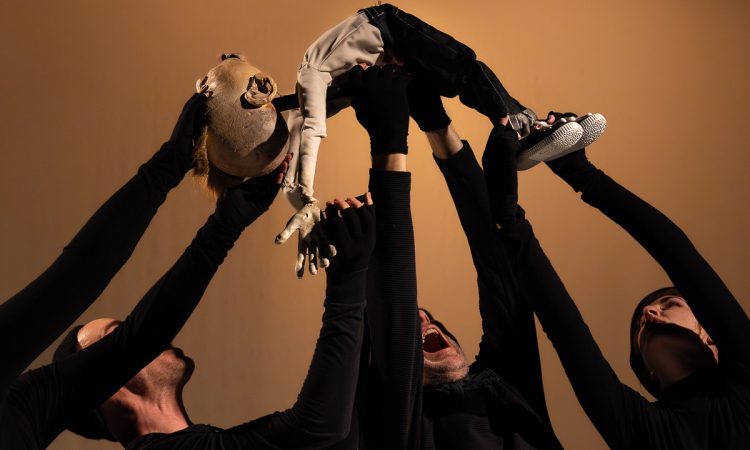
Each puppet typically requires two handlers: one manipulates the arms, hands, and torso while the legs dangle limply over the table’s edge; the other voices the character while operating the mouth via a trigger-controlled handle at the back of the puppet’s neck. The intricate dance between handlers, puppets, and script unfolds at a measured pace, enabled by precise articulation of limbs and crisp vocal delivery. The execution is so seamless that I often couldn’t discern whether scenes were improvised, and found myself marveling at the challenge of rehearsing through an external entity simultaneously manipulated by another performer.
Each puppet possesses distinct human characteristics: styled hair, expressive facial features like wrinkled foreheads and high cheekbones, black hollowed eyes, and oversized hands that amplify each character’s personality. Harry and Frannie, a particularly memorable couple with thick Long Island accents, exemplify this artistry. They begin seated at opposite ends of the table, bodies tense with frustration. “But it’s always things for me to do to you, and not for you to do for me!” Frannie exclaims repeatedly. Harry counters with affirmations, telling the critical Frannie how beautiful her eyes are, promising to take her to Paris one day as the puppeteers gently scoot him closer. “Really?” she gasps. “Wooooooooow!” Her oversized hand runs slowly, bashfully through her hair and behind her red bifocals. The couple then erupts into passionate lovemaking, switching positions with escalating intensity, sustaining the moment just long enough to create joyful discomfort. Harry shatters the “fourth-puppet-wall,” urgently instructing his handlers to move his legs and remove his pants, sending the audience into roaring laughter and applause. The four puppeteers execute this meticulously rehearsed scene of fiery puppet intercourse so convincingly that the entire theater climaxes with glee.
By the end of the night, the audience exited the theater visibly lighter. There was something disarmingly freeing about seeing puppets voice the full spectrum of embodied desire—joy, guilt, selfishness, sadness, and pleasure—through satire, bold accents, and sly political commentary. Grounded in the universal experience of sexuality, the show gave us permission to step outside ourselves and enjoy, without apology, a piece of theater that was “seriously good fun!”
The Sex Lives of Puppets, Blind Summit Theater, Penn Live Arts, The Annenberg Center for the Performing Arts, The Harold Prince Theatre, February 4-7.