Curt Haworth and Tammy Carrasco stage their respective works Imperfect Circles and A Creature of the Garden and Cellar at Christ Church Neighborhood House. In this Philadelphia Dance Projects’ DANCEUPCLOSE program, both works demonstrate the tensions, triumphs, and peculiarities of the interpersonal through choreography that showcases artistic rigor and wit.
In Imperfect Circles, Haworth’s cast (Amalia Colon-Nava, Amanda Rattigan, Anna Scattoni, Kayliani Sood, and Ian “Seven” Tackes) embodies mesmerizing tides of agency and stupor with movement motifs that cycle through collapse and recuperation. Both urgency and indulgence have stakes in the work’s tone. Live music composed and performed by Julius Masri cues shifts in quality and phrasing of movement.
Four dancers walk from distant corners to gather in the centerstage spotlight. Their heads concurrently initiate a slow swivel that suddenly advances into a full-body spiral, sending dancers into collapse. They lie motionless on the marley as a soloist replaces their original position.
Centerstage becomes a meeting ground where the ensemble frequently re-groups. In a circle, tightly latching arms, they lower themselves into a deep second position and tug until their shape’s radius reaches capacity. They make lateral shifts that rotate the circle left and right until one dancer detaches, destabilizing their structure and causing their bond to break. The rupture whisks the ensemble into several spinning circuits – each desperately trying to remain intact. Their bodies scatter and tumble.
Kudos to this crew’s proficiency in the art of falling. With force, the dancers move adaptively using speed, gravity, momentum and their own body weight as tools for the illusion of wreckage. This cycle repeats several times: a lone dancer finishes their solo as the fallen dancers casually recover, meeting one another in the middle for their circular stance. The expectation becomes that it’s only a matter of time before their shape is fractured again.
Imperfect Circles creates allure by building exclusively fleeting connections that normalize the distance maintained by dancers until the very last moments of the piece. Slowly and steadily arcing backward, Kayliani Sood inches off-kilter with the threat of dorsal downfall. In the instant before plummet, Tackes promptly breaks the fall, allowing Sood to relax into the catch until Seven pushes back, reactivating Sood’s agency who then tends to the fall of another. Simultaneously, seconds after Colon-Nava’s fall is received and recovered by Rattigan, Colon-Nava rushes to offer timely relief to Scattoni’s retrogression. Dancers repeatedly redeem one another by transferring weight.
These moments of intentional touch and care feel dutiful, tender, and reciprocal. Against the tension and disruption and fleeting tone that the work prescribes, this final submission to corporeal interdependence feels like a soft landing. Gratifying. Needed. Dancers previously stumbling to the floor and desperately reaching out for missed connections are finally received, supported, and uplifted.
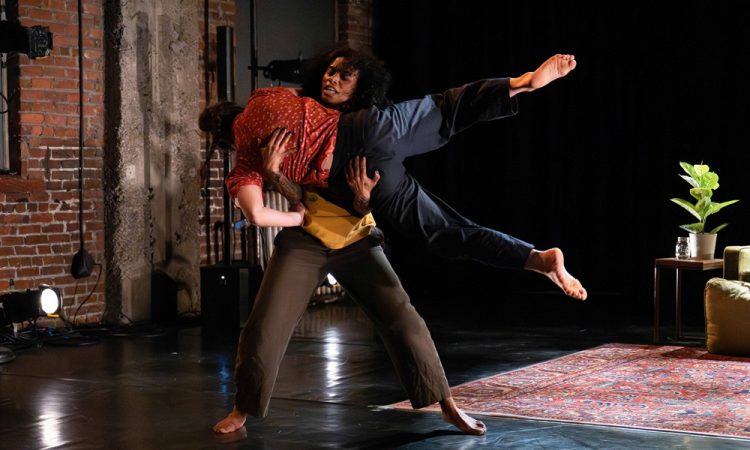
Next, Carrasco’s A Creature of the Garden and Cellar transforms the stage into a living room. A green couch, two orange armchairs, and a floor lamp sit over a large area rug. A potted plant lives on the small end table beside a glass of water. Chloe Marie sits under a blanket on one of the armchairs, and Tamar Gutherz reads a book on the couch. While these two lounge in their cozy home, another story is told just “outside”. Small lanterns adorn the perimeter of the space, alluding to the dark outdoors.
A voiceover echoes over ambient noise, and Carrasco dances with it. “A creature with a solitary light.” She hones transformation and curiosity by shedding a layer of clothing, seeking into the dark with a lantern. The solo feels separate from what comes next, not quite juxtaposing, nor complementing—simply co-existing.
“Inside” the living room, Gutherz and Marie take various positions lounging around the place. They stand face to face in stillness and linger there for a while, initiating their duet. Almost touching, they mold and carve around one another, tracing the other’s body, filling the negative space, and maintaining a proximity that teases contact, but never gives. I’m certain they can smell each other’s scent and feel the wind from the other’s movement grazing their skin. Speed and mobility increase as they turn and lunge around one another, eventually evolving into contact improv. This transitions into a mirroring score that is especially memorable. Their pedestrian movement (walking, drinking water, washing hands, picking up a book) mimics one another, and they become each other’s shadows. They switch roles from leader to follower as if learning from one another, like a parent-child dynamic, or picking up gestures and habits of loved ones.
Gutherz and Marie’s dances appear effortless, while evidencing the rigor required to achieve phrasework that doesn’t short-cut their range of motion or capacity for indulgence and presence in partnering.
A Creature of the Garden and Cellar illustrates a strain of intimacy usually reserved for loved ones. It’s an affection that seems second nature, yet the dynamic is also contentious, playful, strenuous, and a haven. From individual dances performed simultaneously, to a one-on-one mini-brawl, some light acrobatics, and tender touch. It’s unclear whether the relationship symbolizes a romantic partnership, parent-child dynamic, kinship, or friendship…the ambiguity itself is nourishment I didn’t know I needed.
Carrasco and Haworth’s acts both probe the complexity of care and connection, making PDP’s DANCEUPCLOSE a prime container for these complementary works.