“We learn from nature.” — Cheng Tsung-lung
At dawn on a humid mountain, soft light pours through shades of trees. I see “frogs” waking in the sunlight. This forest scene comes to mind as the curtain rises on Cheng Tsung-lung’s Sounding Light, performed by Cloud Gate Dance Theatre of Taiwan. A beam of white light streams from above, illuminating twelve dancers who huddle together in a low, folded position. They bend forward, heads and forearms resting on the ground, slowly stretching their legs on their individual rhythms as if waking to a day in the forest. Their bare backs are painted with vivid splashes of colors, contrasting against neutral-colored pants. There is no music yet, only the faint rustling of leaves and birds’ singing.
Founded by Lin Hwai-min in 1973, Cloud Gate takes its name from an ancient Chinese dance. It is also the first contemporary dance company in the Chinese-speaking world. The company’s training integrates Tai Chi, internal martial arts, modern dance, and ballet. In 2020, Cheng succeeded Lin as artistic director. Having long admired how Lin weaves Chinese movement traditions and Western modern dance into a distinctive choreographic language, I was curious to see how Cheng directs the company with his individual artistic perspective.
According to Cheng, Sounding Light emerged during the 2020 COVID-19 quarantine in Taiwan. When performances were suspended, he retreated to his mountain house, where sparse cellphone reception allowed him to spend his days reading and letting his mind wander. One day, a cicada landed on his open book. He was surprised to see that the cicada stood wide on its legs, swaying its body side-to-side. Cheng later adapted the insect’s motion into a solo in Sounding Light, asking the dancer to imitate the cicadas’ rhythmic buzzing with their tongues, teeth, and lips.
The dancers’ bodies supply much of the score. With minimized background music, the dancers’ vocal sounds and claps bring a vibrant ecosystem to life. During a duet’s alternating lifts, I notice “insects” chasing one another; from a solitary croak, I imagine a “frog” seeking a mate; elsewhere, a dancer becomes a singing bird, swiftly turning its head. I hear a rainstorm striking leaves from the dancers’ percussive slapping of their bodies. As the “storm” subsides, they use their lips to create small drip-plinks evoking droplets falling into puddles. With my senses open, I almost smell the freshness of the mountain.
All twelve dancers remain visible on the white, minimalist stage throughout the hour-long performance. Cheng’s shifting groupings draw my attention to those taking center, while others quietly roll across the floor, gather into formations, or clap, becoming both a living landscape and sound accompaniment. Amid this abundance of gesture and sounding, I find an unexpected stillness. Cheng’s words in the program notes resonate with this feeling: “As life slowed down, I discovered a quiet within. In those days, my senses opened up.”
*
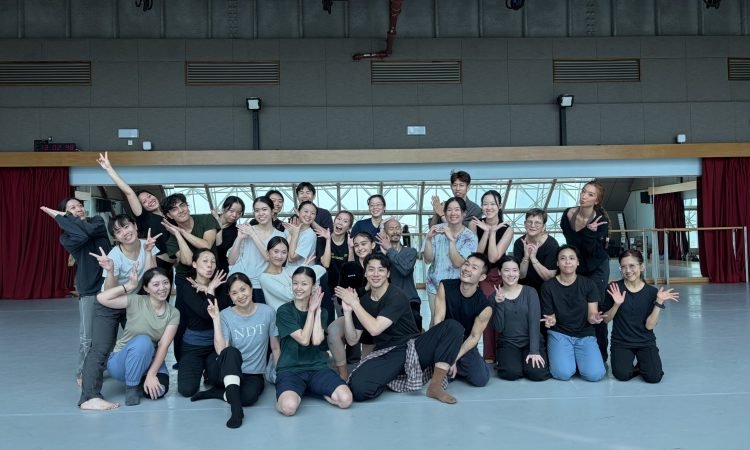
The day after attending the Sounding Light performance, I attended a masterclass with the Cloud Gate dancers. There, I embodied what I had sensed from the audience. Familiar elements of my dance training brought a delightful sense of mind-body coherence, but that familiarity also led me to question ingrained assumptions and habits about….
Dancers Fan Chia-hsuan and Chen Tsung-chiao led the one–and-a-half-hour-long class, structured in three parts: Tai Chi Dao Yin, vocal and movement practices, and learning an excerpt from the choreography.
Developed by Tai Chi master Xiong Wei, Tai Chi Dao Yin is a foundational part of Cloud Gate’s training. Our practice focused on coordinating breath with fluid movement through the joints. Sitting on the floor with legs crossed and eyes closed, we began with guided breathing. The position recalled my Buddhist meditations with my mother during childhood. As we introduced spiral motion through the spine and limbs, I recognized a resemblance to the body-rhythm technique from my Chinese classical dance training.
Holding a horse stance while continuing to rotate my arms, I was struck by the emphasis on muscle relaxation. Fan instructed us, “Try not to use a lot of muscle tension and instead use your bones!” With kinesiology in mind, I wondered how I could move my bones without contracting my muscles. When I closed my eyes again, I slowed the sequence and pictured my skeleton beneath my skin and veins. Attending to my breath and this inner image gradually offered me a sense of “using my bones.” My sore quadriceps became bearable and released.
The turnout principle from my ballet training complicated the spirals. Everything became smooth when I curled my wrists and elbows toward my chest. I felt the qi, or energy, quietly releasing as my spiraling arms reached out through my armpits to the opposite side of my body. Exhaling, I followed the spiral momentum into a lunge and instinctively turned out my foot, like a plie arabesque. Although the turnout allowed me to twist farther through my hips and torso, it made reversing the sequence harder. As I lifted my back leg and circled my shin and ankle inward, I had to reposition my supporting foot to return to the center. That adjustment, however, interrupted the flow I had begun to feel from the ground upward.
The vocal exercises were the most fun part of the class. Standing in a big circle, we sustained an “O” sound, exploring how our voices swelled and faded. My initial shyness of making sound eased as Chen encouraged us to call out and listen to one another’s pitch. Together, we adjusted our voices to form a chord, as the dancers did in Sounding Light.
We mimicked the shushing and buzzing of cicadas, the breathy whisper of wind, the whistling of birds, and the particularly difficult croaking of frogs. But the hardest part was coordinating these calls with our moving bodies. At our own pace, we changed the sounds while walking, weight shifting, crawling, and positioning. I had to slow down to hear my voice, register my actions, and align each sound with a shift. I realized the difficulty of sustaining vocalizations while dancing fluidly and listening to others. As Chen reflected, “There is a lot going on on stage. We have to sing and listen to others to make echoes. Our claps set the count and rhythm for others, so we have to watch the speed and coherence, and we have to dance.”
Learning an excerpt from the choreography brought the earlier exercises together. Tai Chi Dao Yin prepared us for a flexible spine to conduct shifting spirals across the body, while the vocal practice equipped our rhythmicality to clap and dance together. My excitement came from recognizing familiar movements, such as xiaowuhua, a spinning of flower hands from Chinese classical dance, and a playful little kick landing on a flexed foot that appeared in folk dances I had learned previously in my training.
I felt my Graham-based modern dance training emerge throughout the class. Contraction and release from the core helped me articulate torso isolations and agile shifts between positions. Despite fatigue and pain in my injured knee, I was excited to discover how much my past training settled in my body.
The masterclass with the Cloud Gate dancers reinforced my belief that training shapes not only the body, but also the mind. I have always believed that dancers’ training and lived experience inhabit their performance. Through practicing Tai Chi Dao Yin and learning the choreography, I more deeply understood how Cloud Gate brings Chinese movement practices and Western dance techniques into dialogue through the dancing body. The vocalization in Sounding Light also reminded me of dancers’ sighs and deliberate vocal sounds in Philadelphia artist Kun-Yang Lin’s choreography. Yet, Cheng’s account of watching a cicada and hiking with his father brought me back to the particular experience that emerged through his choreography. Shared techniques can take different forms through individual lives and acts of attention. In the theater, I found peace in the dancers’ forest. In the studio, I felt the coordination, energy, and individual expression that brought that forest to life.
Sounding Light and subsequent master class, Cloud Gate Theater of Taiwan, November 2026