Book Reviews

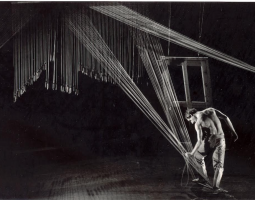
A black and white still of a scene from Daniel Stein’s Inclined to Agree, 1986. A muscular Stein lunges his bent left leg upstage, bending his torso to his left, wearing dress slacks , movement shoes and shirtless. He is stepping on two bunches of taught chords that run diagonally from his right ankle up to the rafters where more chords of varying lengths hang with weights attached . An empty door frame hangs from chords just upstage of Stein, it tilts towards him on a steep incline.
Photo: Daniel Stein

B.F.F. (Before the Fringe Festival: A Moving History)

Walter Bilderback

A reflection on the 2023 memoir of Michael Pedretti of Movement Theatre International, pre-Philadelphia Fringe Festival.

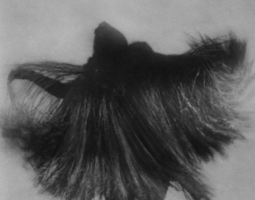
n a soft, blurry black and white photo, dancer Mary Wigman performs in Idolatry (Götzendienst), part of the solo cycle from Ecstatic Dances as revised for her first solo tour in 1919. She wears opaque black tights, shoeless, and a thick fringed black dress that covers her entire torso. It’s difficult to tell, but the shadowy form looks to be throwing her head back. Photograph Courtesy of the Mary Wigman Archive, Academy of Arts, Berlin.
Photo: Hugo Erfurth

The Rear-View Mirror: Hindsight from a Dance Scholar

Megan Mizanty

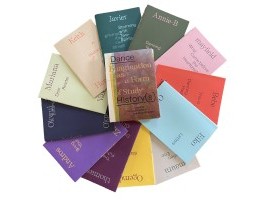
How does the lens switch as time passes? Susan Manning's essays are collected in Dancing on the Fault Lines of History.

Fanned out in a circle on a white surface are 12 booklets in a range of colors. Here and there are sections of text covered or obscured by other booklets. In the center of this circle is the title piece in a wash of brown darker at the bottom and lightening toward the top. The vague image of pine tree tops on its surface. It reads, Dance across the top and History(s) across the bottom with the subtitle Imagination as a Form of Study in the center. Underneath in smaller letters it reads edited by Thomas F. DeFrantz and Annie-B Parson.
Photo: Jack Lazar

To Us/Because of Us

Emilee Lord

Dance is a Weed

A woman in a black leather coat, jeans and a black bowler hat squats down. Her long hair is blown across her face obscuring it and her hand moves up to brush it away. The name Clare Croft appears in black letters in the top left corner. In large white letters, the bottom of the photo reads: Jill Johnston.
Photo by Phyllis Birkby

Interrupting the Paper Daughter

Emilee Lord

Reading writing on a writer dancing

The bright cover of Artists on Creative Administration: A Workbook from the National Center for Choreography asserts itself boldly on a red-orange background. The title makes a right-angle inside an offset rectangle of white and black lines that don’t quite meet at the corners. “Artists on Creative Administration” sits along the top and right of the rectangle with the rest of the title occupying the left and bottom. The text “Tonya Lockyer, Editor” appears just beneath the catawampus rectangle.
Cover Image courtesy of NCC Akron

Stories From The Middle

Jennifer Passios

Humor, joy, hope, tough truths, and pragmatism give this book its staying power.

Photo: James R. Perales

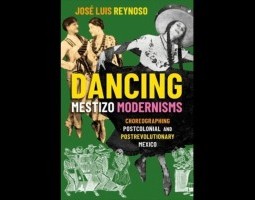
Locating the Body in Postrevolutionary Mexico

Amy Schofield

Reynoso gestures toward decolonial and pluriversal possibilities of mestizaje.
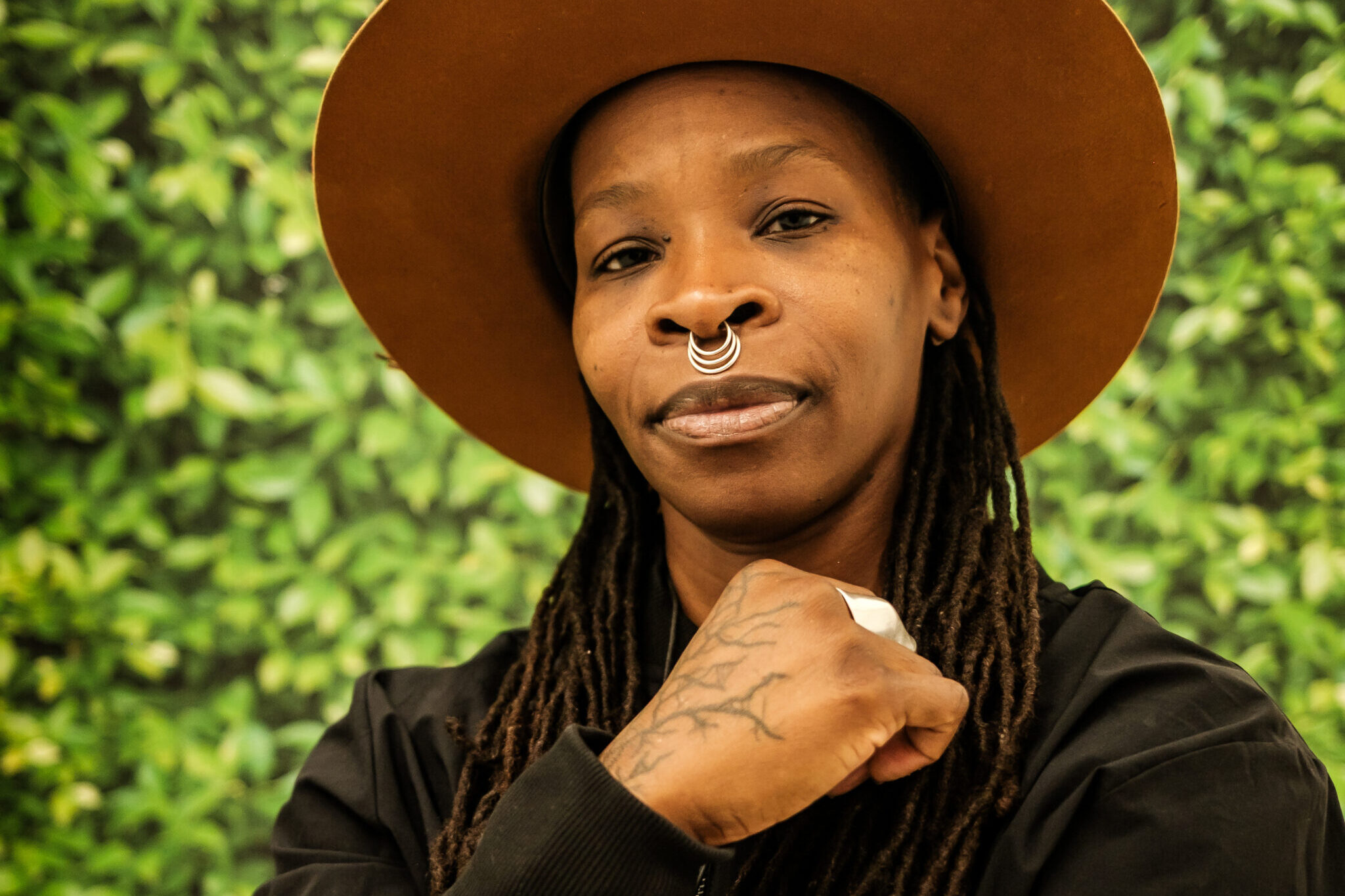
Photo: Robbie Sweeny

Unveiling the Apparatus

Even when Mattingly’s own choreographic apparatus may seem contentious, her viewpoint is definitely worth reading.

Book Review: A Magic Carpet Ride Through Ballet’s History of Orientalism

Catja Christensen

Banishing Orientalism is an intellectually stimulating, essential read.

Photo: Annie-B Parson

Threading through life and choreography with Annie-B Parson

Kristen Shahverdian

What is in choreography and how does it exist around us?

Photo: Noel Bégin/Decidedly Jazz Danceworks

Book Review: Getting Down to the Roots of Jazz Dance

Darcy Grabenstein

The Africanist aesthetic as essential to jazz dance theory, pedagogy, and choreography.