Reviews

Four women stand in a group with their arms upraised and their heads in profile. They are wearing long-sleeved shirts in yellow, red, navy blue, and black.
Photo: Alan Simpson

the power of community

desire amaiya

a caring, authentic ensemble that allowed me to bask in the community of movement.

In a vast black expanse with a dark brown floor, two Gogglers in warm colored shirts, leather aprons, and steampunk goggles hold up a square of red thread around Temple, a Black girl in a bright green sweatshirt. She's pointing at the viewer as her brother, Arturo, looks on in interest while sitting on the ground.
Photo: Courtesy of Pig Iron

Franklin’s Key: A Fun Romp Through Fiction

Madeline Shuron

Pig Iron’s latest adventure amuses.

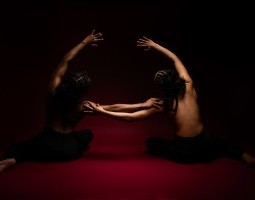
One dancer stands tall, snapping the Shuka with fierce precision to carve rhythm into silence, while the other kneels in exaltation, their body echoing Horton hinges and Graham’s sculptural forms—an image of power, reverence, and kinetic devotion.
Photo: Carlos Avendaño

Noise See: Weaving Masking, Memory, and Maasai Legacy

Lauren Berlin

Fernandes threads a performance of Self

a dancer presses against the bare ground on all fours while another dancer stands barefoot on top of their back with the support of two others who hold her arms. They are wearing long-sleeved clothing in shades of grey, black and red. They are surrounded by trees and foliage. There are audience members in the foreground watching.
Photo: Michelle F Smith

Embodying Human-Nature Interdependence

Caitlin Green

Dancers create a shelter that shape-shifts into tableaus of home.

Shavon Norris stands on stage in black clothing with her eyes closed and mouth open as if shouting in discomfort, with her hands covering part of her face. There is a person playing the upright bass in the background, and a sliver of blue and yellow lighting behind Norris.
Photo: Johanna Austin

Shavon Norris’ CRONING (solo.duet 48:25) at The Philadelphia Death and Arts Festival

Caitlin Green

A work that makes space for the constant tug of death

ight slanted grass supports two performers escaping from a fleshtight yellow and bark-brown garment, a “bodysuit.” One performer lies on the ground, horizontal to the left of the standing figure, with an arm extending upwards.
Photo: Naomieh Jovin, courtesy of BlackStar Projects

Venus Flytrap: A goddess bound to this earth

Noel Price-Bracey

Spring has arrived, and the earth is enlivened.

a book with a black cover and and the words Defending Rumba in Havana; The Sacred and Black Corporeal Undercommons written in blue, green, organge, yellow and pink.
Photo: des amaiya

“Yo te salvo a ti; tú me salvas a mí”

desire amaiya

Berry documents how rumba counters predetermined sanctions and barriers imposed by a money hungry and stratifying regime.

A person wearing a leather skirt and thick black beads around their neck like a warrior stares intently at the camera, one arm extended towards us with the palm out. An upturned golden urn is behind them.
Photo: Steven Pisano

Ankita Sharma’s dhoka/Betrayal/: Militarization and Myth-Making

Brendan McCall

Ankita Sharma's intimate dance interrogates their relationship with India.

Portia, a white trans non-binary person, crouches over a mix of DJ mixer, wires, and opened journals strewn across the floor. They wear a black tank top and athletic shorts, and focus in on a laptop. The glow from the laptop and other technical elements subtly illuminate Portia.
Photo: Ofentse Kwenaite

When the Muzzle Comes Off, Who Do You Bite?

Rachel DeForrest Repinz

Portia Wells finds their bark.

A young man, nude and with his face hidden, squeezes his legs together while his arms are curved downward from his sides, as if his fists are carrying two imaginary buckets. He is in a room next to a white sofa, in front of an abstract painting composed of light blue strokes, and with a vase of violets near his feet.
Photo: Matthew Morrocco

Dancing Beyond the Void

Brendan McCall

An emerging choreographer´s dance about AIDS from a queer, Gen Z perspective