Eiko Otake

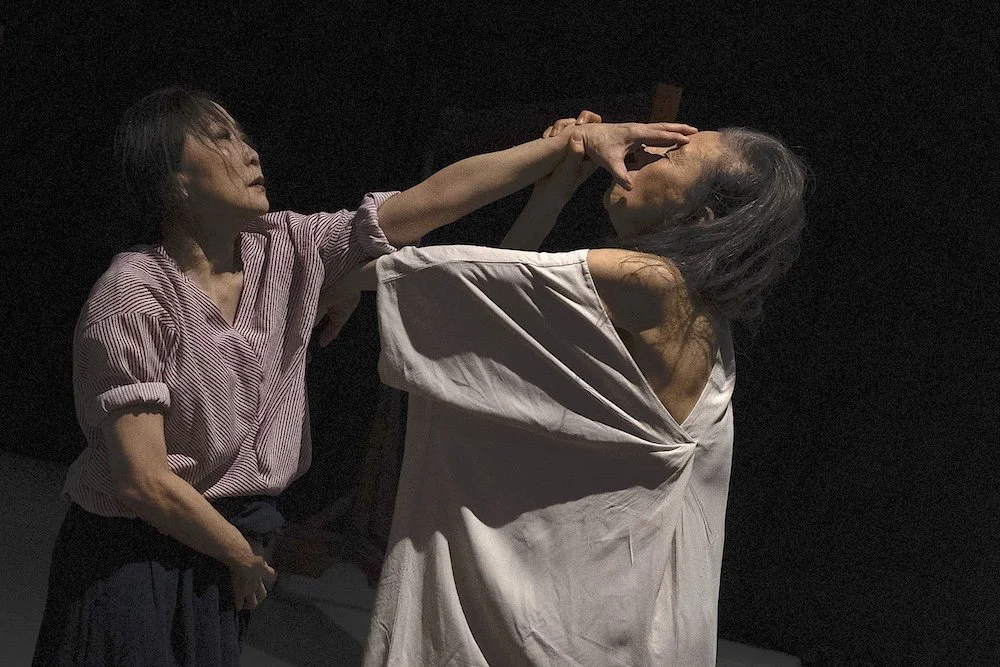
Wen Hui, a Chinese woman dressed in a red striped shirt and black pants, looks down past her nose at Japanese counterpart, Eiko Otake, while reaching a claw-shaped hand out to Otake’s face. Otake wears a baggy white dress that hides her form. One of her hands meets Wen Hui’s upper arm, while the other pulls Wen Hui’s hand to her face.
Photo: Zhou Huiyini

War is (in)human

ankita

We are all tangled. Do you understand?

Tender and frail. Eiko Otake, a slender, elderly Japanese woman dressed in a crumpled white gown, brow furrowed, worriedly looks at the ground in front of her. With bent limbs, elbows prominent, she clutches a woman familiar to her close to her body. Dressed in a lightly pinstriped red blouse with steel-colored trousers, this woman, Wen Hui, leans to the ground, gazing down at the edge of her fingertips.
Photo: Jingqui Guan

Old Lessons for New Wars

ankita

We have all known war, but have we learned? 

Photo: Constance Mensh

In “I Invited Myself,” Eiko Otake asks us to linger

Ellen Miller

In our hurried world, Otake invites you to linger, to watch, and return to watch again.

Photo: Eiko Otake and Wen Hui

When Bodies Remember – Eiko Otake and Wen Hui’s Film “No Rule is Our Rule “

Ziying Cui

As Wen Hui and Eiko note, “Our body memorizes.”

Artists Discuss: How Cultural Identities Inform the Creative Process, Part 2

Kalila Kingsford Smith

Assuming imposed identities, and then going against that, criticizing and parodying.

Artists Discuss: How Cultural Identities Inform the Creative Process, Part 1

Kalila Kingsford Smith

Issues of cutural origins and expectations, and what are artists to do now post-election.