by Derek van der Tak
To the editor,
Though I respect the reviewer’s articulate take on things, here I think he is missing the point. As concerns this evening’s poignant solo “I think not,” Bindler’s work always seems to trace a singular bridge between grace and awkwardness. Her point is that we learn our movement schemes over the course of a lifetime, a hard won awareness that no dance training or choreographic vision can undo as a felt experience. Her performance here has a disarming intimacy, inviting us to witness and come to terms with our own embodied presence. Hello people, you are sitting, looking on at me as I, etc. Whether she is making a bravura entrance, crawling over someone’s lap (Oh, hi!) or just lying there breathing, we squirm a little bit, shake our heads, laugh, wait quietly, take stock, wake up, or not. The audience becomes a psychological holding environment for the body-being to reveal itself in. In great stillness, with beautiful, simple lighting, her whimsical movement and vocal shifts took on an emotional register where some are laughing as she leaves us, some are relieved, and some are quietly grieving, or longing. “Saudade,” but not by the numbers.
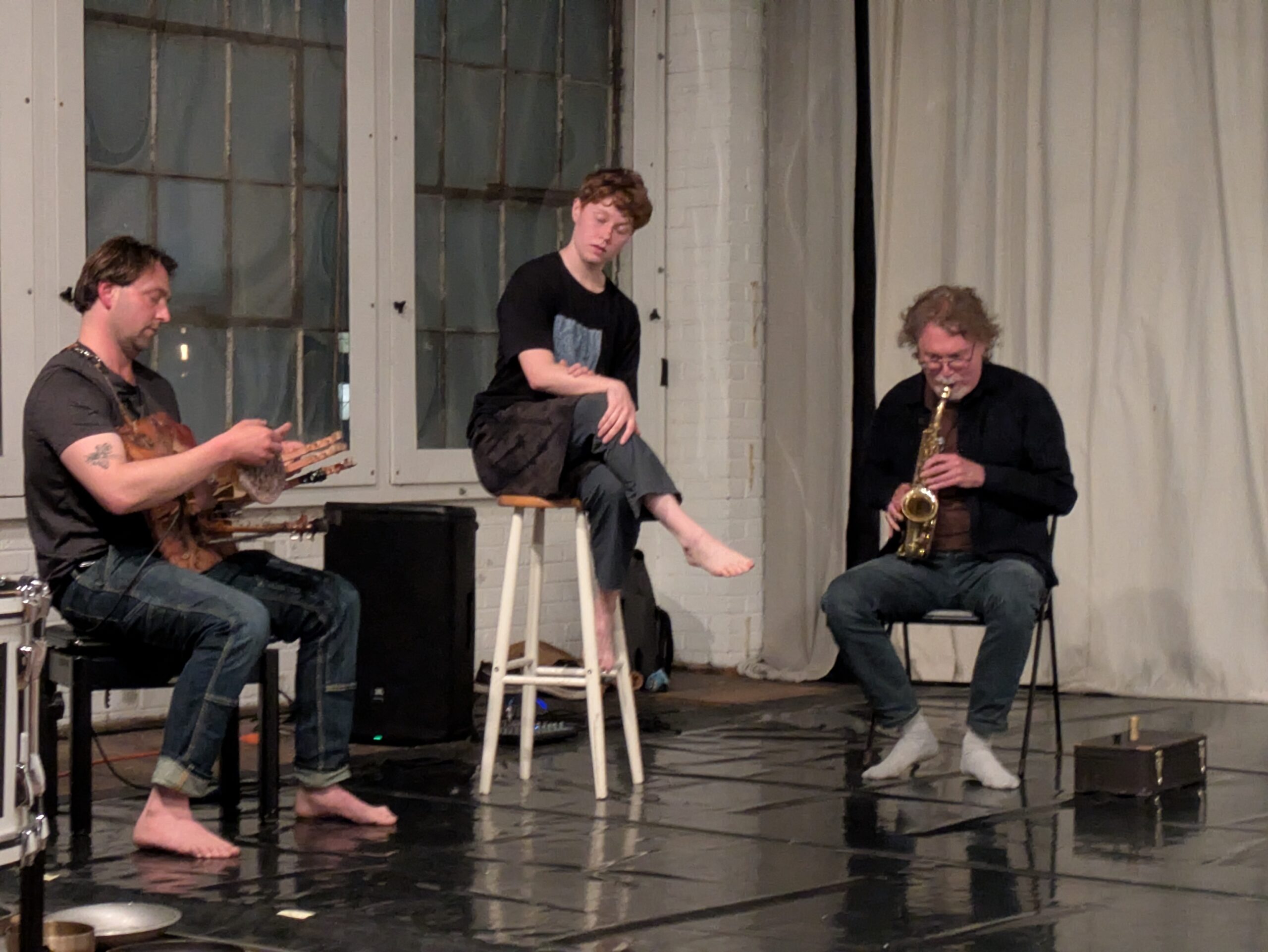
This tone was reiterated in her own choreography and direction for “Pia Mater.” Shifting between performance platforms, the piece opens with eloquent and beautiful dancing a deux, and is counterpointed by long scenes that captured both the threat, urgency and goofiness of group behavior. We hold each other up, travel together and fall apart in the same wise as our own cellular make-up. In the tradition of “danz-theater,” Bindler offers up our social lives on the petri dish of desire, loss, and repetition. The party scene here, both delightfully silly and all too monotonously real, was anchored by wonderfully evocative musicians playing as-if groove music. Noise jazz as befits our indistinct social matrix. The whole affair brought back very distinct recollections of my own youth, from elation to alienation, the failed assays at human communion. Bindler shows us explicitly that yes indeed, there is the dance, folks, as lovely, child-like and ungainly as it is, but in the end she has the dancers edging forward on the ground, a limbless and wordless integument. No argument with gravity here, this is a return to the deep past of our somatic being, before the infolding of memory and consciousness took root, a zone preceding our experiences of fear, joy and pain. One lone dancer fitfully moving in the opposite direction, as if lost (come back!) reminds us that this is our present condition too. We are contained, and yet unfathomable.
I thank Ms. Bindler for providing such a striking and refreshing turn on the peculiar emotional terrain of “Saudade.” This time the Bossa Nova was not missed.
Sincerely,
Derek van der Tak
Philadelphia, PA