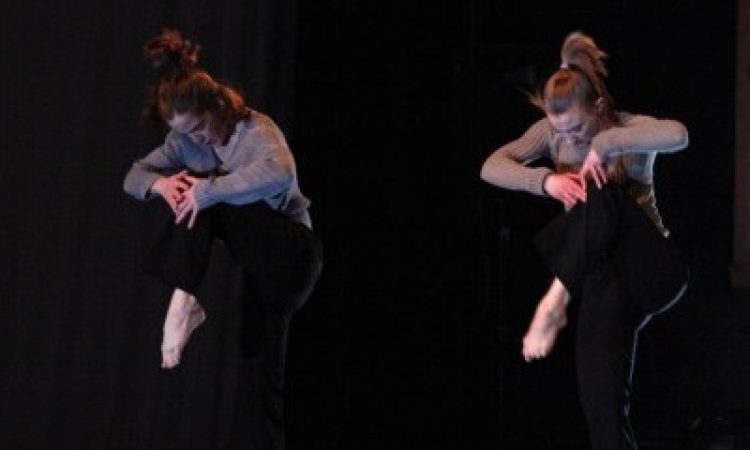
Ellie Goudie-Averill and Pamela Vail began their joint program with “Mechanism,” a co-choreographed duet. The piece’s spare sensibility and air of futurism were enhanced by a score by Brandon Evans. Dressed in matching reflective gray pants and knit tunics, Goudie-Averill and Vail began the piece by alternating turns of the head towards one another. I read this motif as both metaphor and preparation—two women deciding to move together. When it returned later, the looks longer, it seemed a rare moment of meaningful contact in a largely impersonal movement landscape. The two had maneuvered around each other and the stage with the simple precision of a clockwork, touching occasionally without narrative or drama. But to call the dancing abstract would be to ignore the impact of the dancers’ weaving through the clear field of stage.
As I watched, a snatched lyric from a Fleet Foxes’s song embedded itself in my head…a functioning cog in some great machinery/serving something beyond me. The evening was studded with moments like these: small gestures (fingers rubbing together as if measuring pollen in the air), points of contact (a dancer’s hands skimming down another’s shoulderblades), and spoken words (“the back is a reflective surface”) that gained their significance from the nearly meditative strata from which they emerged.
Both Vail and Goudie-Averill favor the full and fully-grounded execution of clear lines, circular and fluid pathways through the space, and a pared down approach to gesture and facial expression. The evening showcased them not only as choreographers but as movers—Goudie-Averill also performed an improv solo, and Vail, in addition to a second duet and a solo, was featured in two short dance films directed by filmmaker Jeremy Moss. The first, “CONSTRUCTS,” with its obscuringly-close attention to a duet performed on snow-covered train tracks, and “CHROMA,” by editing Vail’s movements through the staccato strobe of a super-saturated color palette, offered two diverse terrains for consideration. Dance served as the departure point in these films: they did not so much document movement as choreograph the audience’s engagement with it.
Goudie-Averill’s solo “Flesh for Sap: an improvisation” also provided choices. She asked us to pick one of three ideas—tree, avatar, and advice column. The written material she read after we chose and before she began dancing was developed from a somatic workshop she attended with CA Conrad, a local Philadelphia poet. This searching improv, about the difficulty of taking one’s own advice, as well as Goudie-Averill’s final work of the evening—“American Nostalgia: I think I no you from some knowhere”—included moments of humor and wit and even virtuosity that lightened the mood of a sometimes stark program. The live percussion and sense of community in the large group work “American Nostalgia” ended the evening with a picture of the chaotic, dynamic machine that is humanity. Order and disorder, monochrome and the spectrum, word and action, isolation and investment: such pairings, these choreographers recognize, create friction. Rubbed together—they go.
Go Together, Eleanor Goudie-Averill and Pamela Vail, Community Education Center, 3500 Lancaster Avenue, September 7, 6pm, September 8, 4 and 8 p.m., www.livearts-fringe.org