A series of dance films and live works by Anne-Marie Mulgrew, with one solo performed and choreographed by Ashley Searles, culminated a week-long artistic residency at Christ Church Neighborhood House by Anne-Marie Mulgrew & Dancers Co. The evening was a pleasant one, with music that landed comfortably on the ears (a tango sung by Carlos Gardel, big-band jazz by Harry James and even a piece by Justin Bieber), dancers who were committed and clean in execution, and videos of people you felt you might well know.
Mulgrew opened the show with Six Short Works, covering 22 years of her dances and dance videos. First, “long, tall Texan” (program notes) Barbara Tait emerged from the audience to dance a mugging, gesturing solo titled “The Busker” (2011). Tait’s performance was precise and engaging, but this series of tight phrases that juxtaposed oddities and movement flavors (pantomimic gestures, ragdoll floppiness, hip-rolls, audience-directed facial expressions) did not coalesce into a clear statement for me.
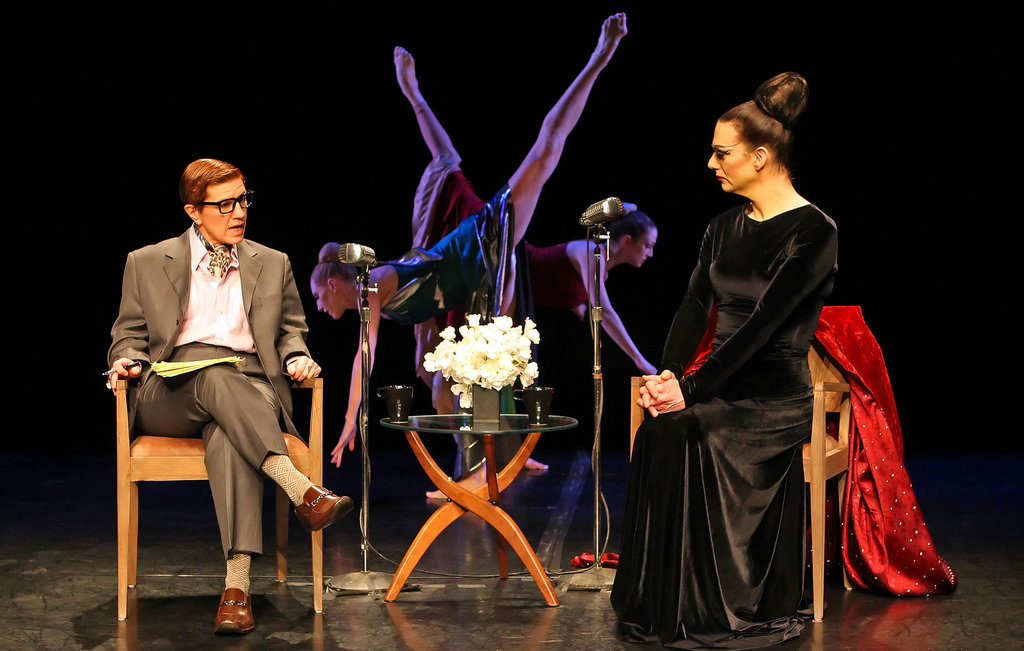
Two video works in this section of the program were particularly fun: “Tales of the Buffoon” (1992, video by Mitchell Taylor Gillette and music by Claude White) places the dancers amid a 1950s cartoon of the nuclear family and friends where magic and masochism mix. In “Pre-Dinner Cocktails” (2001, video by Carmella Vassor Johnson) dancer Joseph Cicala, Mulgrew’s long-time collaborator and company rehearsal director, partners Melissa Bessent in a very real kitchen where the two rhythmically and artfully move themselves, one another, the appliances, and the cupboard doors in the tight space while concocting gigantic versions of the mixed drinks that they consume into the film’s blackout.
Other works in this series included “Paper Waitress” (2000), “I Remember” (2013), and “Cleanse” (2009), this last work performed by Mulgrew in a big, spot-lit wash basin where she luxuriates in the womanly pleasures of a bath—a spiritual as much as a physical purification.
After intermission, guest artist Ashley Searles performed Elevation, a new work inaugurating her Philadelphia performance career following years with companies such as Parsons Dance and Liz Lerman Dance Exchange. Against a grainy video backdrop of a rising moon that eventually floats off the screen, Searles, in stark black-and-white and pointe shoes, riles, rolls and rises like an awkward mermaid finding newly grown legs. Along with the moon behind her, Searles rises to fullness, showing her considerable capacities to turn, stretch and balance, before sinking again to the floor—apparently much the wiser and satisfied for her moments of verticality and power.
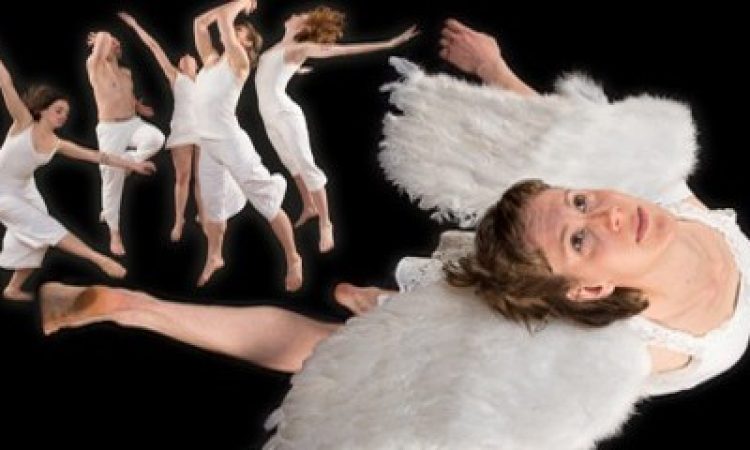
Mulgrew’s new work, World of Dreams, was introduced in the program by a series of questions, including “What is and what makes an American? Is the American dream alive, breathing, misplaced, or has it been absorbed and impacted by the world we all live in?” The work opens with a quartet of dancers who follow Tait’s high-lifted white flag with movements that hint at Middle Eastern or Indian dance with mudras, flexed feet and eye gestures. A “Dance Hall” scene follows (here’s the Harry James music), with dancers hugging, whispering, giggling, swaying and partner-dancing. The movement becomes lusher and bigger, and breaks from pairs to a quintet dancing deliciously together until hoisting one of them (Megan Wilson Stern) aloft in a friendly, smiling pose. To a series of voice-overs about “what it means to be an American,” six dancers march, pivot, flail arms and bob heads, only to be calmed by Mulgrew’s entrance – now it is she bearing the white flag – as she slowly journeys across the stage’s long diagonal to wipe the space clear of the group’s sometimes chaotic images. For the last section of this work, “Hopes, Dreams, Aspirations,” the dancers don white-feathered wings. At first, I wondered if these were to represent American eagles, or maybe snowy owls—some of which flew over Pennsylvania this winter—but I soon realized the symbolism pointed to angels. The dancers carry and fly one another overhead, sway in a circle, dance big and wide, crash to the floor and then rise again, until an emotionally frenzied ending comes to a sudden halt as the lights fade. This work best illuminated the program’s dedication to Mulgrew’s recently deceased father, Robert Mulgrew.
It’s no minor feat to keep a company going for 28 years, as Anne-Marie Mulgrew has done. I’m glad she’s been able to grace Philadelphia with her persistence and generous programming. Onward!
Anne-Marie Mulgrew & Dancers Co., Christ Church Neighborhood House, May 16-18.