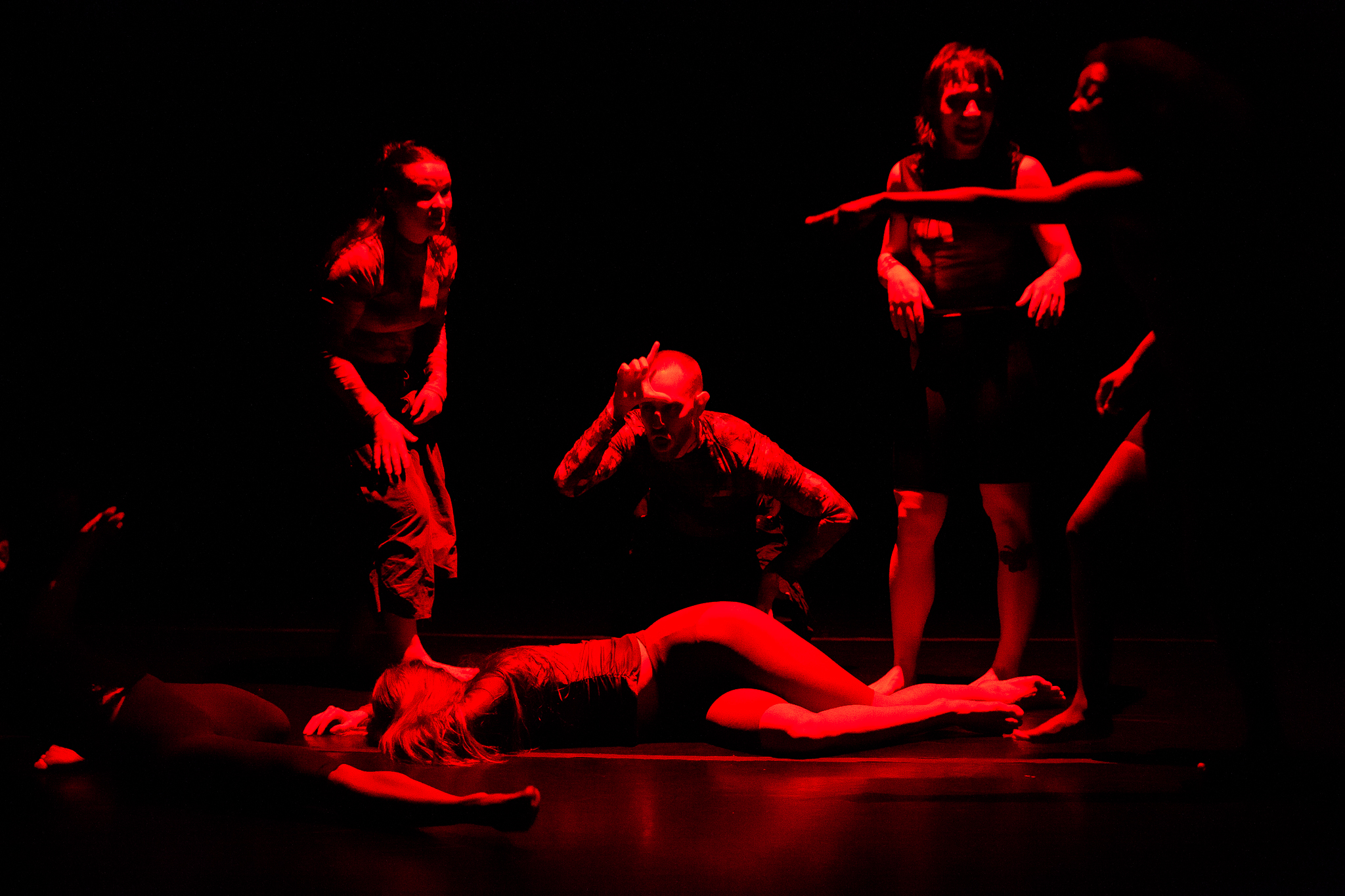
I dove into Vervet Dance’s curated evening of five works featuring artists from throughout the region. In Persephone and Demeter, Malcolm Shute and his Human Landscape Dance reimagine Persephone’s journey into the Underworld. Alexander Short and Shute roll effortlessly together as the roiling, muddy currents of the underworld’s River Styx. Becoming Hades, Shute rests alongside Eliza Talbott (Persephone) on Short’s back. Shute presses and prods Talbott as she struggles away from his grasp, until his hand reaches her mouth to feed her the pomegranate seed that will lock Persephone into his world. Ultimately, Talbott’s Persephone sits with her mother, Demeter (Nicole McClam), at the stage edge, Demeter’s stunned gaze revealing Persephone’s fate.
Scores of bouncing ping-pong balls cascading into the space open Boing! by flandrew fleisenberg and Loren Groenendaal. Generating both sound and movement with their metal soup pots, the performers drop, toss, and swing through playful choreographed structures of gathering and scattering. While Groenendaal’s physicality is particularly expansive—rolling circles, long striking lines, and flicking hands—I was excited by both performers’ full engagement in the wonderfully ambiguous roles of dancer/musicians. They finally collect all the stray balls only to unload them in a satisfying cacophony of pings and pops that moves into a slow light fade and delicious silence.
In Becca Weber’s Waterbody, two versatile performers (Caroline O’Brien and Nick Picknally) in blue jumpsuits slide, circle, and slice through luscious reels of movement. Rori Smith’s video installation—shimmering lights on a pond’s surface—creates an ethereal and moving landscape. The dancers enter singly, crawling forward with slippery ease, reaching their heads towards the ceiling with a gasp of breath. As water navigates around obstacles in its path, these dancers ooze to the floor or glide past one another, tranquil or torrential, alternating stillness with bold, rushing intensity. Near the end, they lift each other skyward: crashing waves on a rocky shoreline.
Aurora’s Dream, Shute’s second offering, follows Sleeping Beauty, danced with commanding poignancy by McClam, through her centuries-long stream of consciousness, dominated by a looming Prince and frenzied Lilac Fairy. This version of the tale is no idyllic vision of peaceful slumber, but reveals instead the torturous reality of a hundred years stuck inside one’s head with evil visions and disconnected dreams for company.
In the final work, Let us dissolve, Eun Jung Choi, Guillermo Ortega Tanus, and Erick Montes weave intricate webs of improvisation with costume changes, prop manipulation, and sonic design through cell phones and portable speakers. Responding to the recent disappearance of 43 students in Iguala, Mexico and the subsequent protests throughout the region, Choi exclaims, “People are holding hands, people are on the ground,” as Ortega Tanus and Montes tussle, their bodies melded together. Directing the action, Montes tells Choi to keep spinning as he looks under her tulle skirt; she complies until he yells, “Stop!” At another point, Montes screams, “43!” as Choi pushes Ortega Tanus inside a plastic trash bag, his pants peeling off in the process. Montes’ scream, “Justice!” felt real, as though emanating from a deep chamber of physical empathy. Cleaning the space with gloved hands, Choi places debris into trash bags, then sits on Tanus, still wrapped in plastic. “Let’s sit,” Choi says, demurely placing herself on him, while Montes rests beside her in a powerful tableau: two people, cheerily seated over a prone and seemingly discarded body, apathetic to his plight. The chaotic layering of images throughout has inherent power in its imperfect and of-the-moment authenticity.
After dipping my toe into the potential of these artists’ works I left wanting more.Plunging into the Stream, Mascher Space Co-operative, Dec. 6-7, 2014.